Question 1
Match each term to its meaning.
Match each item to an option.
Items
- Producer
- Consumer
- Decomposer
- Herbivore
- Carnivore
Options


Teachers who sign in can assign LessonRally activities to their Google Classroom classes: students open them in Classroom and answer online, and their grades go to the teacher's Classroom gradebook. Practice lets you try it first, the way students see it.
Free for teachers. Sign in to assign activities to your Google Classroom classes.
 (opens in a new tab)
3 pages · Student copy, no answers
Print worksheet (opens in a new tab)Answer keyPremiumStudents match the roles producer, consumer, decomposer, herbivore and carnivore to their meanings, then apply them to an oak forest, pond algae and a fungus on a dead log. A test of oak leaves on living and heated soil shows how decomposers break down dead matter and return nutrients to the soil.
Learning goal: Classify organisms as producers, consumers or decomposers and explain how decomposers return nutrients from dead matter to the soil.
The estimate is the middle score of five readability formulas. Their scores run from 4.9 to 8.5.
Adapted from common readability formulas (Flesch-Kincaid, Gunning Fog, Coleman-Liau and ARI, plus SMOG for long texts), which look at sentence length and word length. Answer choices count toward word length only. Grades below the estimate will likely find the text harder, grades above it easier. It does not measure ideas, background knowledge or images.
Determine the meaning of symbols, key terms, and other domain-specific words and phrases as they are used in a specific scientific or technical context relevant to grades 6-8 texts and topics.
Student preview question 2
Matched independently by two AI models from this activity's questions.
© Copyright 2010. National Governors Association Center for Best Practices and Council of Chief State School Officers. All rights reserved.
Topics: Ecosystems and Food Webs, Experimental Design Chosen by LessonRally
Question types: matching, multiple choice, number answer.
The questions as students see them, without the answers.
For the questions about the oak forest and the leaf test, use the passage and the table. Answer the other questions using what you know about producers, consumers and decomposers.
Use the passage and the table to answer these questions.
Every living thing needs food. Food gives it energy and the materials to build its body. Living things get food in different ways.
An oak tree is a producer, a living thing that makes its own food. Its leaves use light energy to turn carbon dioxide and water into sugar. The tree also takes in water from the soil, along with minerals called nutrients that it needs to grow.
A caterpillar that chews oak leaves is a consumer. A consumer cannot make its own food, so it gets energy by eating other living things. This caterpillar eats only plants, which makes it an herbivore. A spider that catches and eats the caterpillar is also a consumer. Because it eats animals, it is a carnivore.
When oak leaves fall, decomposers go to work. Decomposers, such as many fungi and bacteria, break down dead plants, dead animals and wastes. As they do, they release nutrients into the soil, where plant roots can take them up again.
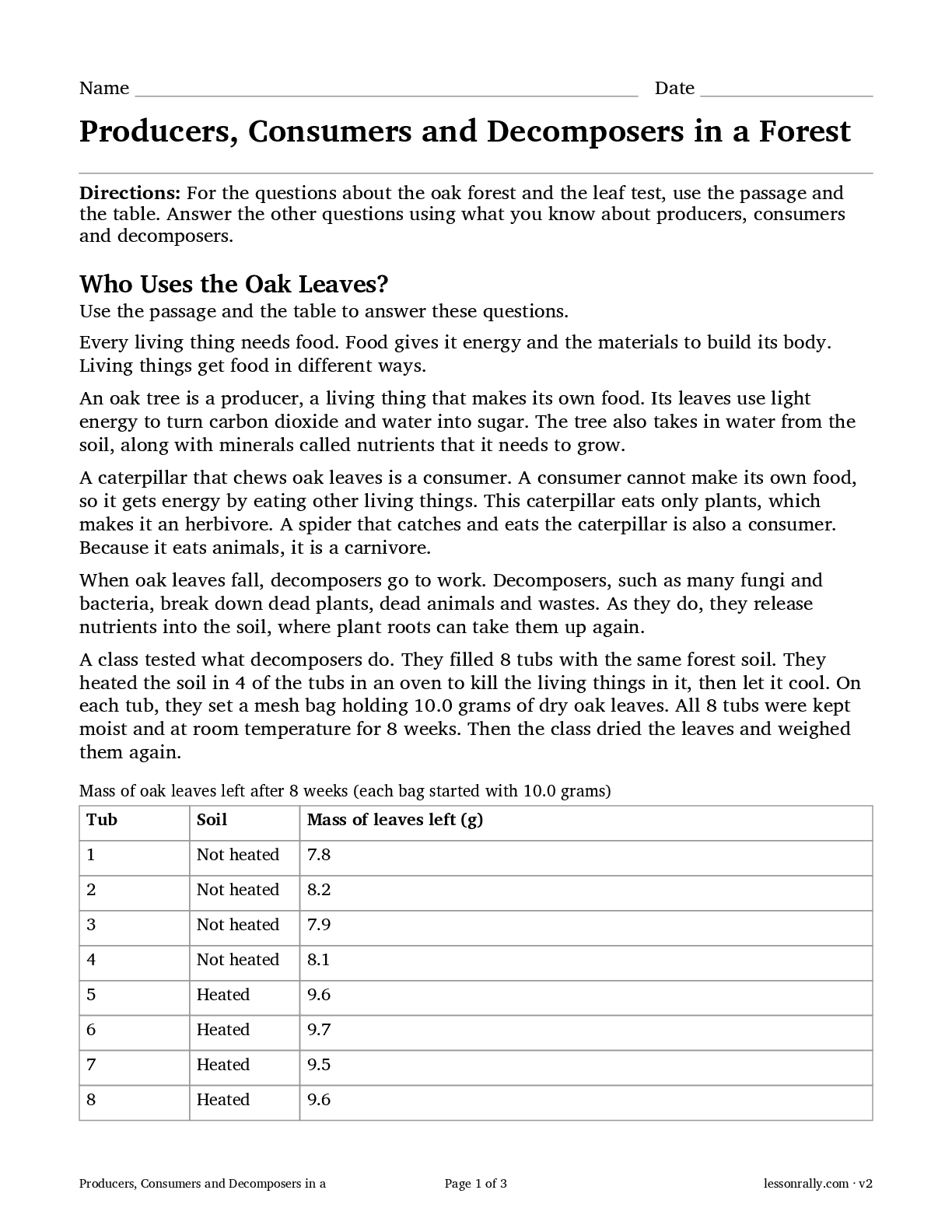
A class tested what decomposers do. They filled 8 tubs with the same forest soil. They heated the soil in 4 of the tubs in an oven to kill the living things in it, then let it cool. On each tub, they set a mesh bag holding 10.0 grams of dry oak leaves. All 8 tubs were kept moist and at room temperature for 8 weeks. Then the class dried the leaves and weighed them again.
| Tub | Soil | Mass of leaves left (g) |
|---|---|---|
| 1 | Not heated | 7.8 |
| 2 | Not heated | 8.2 |
| 3 | Not heated | 7.9 |
| 4 | Not heated | 8.1 |
| 5 | Heated | 9.6 |
| 6 | Heated | 9.7 |
| 7 | Heated | 9.5 |
| 8 | Heated | 9.6 |
Match each term to its meaning.
Match each item to an option.
Items
Options
As the passage uses the word, what are nutrients?
Choose one answer.
Which statement about the oak tree's food is correct, according to the passage?
Choose one answer.
The spider gets energy by eating the caterpillar. Based on the passage, where did that energy first come from?
Choose one answer.
In the leaf test, what did the class change on purpose?
Choose one answer.
What was the mean mass of oak leaves left in the 4 tubs whose soil was not heated?
Enter a number.
g
Which claim does the evidence from the leaf test support?
Choose one answer.
Suppose a forest had no decomposers at all. Based on the passage, what would most likely happen over many years?
Choose one answer.
Green algae floating in a pond use light energy to make sugar. Which role do these algae play in the pond?
Choose one answer.
A fungus grows on a fallen, dead log and slowly softens the wood as it feeds on it. Its mushrooms poke up from the bark like small plants. Which role does this fungus play?
Choose one answer.
No reviews yet.
Reviews come from teachers who assigned this activity to a class.
Have a topic of your own? Make a printable worksheet and online quiz, free.
Create an activityCommon Core RST.6-8.7
Made by Theo Nakamura · LessonRally (AI-assisted)
Common Core RST.6-8.4
Made by Myra Jefferson · LessonRally (AI-assisted)
Made by Theo Nakamura · LessonRally (AI-assisted)
Made by Myra Jefferson · LessonRally (AI-assisted)