

Ecosystems and Food Webs
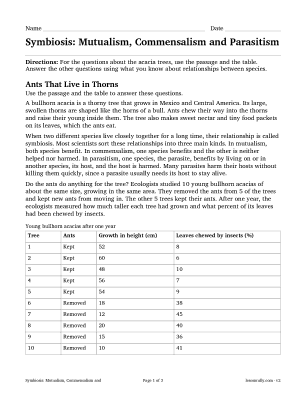
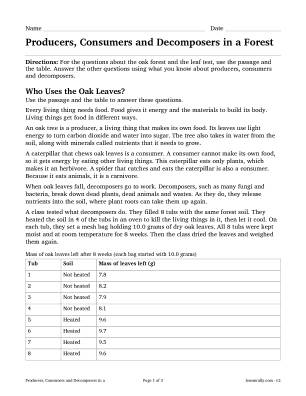
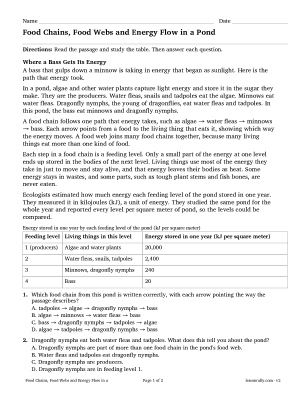
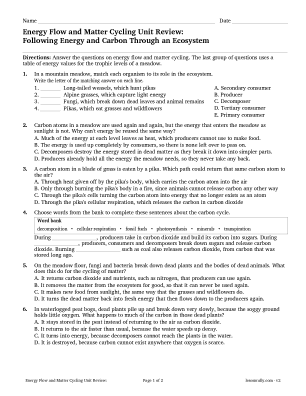
An ecosystem is the living things in an area together with their nonliving surroundings. Students trace energy, usually from the sun, through food chains and webs, follow matter as it cycles, and classify symbiotic relationships.
Topics are chosen by LessonRally.
Filter by grade
- ScienceFeatured
Symbiosis: Mutualism, Commensalism and Parasitism (opens in a new tab)
- Grade 7
- 10 questions
- Estimated reading level 9.0
Common Core RST.6-8.4
Made by Myra Jefferson · LessonRally (AI-assisted)
- ScienceFeatured
Producers, Consumers and Decomposers in a Forest (opens in a new tab)
- Grade 7
- 10 questions
- Estimated reading level 7.4
Common Core RST.6-8.4
Made by Myra Jefferson · LessonRally (AI-assisted)
- ScienceFeatured
Food Chains, Food Webs and Energy Flow in a Pond (opens in a new tab)
- Grade 7
- 9 questions
- Estimated reading level 7.5
Common Core RST.6-8.7
Made by Myra Jefferson · LessonRally (AI-assisted)
- ScienceFeatured
Energy Flow and Matter Cycling Unit Review: Following Energy and Carbon Through an Ecosystem (opens in a new tab)
- Grades 9–10
- 13 questions
- Estimated reading level 7.9
Common Core RST.9-10.7
Made by Leah Rosen · LessonRally (AI-assisted)
- ScienceFeatured
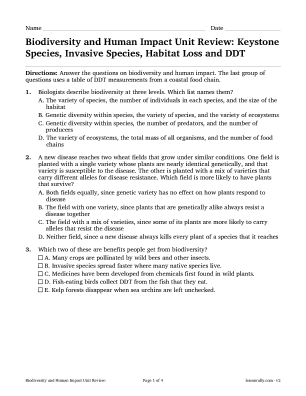
Biodiversity and Human Impact Unit Review: Keystone Species, Invasive Species, Habitat Loss and DDT (opens in a new tab)
- Grades 9–10
- 14 questions
- Estimated reading level 9.7
Common Core RST.9-10.7
Made by Leah Rosen · LessonRally (AI-assisted)
- ScienceFeatured
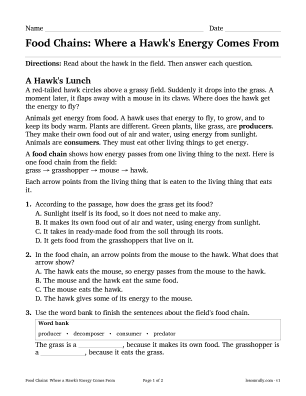
Food Chains: Where a Hawk's Energy Comes From (opens in a new tab)
- Grade 5
- 8 questions
- Estimated reading level 5.7
Made by Wes Calloway · LessonRally (AI-assisted)
About teaching Ecosystems and Food Webs
- What students practice
- Sorting producers, consumers and decomposers, explaining why only roughly a tenth of the energy passes to the next level, tracing a carbon atom from air to plant to animal and back, and classifying pairs such as bees and flowers or ticks and deer.
- Common mistakes
- Students often read food chain arrows as meaning “eats”; have them read each arrow as “gives energy to.” Many think plants get food from soil rather than making it from carbon dioxide and water using light. Others say energy cycles like matter, but it leaves the ecosystem as heat.
- Ways to use these activities
- Use one of these activities before a schoolyard walk to find producers, consumers and decomposers. In pairs, one student removes an organism from a food web and the other explains which feeding links break. For an exit ticket, have students trace the energy in their lunch back to the sun.