Teachers who sign in can assign LessonRally activities to their Google Classroom classes: students open them in Classroom and answer online, and their grades go to the teacher's Classroom gradebook. Practice lets you try it first, the way students see it.
Students review biodiversity and human impact: the three levels of biodiversity, why genetic variety matters, benefits people get from biodiversity, a grassland drought study, keystone species and sea otters, invasive species and the brown tree snake on Guam, habitat fragmentation, biomagnification of DDT, and a table of DDT levels in a coastal food chain.
Learning goal: Explain why biodiversity matters, how keystone species, invasive species and habitat loss change ecosystems, and how biomagnification concentrates pollutants such as DDT in top predators.
Estimated reading level9.7
Grade 7Hard
Grade 8Stretch
Grade 9On level
Grade 10Easier
Grade 11Easy
About this estimate
The estimate is the middle score of five readability formulas. Their scores run from 7.5 to 9.8.
Flesch-Kincaid GradeSentence length and syllables per word7.5
Gunning Fog Middle scoreSentence length and words of three or more syllables9.7
Coleman-LiauLetters per word and sentences per 100 words9.8
Automated Readability IndexCharacters per word and words per sentence8.0
SMOGWords of three or more syllables, for texts of 30 sentences or more9.8
Grade 181216
Flesch Reading Ease
67.8 on a 0 to 100 scale where higher is easier: standard. Not part of the estimate.
Text measured
1,207 words, 32 sentences
Adapted from common readability formulas (Flesch-Kincaid, Gunning Fog, Coleman-Liau and ARI, plus SMOG for long texts), which look at sentence length and word length. Answer choices count toward word length only. Grades below the estimate will likely find the text harder, grades above it easier. It does not measure ideas, background knowledge or images.
Common Core
Press Ctrl+C or Command+C to copy.
Closest anchor:CCRA.R.7Integrate and evaluate content presented in diverse media and formats, including visually and quantitatively, as well as in words.Anchor Standards for ReadingShow 1 matched standardHide matched standard
Translate quantitative or technical information expressed in words in a text into visual form (e.g., a table or chart) and translate information expressed visually or mathematically (e.g., in an equation) into words.
Question types: multiple choice, select all that apply, fill in the blank.
Student preview
The questions as students see them, without the answers.
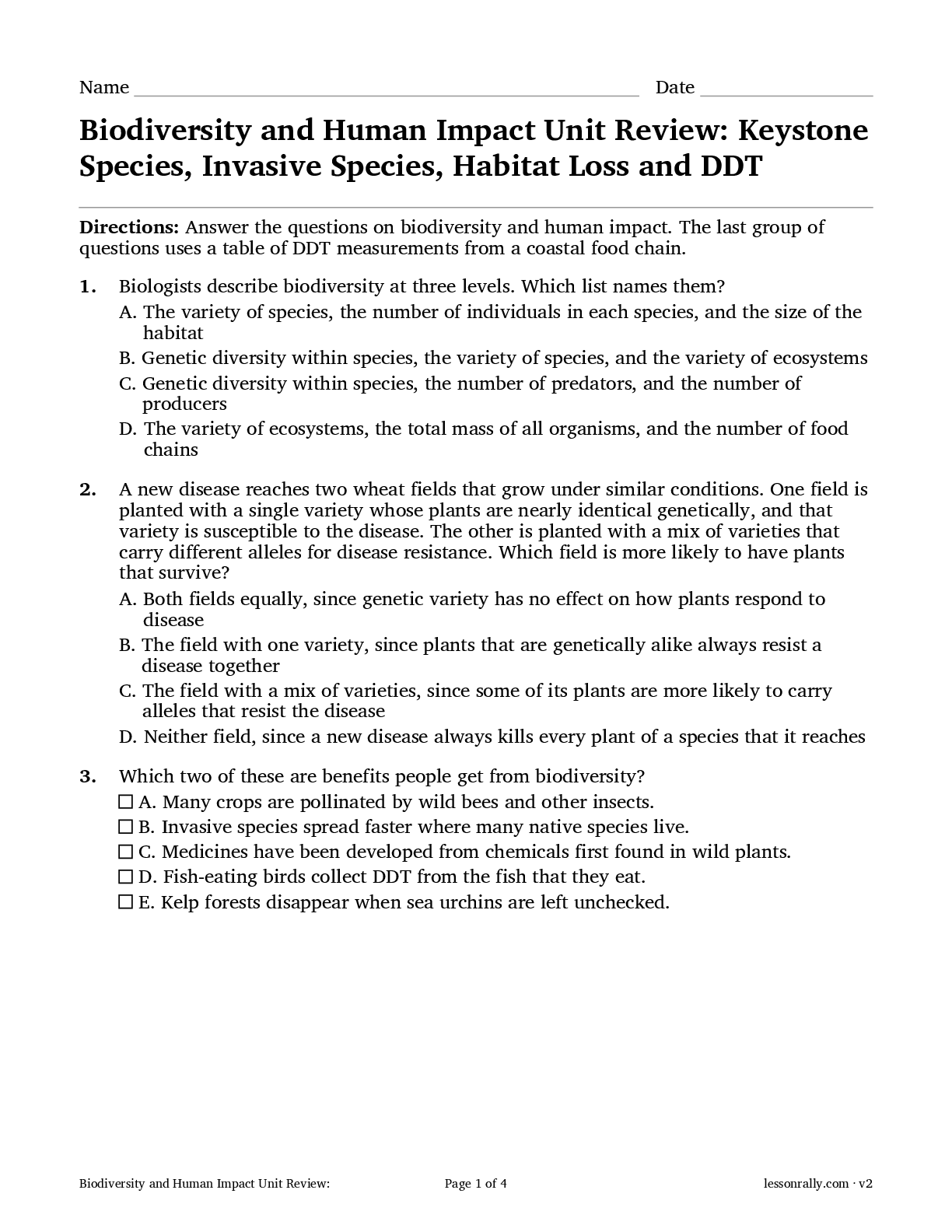
Answer the questions on biodiversity and human impact. The last group of questions uses a table of DDT measurements from a coastal food chain.
Question 1
Biologists describe biodiversity at three levels. Which list names them?
Choose one answer.
The variety of ecosystems, the total mass of all organisms, and the number of food chains
Genetic diversity within species, the number of predators, and the number of producers
The variety of species, the number of individuals in each species, and the size of the habitat
Genetic diversity within species, the variety of species, and the variety of ecosystems
Question 2
A new disease reaches two wheat fields that grow under similar conditions. One field is planted with a single variety whose plants are nearly identical genetically, and that variety is susceptible to the disease. The other is planted with a mix of varieties that carry different alleles for disease resistance. Which field is more likely to have plants that survive?
Choose one answer.
The field with a mix of varieties, since some of its plants are more likely to carry alleles that resist the disease
Both fields equally, since genetic variety has no effect on how plants respond to disease
The field with one variety, since plants that are genetically alike always resist a disease together
Neither field, since a new disease always kills every plant of a species that it reaches
Question 3
Which two of these are benefits people get from biodiversity?
Choose 2 answers.
Medicines have been developed from chemicals first found in wild plants.
Kelp forests disappear when sea urchins are left unchecked.
Fish-eating birds collect DDT from the fish that they eat.
Invasive species spread faster where many native species live.
Many crops are pollinated by wild bees and other insects.
Question 4
In a long-term study of grassland plots in Minnesota, plots with more plant species lost less of their plant growth during a severe drought and recovered more fully afterward than plots with few species. Which conclusion do these results support?
Choose one answer.
The number of plant species had no connection with how the plots responded to the drought.
Plots with fewer plant species always produce more plant growth than plots with many species do.
The results prove that any ecosystem collapses as soon as it loses even a single species.
In these grasslands, plots with more species kept their plant growth better through the drought.
Question 5
What makes a species a keystone species?
Choose one answer.
Its effect on its community is far larger than its numbers alone would suggest.
It is the first species to arrive on bare ground after a disturbance such as a fire.
It is the largest predator found anywhere in its ecosystem.
It is always the most common species, so it outnumbers every other one in its community.
Question 6
Along parts of the North Pacific coast, sea otters eat sea urchins, and sea urchins graze on kelp. Studies compared coasts where otters were present with coasts where otters were absent. Which pattern did they find where otters were absent?
Choose one answer.
Kelp grew thicker than on other coasts, since no otters swam through it.
Kelp and urchins stayed the same, since otters do not eat kelp.
Urchins became far more common and grazed away much of the kelp.
Urchins died out, since otters were no longer there to protect them.
Question 7
Why can an invasive species often spread quickly after it reaches a new place?
Choose one answer.
It evolves on purpose to fit its new home within a single generation of arriving.
It often leaves behind the predators, diseases and competitors that limited it at home.
It cannot reproduce in its new home, so it keeps spreading in search of mates.
It is always larger and stronger than every native species in its new home.
Question 8
The brown tree snake was carried to the island of Guam by accident, most likely in cargo, soon after World War II. Guam's forest birds had evolved without snakes like it. Over the following decades, most of the island's native forest bird species disappeared. Which explanation fits these events best?
Choose one answer.
The birds had few defenses against this new predator, and the snakes had plenty of prey and few natural enemies.
The snake changed the island's climate, so the birds could no longer find their usual food.
The birds were outcompeted for seeds, since the snake eats the same food that they do.
The birds all chose to leave the island and fly elsewhere once the snakes had arrived.
Question 9
A large forest is split into many small patches separated by roads and fields. Apart from the loss of forest area, how can splitting the forest harm forest animals?
Choose one answer.
Each small patch quickly grows back into one large, unbroken forest on its own.
Splitting the forest matters only for plants, since every kind of animal can cross roads and fields.
Small patches always hold more species than one large forest, since they have more edges.
Small, separated populations are more likely to die out, and animals may not reach other patches.
Question 10
Fill in the blanks about how DDT builds up in food chains, using the word bank.
Fill in each blank.
DDT breaks down very slowly, and it builds up in an animal's blank 1 because the body gets rid of it only slowly. Because each predator eats many prey over its life, DDT tends to become more concentrated at each higher blank 2, a pattern called blank 3.
Word bank
bones
succession
biomagnification
trophic level
fat
photosynthesis
DDT in a Coastal Marsh
In a study, scientists measured DDT in the water of a coastal marsh and in organisms at each level of one of its food chains, years after DDT had been used in the area. Each value is the mean of 5 samples.
Mean DDT concentration at each level of a coastal marsh food chain, in parts per million (ppm), from 5 samples at each level
Part of the food chain
Mean DDT concentration (ppm)
Marsh water
0.00004
Plankton (tiny drifting organisms)
0.03
Small fish that eat plankton
0.4
Large fish that eat small fish
2.2
Fish-eating birds
18
Question 11
About how many times higher was the mean DDT concentration in the fish-eating birds than in the small fish?
Choose one answer.
About 18 times
About 8 times
About 45 times
About 450 times
Question 12
Which statement do these data support?
Choose one answer.
Mean DDT concentration was about the same at every level, since all share the same water.
Each kind of organism made DDT inside its own body, which is why the values differ.
The plankton had the highest DDT concentration, since they take it straight from the water.
Mean DDT concentration rose at each step, from the water up to the fish-eating birds.
Question 13
Based on how DDT moves through food chains, which explanation fits the high concentration in the fish-eating birds best?
Choose one answer.
Each bird eats many fish over its life and stores much of their DDT in its own fat.
Birds are the youngest organisms in the marsh, and young bodies collect the most DDT.
The birds drink far more marsh water than the fish do, so they take in more DDT.
Sunlight on the birds' feathers turns other chemicals in their bodies into DDT.
Question 14
In the 1960s, fish-eating birds such as ospreys and brown pelicans with high levels of DDT and its breakdown products often laid eggs with thin shells that broke during incubation. What effect would this most likely have on those bird populations?
Choose one answer.
More chicks would hatch, since thin shells are easier for the chicks to break out of.
The adults would grow thicker shells on later eggs, because their chicks needed them.
Fewer chicks would hatch, so the populations could decline even if most adults survived.
The populations would stay the same, since adult birds are not harmed by thin eggshells.