Question 1
Which three structures are shared by nearly all cells, prokaryotic and eukaryotic alike?
Choose 3 answers.
- Mitochondria
- Cell wall
- Cell membrane
- Nucleus
- Ribosomes
- DNA


Teachers who sign in can assign LessonRally activities to their Google Classroom classes: students open them in Classroom and answer online, and their grades go to the teacher's Classroom gradebook. Practice lets you try it first, the way students see it.
Free for teachers. Sign in to assign activities to your Google Classroom classes.
 (opens in a new tab)
2 pages · Student copy, no answers
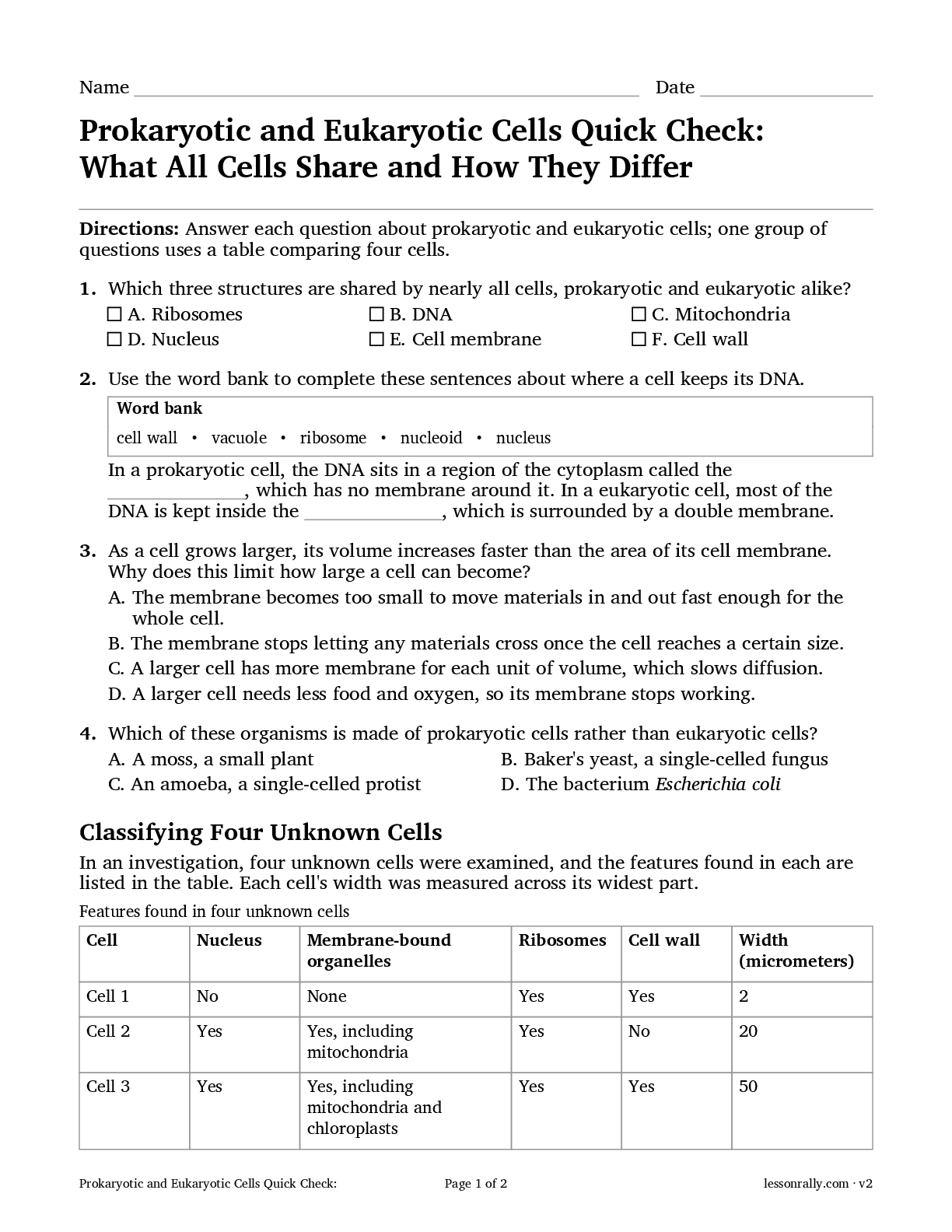
Print worksheet (opens in a new tab)Answer keyPremiumStudents answer eight questions comparing prokaryotic and eukaryotic cells: the structures nearly every cell has, the nucleoid and the nucleus, why cells stay small, which organisms are prokaryotes, and a comparison table of four cells to classify by their features, including cell size and cell walls.
Learning goal: Compare prokaryotic and eukaryotic cells and classify a cell as prokaryotic or eukaryotic from its features.
The estimate is halfway between the two middle scores of four readability formulas. Their scores run from 7.5 to 10.5.
Adapted from common readability formulas (Flesch-Kincaid, Gunning Fog, Coleman-Liau and ARI, plus SMOG for long texts), which look at sentence length and word length. Answer choices count toward word length only. Grades below the estimate will likely find the text harder, grades above it easier. It does not measure ideas, background knowledge or images.
Topic: Cells Chosen by LessonRally
Question types: select all that apply, fill in the blank, multiple choice.
The questions as students see them, without the answers.
Answer each question about prokaryotic and eukaryotic cells; one group of questions uses a table comparing four cells.
Which three structures are shared by nearly all cells, prokaryotic and eukaryotic alike?
Choose 3 answers.
Use the word bank to complete these sentences about where a cell keeps its DNA.
Fill in each blank.
In a prokaryotic cell, the DNA sits in a region of the cytoplasm called the blank 1, which has no membrane around it. In a eukaryotic cell, most of the DNA is kept inside the blank 2, which is surrounded by a double membrane.
Word bank
As a cell grows larger, its volume increases faster than the area of its cell membrane. Why does this limit how large a cell can become?
Choose one answer.
Which of these organisms is made of prokaryotic cells rather than eukaryotic cells?
Choose one answer.
In an investigation, four unknown cells were examined, and the features found in each are listed in the table. Each cell's width was measured across its widest part.
| Cell | Nucleus | Membrane-bound organelles | Ribosomes | Cell wall | Width (micrometers) |
|---|---|---|---|---|---|
| Cell 1 | No | None | Yes | Yes | 2 |
| Cell 2 | Yes | Yes, including mitochondria | Yes | No | 20 |
| Cell 3 | Yes | Yes, including mitochondria and chloroplasts | Yes | Yes | 50 |
| Cell 4 | No | None | Yes | No | 0.3 |
Judging by the features in the table, which of the four cells are prokaryotic?
Choose one answer.
Based on the features listed in the table, which kind of organism did Cell 3 most likely come from?
Choose one answer.
According to the table, about how many times wider is Cell 3 than Cell 1?
Choose one answer.
Penicillin kills many bacteria by blocking them from building cell walls made of peptidoglycan. Based on the table, which cell could be a bacterium with this kind of wall?
Choose one answer.
No reviews yet.
Reviews come from teachers who assigned this activity to a class.
Have a topic of your own? Make a printable worksheet and online quiz, free.
Create an activityCommon Core RST.9-10.7
Made by Leah Rosen · LessonRally (AI-assisted)
Made by Leah Rosen · LessonRally (AI-assisted)
Made by Leah Rosen · LessonRally (AI-assisted)
Common Core RST.9-10.7
Made by Leah Rosen · LessonRally (AI-assisted)