Teachers who sign in can assign LessonRally activities to their Google Classroom classes: students open them in Classroom and answer online, and their grades go to the teacher's Classroom gradebook. Practice lets you try it first, the way students see it.
Students review inheritance beyond simple dominance: human sex chromosomes and X-linked genes, incomplete dominance in snapdragons, codominance in Shorthorn cattle and ABO blood types, multiple alleles, red-green color blindness, traits shaped by many genes, and a table of results from a fruit fly cross for an X-linked trait.
Learning goal: Predict and explain offspring for incomplete dominance, codominance, multiple alleles and X-linked traits, and interpret cross results in a table.
Estimated reading level8.5
Grade 6Hard
Grade 7Stretch
Grade 8On level
Grade 9Easier
Grade 10Easy
About this estimate
The estimate is halfway between the two middle scores of four readability formulas. Their scores run from 8.3 to 10.7.
Flesch-Kincaid Grade Middle scoreSentence length and syllables per word8.5
Gunning FogSentence length and words of three or more syllables10.7
Coleman-LiauLetters per word and sentences per 100 words8.3
Automated Readability Index Middle scoreCharacters per word and words per sentence8.4
Grade 181216
Flesch Reading Ease
66.7 on a 0 to 100 scale where higher is easier: standard. Not part of the estimate.
Text measured
1,013 words, 27 sentences
Adapted from common readability formulas (Flesch-Kincaid, Gunning Fog, Coleman-Liau and ARI, plus SMOG for long texts), which look at sentence length and word length. Answer choices count toward word length only. Grades below the estimate will likely find the text harder, grades above it easier. It does not measure ideas, background knowledge or images.
Question types: fill in the blank, matching, multiple choice, select all that apply.
Student preview
The questions as students see them, without the answers.
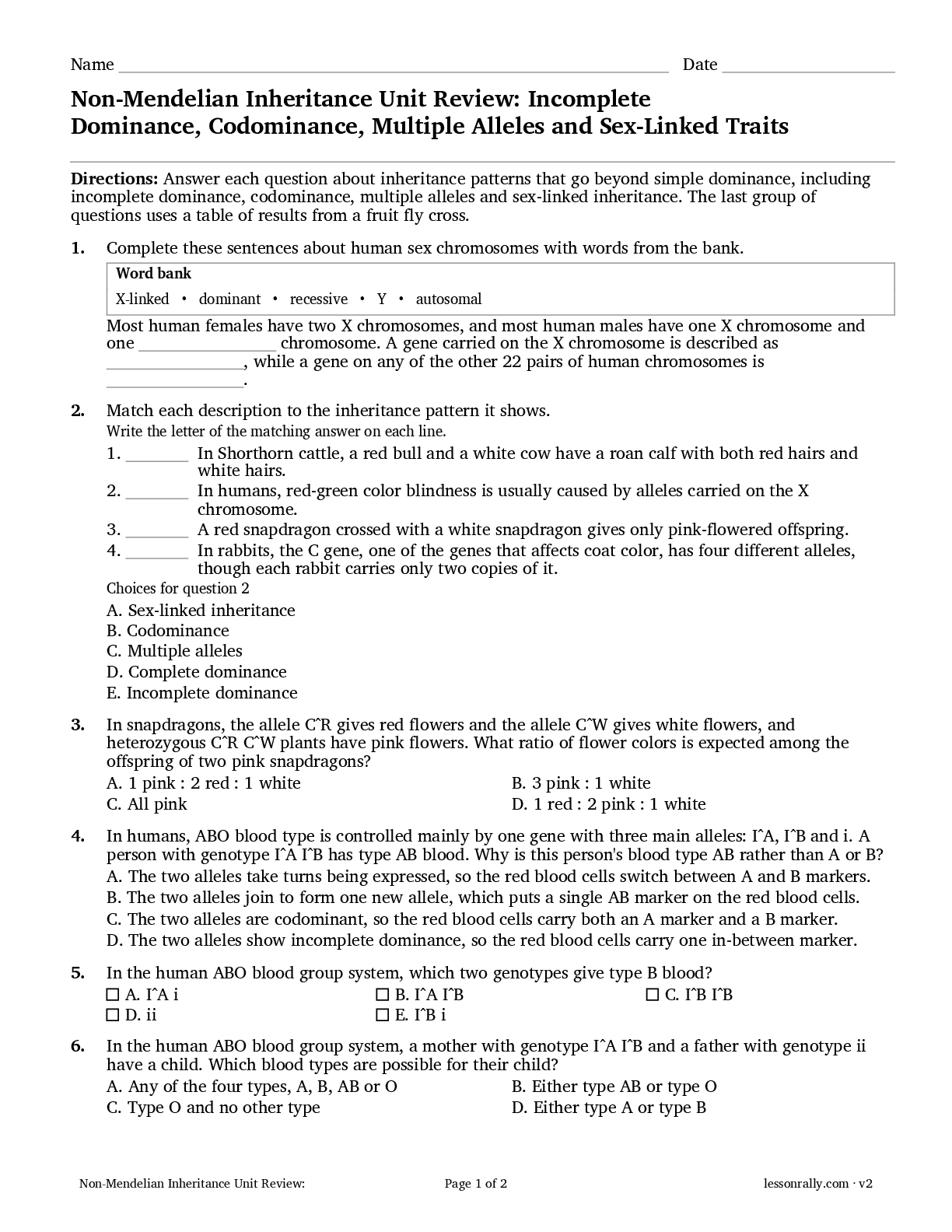
Answer each question about inheritance patterns that go beyond simple dominance, including incomplete dominance, codominance, multiple alleles and sex-linked inheritance. The last group of questions uses a table of results from a fruit fly cross.
Question 1
Complete these sentences about human sex chromosomes with words from the bank.
Fill in each blank.
Most human females have two X chromosomes, and most human males have one X chromosome and one blank 1 chromosome. A gene carried on the X chromosome is described as blank 2, while a gene on any of the other 22 pairs of human chromosomes is blank 3.
Word bank
dominant
recessive
autosomal
X-linked
Y
Question 2
Match each description to the inheritance pattern it shows.
Match each item to an option.
Items
In Shorthorn cattle, a red bull and a white cow have a roan calf with both red hairs and white hairs.
In humans, red-green color blindness is usually caused by alleles carried on the X chromosome.
A red snapdragon crossed with a white snapdragon gives only pink-flowered offspring.
In rabbits, the C gene, one of the genes that affects coat color, has four different alleles, though each rabbit carries only two copies of it.
Options
Complete dominance
Codominance
Multiple alleles
Incomplete dominance
Sex-linked inheritance
Question 3
In snapdragons, the allele C^R gives red flowers and the allele C^W gives white flowers, and heterozygous C^R C^W plants have pink flowers. What ratio of flower colors is expected among the offspring of two pink snapdragons?
Choose one answer.
1 pink : 2 red : 1 white
1 red : 2 pink : 1 white
All pink
3 pink : 1 white
Question 4
In humans, ABO blood type is controlled mainly by one gene with three main alleles: I^A, I^B and i. A person with genotype I^A I^B has type AB blood. Why is this person's blood type AB rather than A or B?
Choose one answer.
The two alleles are codominant, so the red blood cells carry both an A marker and a B marker.
The two alleles take turns being expressed, so the red blood cells switch between A and B markers.
The two alleles join to form one new allele, which puts a single AB marker on the red blood cells.
The two alleles show incomplete dominance, so the red blood cells carry one in-between marker.
Question 5
In the human ABO blood group system, which two genotypes give type B blood?
Choose 2 answers.
I^B I^B
I^B i
ii
I^A i
I^A I^B
Question 6
In the human ABO blood group system, a mother with genotype I^A I^B and a father with genotype ii have a child. Which blood types are possible for their child?
Choose one answer.
Either type A or type B
Either type AB or type O
Type O and no other type
Any of the four types, A, B, AB or O
Question 7
How many different genotypes can the three main ABO alleles form when each person carries two of them?
Choose one answer.
4 genotypes
9 genotypes
6 genotypes
3 genotypes
Question 8
In humans, red-green color blindness is usually inherited as an X-linked recessive trait, and most males have one X and one Y chromosome, while most females have two X chromosomes. Why does this trait show up more often in males than in females?
Choose one answer.
A male has two X chromosomes, which doubles his chances of inheriting the color-blindness allele.
A male needs only one copy of the allele to show the trait, but a female needs two.
Females cannot inherit the allele from their fathers, only from their mothers.
The allele is carried on the Y chromosome, which only males have.
Question 9
For red-green color blindness in humans, X^B is the allele for normal color vision and X^b is the recessive allele for color blindness. A woman who inherited the trait has the genotype X^b X^b. Which statement about her parents is most likely true?
Choose one answer.
Her father is color-blind, and her mother carries at least one color-blindness allele.
Neither parent carries the allele, since the trait skipped a generation to reach her.
Her mother must be color-blind herself, and her father may have normal color vision.
Her father has normal color vision, and her mother has two color-blindness alleles.
Question 10
Human height varies smoothly across a wide range, from very short to very tall, instead of falling into a few separate classes. Which explanation fits this pattern?
Choose one answer.
Height depends only on nutrition, and genes have no effect on it.
Height is controlled by a single gene, with one allele for tall and one allele for short.
Height is controlled by a gene on the Y chromosome, so it varies only in males.
Height is shaped by many genes acting together, along with factors such as nutrition.
An X-Linked Cross in Fruit Flies
In fruit flies, a gene on the X chromosome has an allele for red eyes (X^R), which is dominant to an allele for white eyes (X^r). Female fruit flies are usually XX, and males are usually XY. In a cross, a red-eyed female known to be heterozygous, X^R X^r, was crossed with a red-eyed male, X^R Y, and all 404 offspring were counted.
Offspring of a red-eyed female fruit fly (X^R X^r) and a red-eyed male (X^R Y), sorted by sex and eye color
Offspring
Number with red eyes
Number with white eyes
Females
204
0
Males
98
102
Question 11
About what percent of the male offspring in the table had white eyes?
Choose one answer.
About 75 percent
About 50 percent
About 25 percent
0 percent
Question 12
In this cross, why did white eyes appear in sons but not in daughters?
Choose one answer.
Each daughter got her father's red-eye allele, while each son's only X chromosome came from his mother.
The white-eye allele is carried on the Y chromosome, which only the sons in this cross receive from their father.
Daughters cannot inherit a white-eye allele from either one of their two parents.
Sons have two X chromosomes, so they show X-linked traits more easily than daughters do.
Question 13
Suppose a white-eyed male fruit fly (X^r Y) is crossed with a red-eyed female that carries no X^r (X^R X^R). Which offspring would most likely result?
Choose one answer.
All offspring red-eyed, with every daughter carrying the white-eye allele
About half of the daughters white-eyed like their father, and all sons red-eyed
All daughters red-eyed and carrying no white-eye allele, and all sons white-eyed
All daughters red-eyed, and about half of the sons white-eyed like their father