Question 1
Hemoglobin, antibodies and most enzymes all belong to which class of macromolecules?
Choose one answer.
- Carbohydrates
- Proteins
- Nucleic acids
- Lipids


Teachers who sign in can assign LessonRally activities to their Google Classroom classes: students open them in Classroom and answer online, and their grades go to the teacher's Classroom gradebook. Practice lets you try it first, the way students see it.
Free for teachers. Sign in to assign activities to your Google Classroom classes.
 (opens in a new tab)
2 pages · Student copy, no answers
Print worksheet (opens in a new tab)Answer keyPremiumStudents review the four classes of macromolecules: the jobs proteins do, the monomers and other units each class is built from, dehydration synthesis and hydrolysis, sugars and glycogen, lipids and fats, protein shape and nucleotides, then interpret a table of food test results for starch, sugar and protein (iodine, Benedict's and biuret tests).
Learning goal: Identify the building units and functions of carbohydrates, lipids, proteins and nucleic acids, and interpret food test results for starch, sugar and protein.
The estimate is halfway between the two middle scores of four readability formulas. Their scores run from 7.7 to 10.0.
Adapted from common readability formulas (Flesch-Kincaid, Gunning Fog, Coleman-Liau and ARI, plus SMOG for long texts), which look at sentence length and word length. Answer choices count toward word length only. Grades below the estimate will likely find the text harder, grades above it easier. It does not measure ideas, background knowledge or images.
Translate quantitative or technical information expressed in words in a text into visual form (e.g., a table or chart) and translate information expressed visually or mathematically (e.g., in an equation) into words.
Chosen by LessonRally.
© Copyright 2010. National Governors Association Center for Best Practices and Council of Chief State School Officers. All rights reserved.
Topic: Biomolecules and Enzymes Chosen by LessonRally
Question types: multiple choice, matching, fill in the blank, select all that apply.
The questions as students see them, without the answers.
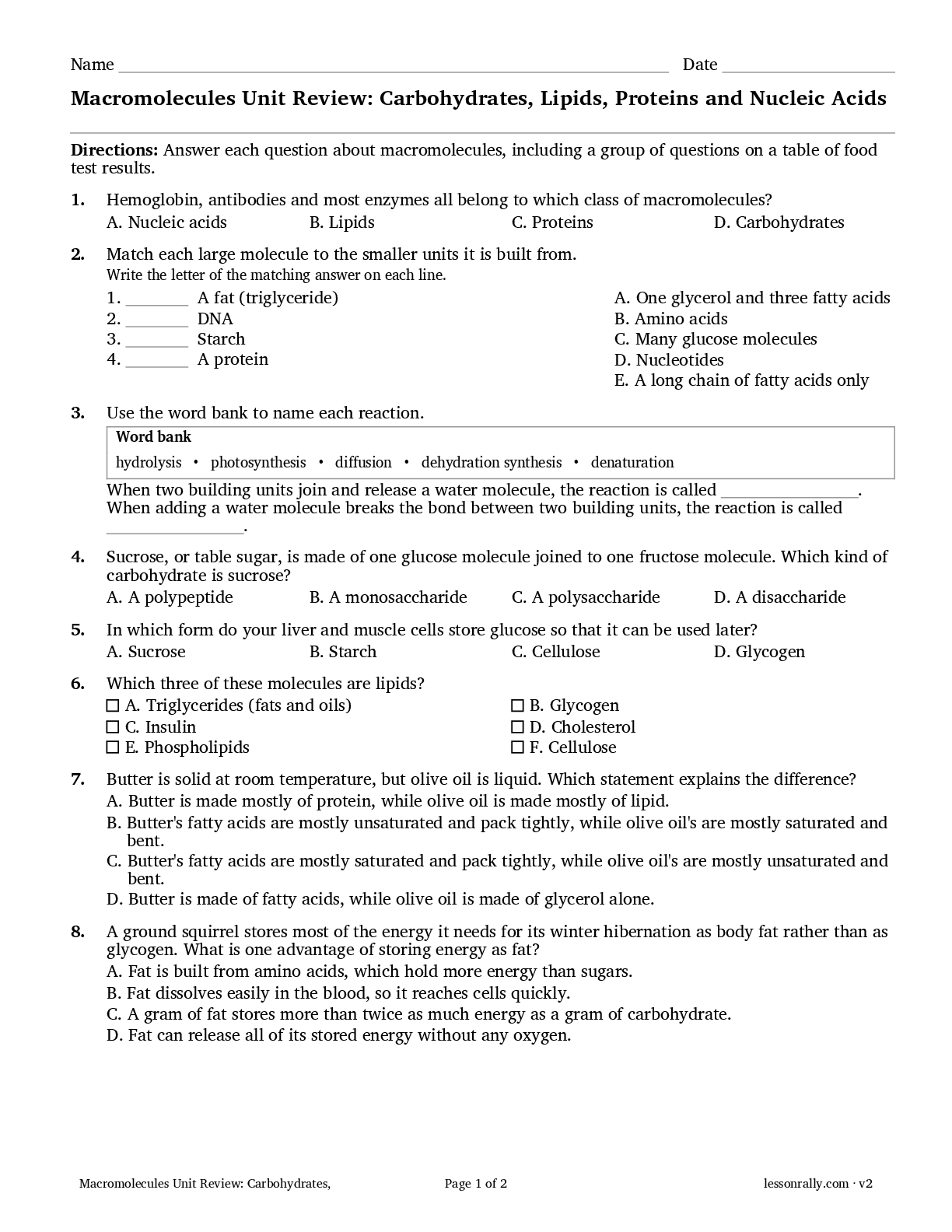
Answer each question about macromolecules, including a group of questions on a table of food test results.
Hemoglobin, antibodies and most enzymes all belong to which class of macromolecules?
Choose one answer.
Match each large molecule to the smaller units it is built from.
Match each item to an option.
Items
Options
Use the word bank to name each reaction.
Fill in each blank.
When two building units join and release a water molecule, the reaction is called blank 1. When adding a water molecule breaks the bond between two building units, the reaction is called blank 2.
Word bank
Sucrose, or table sugar, is made of one glucose molecule joined to one fructose molecule. Which kind of carbohydrate is sucrose?
Choose one answer.
In which form do your liver and muscle cells store glucose so that it can be used later?
Choose one answer.
Which three of these molecules are lipids?
Choose 3 answers.
Butter is solid at room temperature, but olive oil is liquid. Which statement explains the difference?
Choose one answer.
A ground squirrel stores most of the energy it needs for its winter hibernation as body fat rather than as glycogen. What is one advantage of storing energy as fat?
Choose one answer.
Cooking an egg turns the clear, runny egg white into a firm white solid. What happens to the proteins in the egg white?
Choose one answer.
Which list names the three parts that make up a nucleotide?
Choose one answer.
In a lab, five unknown samples were each tested with iodine solution, Benedict's solution and biuret solution. Each test used 2 mL of sample and 5 drops of reagent, the Benedict's tubes were heated in a hot water bath for 5 minutes, and every test was run twice with the same result.
| Sample | Iodine test | Benedict's test (heated) | Biuret test |
|---|---|---|---|
| A | Blue-black | Stayed blue | Stayed blue |
| B | Stayed yellow-brown | Brick red | Stayed blue |
| C | Stayed yellow-brown | Stayed blue | Violet |
| D | Blue-black | Stayed blue | Violet |
| E | Stayed yellow-brown | Stayed blue | Stayed blue |
According to the food test results, which sample contained both starch and protein?
Choose one answer.
Which samples gave no sign of protein in the biuret test?
Choose one answer.
Which conclusion about Sample E do its food test results support?
Choose one answer.
Suppose Sample A is mixed with amylase, an enzyme that breaks starch into smaller sugars that react with Benedict's solution, and then tested again. Which result is most likely?
Choose one answer.
No reviews yet.
Reviews come from teachers who assigned this activity to a class.
Have a topic of your own? Make a printable worksheet and online quiz, free.
Create an activityMade by Leah Rosen · LessonRally (AI-assisted)
Common Core RST.9-10.7
Made by Leah Rosen · LessonRally (AI-assisted)
Made by Leah Rosen · LessonRally (AI-assisted)
Made by Leah Rosen · LessonRally (AI-assisted)