

Biomolecules and Enzymes
Cells rely on four groups of biological molecules: carbohydrates, lipids, proteins and nucleic acids. Students match each to its building blocks and jobs, run food tests, and explain how enzymes speed reactions.
Topics are chosen by LessonRally.
Filter by grade
- ScienceFeatured
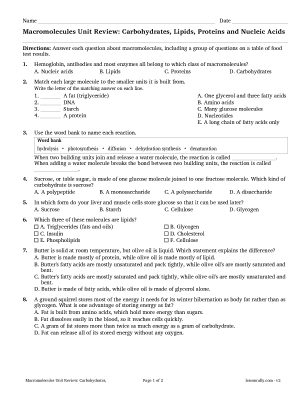
Macromolecules Unit Review: Carbohydrates, Lipids, Proteins and Nucleic Acids (opens in a new tab)
- Grades 9–10
- 14 questions
- Estimated reading level 8.8
Common Core RST.9-10.7
Made by Leah Rosen · LessonRally (AI-assisted)
- ScienceFeatured
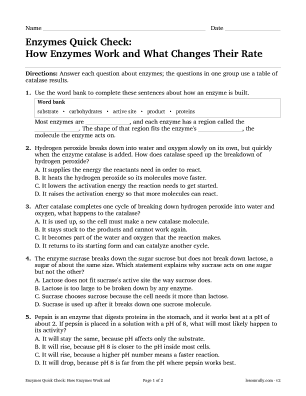
Enzymes Quick Check: How Enzymes Work and What Changes Their Rate (opens in a new tab)
- Grades 9–10
- 8 questions
- Estimated reading level 7.8
Made by Leah Rosen · LessonRally (AI-assisted)
About teaching Biomolecules and Enzymes
- What students practice
- Linking glucose to starch, amino acids to proteins and nucleotides to nucleic acids, reading iodine turning blue-black as starch and biuret turning purple as protein, and explaining that an enzyme’s active site fits a specific substrate.
- Common mistakes
- Students often say heat kills enzymes, but enzymes are not alive; high heat changes their shape so the active site no longer fits. Many assume every enzyme works best at neutral pH, but pepsin works best in strong stomach acid. Others think an enzyme is used up after one reaction, but it can work again and again.
- Ways to use these activities
- Use one of these activities before a lab in which students add 3 percent hydrogen peroxide to fresh and boiled potato and compare the bubbles. In pairs, students test foods with iodine and compare each result with a drop on plain water as a control.