Teachers who sign in can assign LessonRally activities to their Google Classroom classes: students open them in Classroom and answer online, and their grades go to the teacher's Classroom gradebook. Practice lets you try it first, the way students see it.
Students answer eight questions on how enzymes work: the active site and substrate, activation energy, why an enzyme can be used again, specificity, and how temperature and pH change enzyme activity, including denaturation, with a short table of catalase results.
Learning goal: Explain how an enzyme's active site speeds up a specific reaction and predict how temperature and pH change an enzyme's rate.
Estimated reading level7.8
Grade 5Hard
Grade 6Stretch
Grade 7On level
Grade 8Easier
Grade 9Easy
About this estimate
The estimate is halfway between the two middle scores of four readability formulas. Their scores run from 7.2 to 10.8.
Flesch-Kincaid Grade Middle scoreSentence length and syllables per word8.0
Gunning FogSentence length and words of three or more syllables10.8
Coleman-Liau Middle scoreLetters per word and sentences per 100 words7.6
Automated Readability IndexCharacters per word and words per sentence7.2
Grade 181216
Flesch Reading Ease
66.6 on a 0 to 100 scale where higher is easier: standard. Not part of the estimate.
Text measured
623 words, 18 sentences
Adapted from common readability formulas (Flesch-Kincaid, Gunning Fog, Coleman-Liau and ARI, plus SMOG for long texts), which look at sentence length and word length. Answer choices count toward word length only. Grades below the estimate will likely find the text harder, grades above it easier. It does not measure ideas, background knowledge or images.
Question types: fill in the blank, multiple choice.
Student preview
The questions as students see them, without the answers.
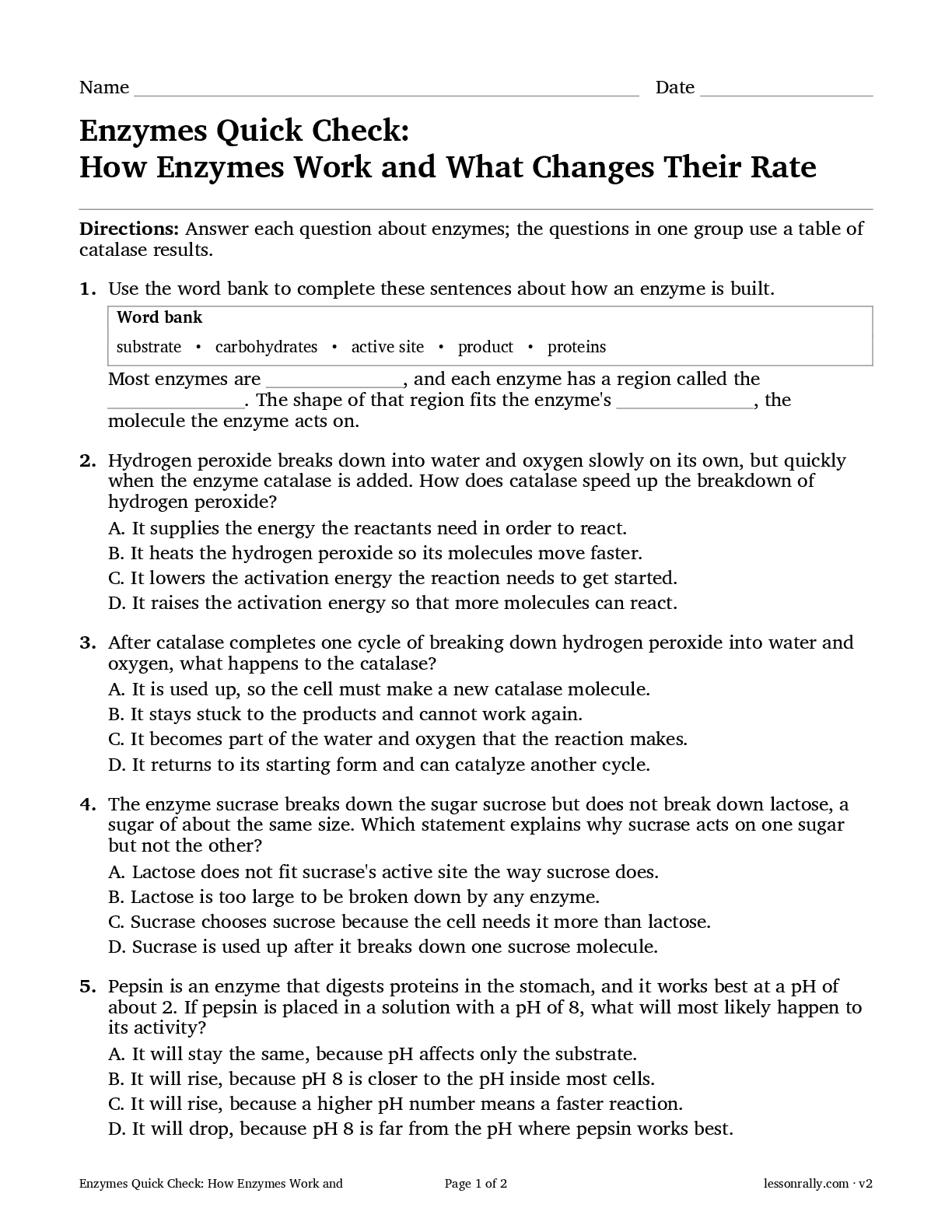
Answer each question about enzymes; the questions in one group use a table of catalase results.
Question 1
Use the word bank to complete these sentences about how an enzyme is built.
Fill in each blank.
Most enzymes are blank 1, and each enzyme has a region called the blank 2. The shape of that region fits the enzyme's blank 3, the molecule the enzyme acts on.
Word bank
proteins
active site
substrate
carbohydrates
product
Question 2
Hydrogen peroxide breaks down into water and oxygen slowly on its own, but quickly when the enzyme catalase is added. How does catalase speed up the breakdown of hydrogen peroxide?
Choose one answer.
It heats the hydrogen peroxide so its molecules move faster.
It raises the activation energy so that more molecules can react.
It lowers the activation energy the reaction needs to get started.
It supplies the energy the reactants need in order to react.
Question 3
After catalase completes one cycle of breaking down hydrogen peroxide into water and oxygen, what happens to the catalase?
Choose one answer.
It is used up, so the cell must make a new catalase molecule.
It stays stuck to the products and cannot work again.
It returns to its starting form and can catalyze another cycle.
It becomes part of the water and oxygen that the reaction makes.
Question 4
The enzyme sucrase breaks down the sugar sucrose but does not break down lactose, a sugar of about the same size. Which statement explains why sucrase acts on one sugar but not the other?
Choose one answer.
Lactose is too large to be broken down by any enzyme.
Sucrase chooses sucrose because the cell needs it more than lactose.
Sucrase is used up after it breaks down one sucrose molecule.
Lactose does not fit sucrase's active site the way sucrose does.
Question 5
Pepsin is an enzyme that digests proteins in the stomach, and it works best at a pH of about 2. If pepsin is placed in a solution with a pH of 8, what will most likely happen to its activity?
Choose one answer.
It will drop, because pH 8 is far from the pH where pepsin works best.
It will rise, because pH 8 is closer to the pH inside most cells.
It will stay the same, because pH affects only the substrate.
It will rise, because a higher pH number means a faster reaction.
Catalase at Six Temperatures
In an investigation, catalase and hydrogen peroxide were each held at one of six temperatures for 5 minutes and then mixed. The oxygen gas given off in the next 2 minutes was collected and measured. Every tube had the same amount of catalase, the same amount and concentration of hydrogen peroxide, and the same pH, and each temperature was tested 3 times.
Oxygen gas given off by catalase and hydrogen peroxide at six temperatures. Each value is the average of 3 trials.
Temperature (°C)
Average oxygen collected in 2 minutes (mL)
10
4.1
20
6.8
30
9.5
40
10.2
50
5.3
60
1.2
Question 6
Which conclusion about catalase and temperature does this test justify?
Choose one answer.
No oxygen at all was given off at temperatures above 40 °C.
Every enzyme works fastest at 40 °C.
Of the six temperatures tested, 40 °C gave the most oxygen in 2 minutes.
A test at 45 °C would give even more oxygen than 40 °C did.
Question 7
Suppose the test were repeated at 70 °C, with everything else kept the same. Based on the trend in the table, what is the most likely result?
Choose one answer.
About as much oxygen as at 40 °C
Less oxygen than at 50 °C
More oxygen than at 50 °C but less than at 40 °C
More oxygen than at 40 °C
Question 8
Which explanation of why so little oxygen was collected at 60 °C fits how enzymes work?
Choose one answer.
High heat can denature an enzyme, changing its active site so the substrate fits poorly.
High heat can rearrange the order of an enzyme's amino acids, giving it a new active site.
High heat makes molecules move more slowly, so the enzyme meets less substrate.
High heat can kill an enzyme in the same way it kills a living cell.