Population Growth Quick Check: Why Many Populations Grow Fast and Then Level Off

8 questions · 8 points · Grades 9–10 · English · Preview the 8 questions

Made by Leah Rosen · LessonRally (AI-assisted)

Digital classroom activity

What is a digital classroom activity?

Teachers who sign in can assign LessonRally activities to their Google Classroom classes: students open them in Classroom and answer online, and their grades go to the teacher's Classroom gradebook. Practice lets you try it first, the way students see it.

Free for teachers. Sign in to assign activities to your Google Classroom classes.

Printable worksheet

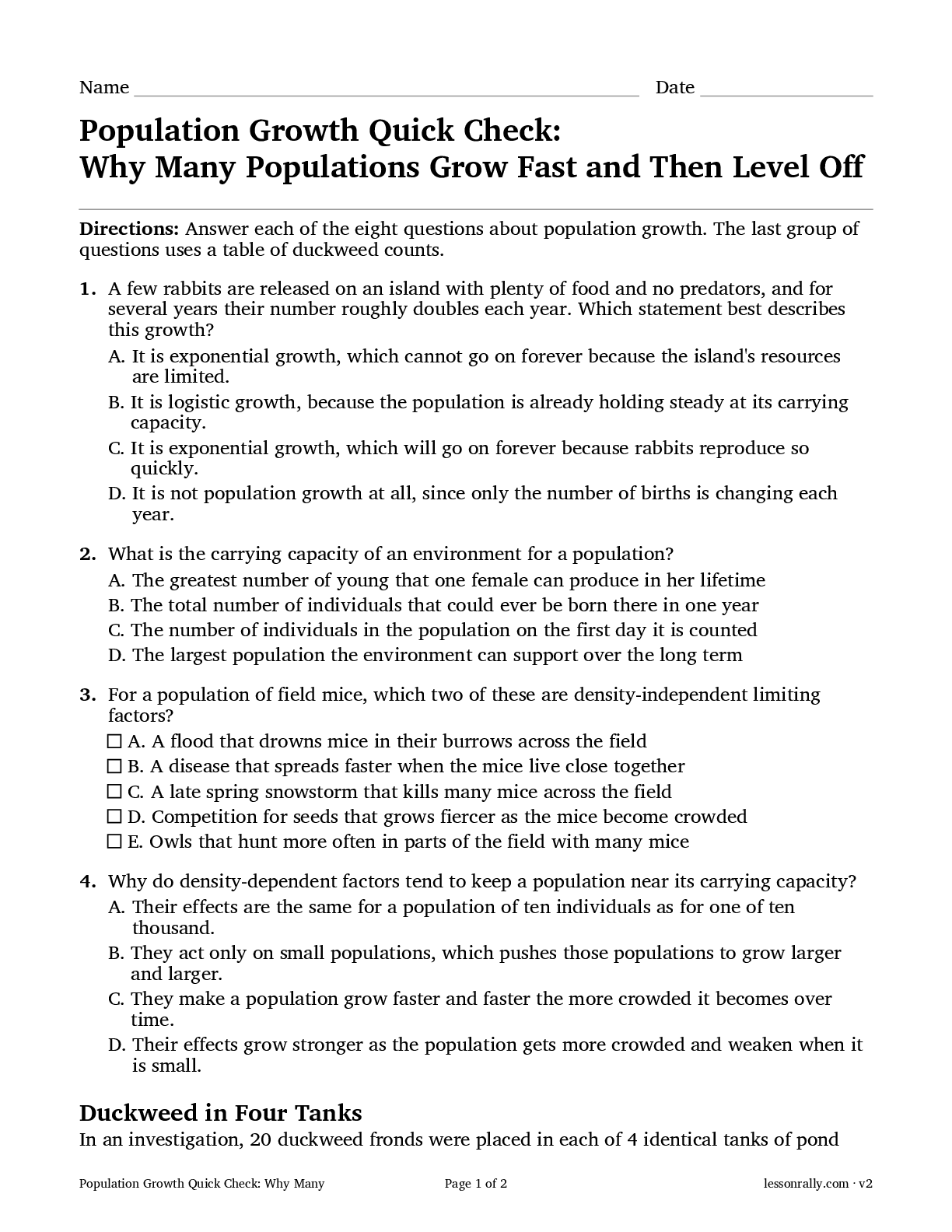
Students answer eight questions on population growth: exponential growth of rabbits on an island, carrying capacity, density-independent and density-dependent limiting factors, and a table of duckweed counts that rise quickly and then level off.

Learning goal: Distinguish exponential and logistic growth, explain carrying capacity and how density-dependent and density-independent factors limit populations, and interpret population data over time.

Estimated reading level 7.6

  1. Grade 5Hard
  2. Grade 6Stretch
  3. Grade 7On level
  4. Grade 8Easier
  5. Grade 9Easy
About this estimate

The estimate is halfway between the two middle scores of four readability formulas. Their scores run from 6.6 to 8.8.

  • Flesch-Kincaid GradeSentence length and syllables per word6.6
  • Gunning FogSentence length and words of three or more syllables8.8
  • Coleman-Liau Middle scoreLetters per word and sentences per 100 words8.3
  • Automated Readability Index Middle scoreCharacters per word and words per sentence6.9
Flesch Reading Ease
72.3 on a 0 to 100 scale where higher is easier: fairly easy. Not part of the estimate.
Text measured
602 words, 15 sentences

Adapted from common readability formulas (Flesch-Kincaid, Gunning Fog, Coleman-Liau and ARI, plus SMOG for long texts), which look at sentence length and word length. Answer choices count toward word length only. Grades below the estimate will likely find the text harder, grades above it easier. It does not measure ideas, background knowledge or images.

Common Core

Closest anchor: CCRA.R.7 Integrate and evaluate content presented in diverse media and formats, including visually and quantitatively, as well as in words.Anchor Standards for ReadingShow 1 matched standardHide matched standard

Matched standard

  • RST.9-10.7

    Translate quantitative or technical information expressed in words in a text into visual form (e.g., a table or chart) and translate information expressed visually or mathematically (e.g., in an equation) into words.

    Student preview questions 5, 6, 7

Matched independently by two AI models from this activity's questions.

© Copyright 2010. National Governors Association Center for Best Practices and Council of Chief State School Officers. All rights reserved.

Topic: Populations Chosen by LessonRally

Question types: multiple choice, select all that apply.

Student preview

The questions as students see them, without the answers.

Answer each of the eight questions about population growth. The last group of questions uses a table of duckweed counts.

Question 1

A few rabbits are released on an island with plenty of food and no predators, and for several years their number roughly doubles each year. Which statement best describes this growth?

Choose one answer.

  • It is exponential growth, which will go on forever because rabbits reproduce so quickly.
  • It is logistic growth, because the population is already holding steady at its carrying capacity.
  • It is not population growth at all, since only the number of births is changing each year.
  • It is exponential growth, which cannot go on forever because the island's resources are limited.
Question 2

What is the carrying capacity of an environment for a population?

Choose one answer.

  • The number of individuals in the population on the first day it is counted
  • The total number of individuals that could ever be born there in one year
  • The largest population the environment can support over the long term
  • The greatest number of young that one female can produce in her lifetime

Question 3

For a population of field mice, which two of these are density-independent limiting factors?

Choose 2 answers.

  • A disease that spreads faster when the mice live close together
  • Owls that hunt more often in parts of the field with many mice
  • A flood that drowns mice in their burrows across the field
  • Competition for seeds that grows fiercer as the mice become crowded
  • A late spring snowstorm that kills many mice across the field

Question 4

Why do density-dependent factors tend to keep a population near its carrying capacity?

Choose one answer.

  • Their effects are the same for a population of ten individuals as for one of ten thousand.
  • Their effects grow stronger as the population gets more crowded and weaken when it is small.
  • They act only on small populations, which pushes those populations to grow larger and larger.
  • They make a population grow faster and faster the more crowded it becomes over time.

Duckweed in Four Tanks

In an investigation, 20 duckweed fronds were placed in each of 4 identical tanks of pond water. Light and temperature were kept the same, and fresh nutrients were added each week so they would not run out. Fronds were counted every 3 days, and each value is the mean for the 4 tanks.

Mean number of duckweed fronds in 4 tanks over 24 days (a frond is one small, leaflike floating part of the plant)
DayMean number of fronds per tank
020
338
674
9140
12250
15380
18470
21505
24515

Question 5

Between which two counts did the mean number of fronds increase the most?

Choose one answer.

  • Day 0 and day 3
  • Day 21 and day 24
  • Day 9 and day 12
  • Day 12 and day 15

Question 6

Which kind of growth do the counts in the table fit best?

Choose one answer.

  • Logistic growth: fast increases at first, then smaller ones as the counts leveled off
  • Exponential growth: each 3-day increase was larger than the one before, right up to day 24
  • No growth: the mean number of fronds stayed about the same from day 0 to day 24
  • A crash: the mean number of fronds rose quickly and then fell sharply after day 15

Question 7

Based on the table, about what is the carrying capacity of one tank for duckweed under these conditions?

Choose one answer.

  • About 1,000 to 1,100 fronds
  • About 240 to 260 fronds
  • About 500 to 520 fronds
  • About 130 to 150 fronds

Question 8

Nutrients were added each week, and light and temperature stayed the same. What most likely slowed the duckweed's growth after day 15?

Choose one answer.

  • Running out of nutrients, since the duckweed used them up faster than they were added
  • A cold spell, since lower temperatures slow growth in every tank by the same amount
  • Crowding, as fronds covered more of the water's surface and shaded one another
  • The fronds sensing that the tank looked full and choosing to stop making new fronds

Reviews

No reviews yet.

Reviews come from teachers who assigned this activity to a class.

Sign in to write a review

Have a topic of your own? Make a printable worksheet and online quiz, free.

Create an activity

Answer key

Answer keys come with Premium

Print this worksheet with the correct answers marked. The key includes any explanations, sample answers, and rubrics supplied with the activity.

Answer keys aren't public: only teachers with Premium and the people who can edit an activity can download one, so students can't get a ready-to-print key from this page.

Premium includes:

  • No ads for you, and no ads for your students on the assignments you post.
  • Answer keys for printable worksheets, with the correct answers marked and any explanations, sample answers, and rubrics.
  • Create with AI: up to 100 activities a year (5 during the free trial), with every answer checked before you see the draft.

$29 a year, plus sales tax where it applies.

New Premium teachers can try it free for 7 days. A card or other payment method is needed to start. Unless you cancel before the trial ends, you are charged then and the plan renews every year.

Already have Premium or edit this activity? Sign in