

Populations
A population is all the members of one species in one area at one time. Students tell exponential growth from growth that levels off, connect limiting factors to carrying capacity, and read predator and prey data over time.
Topics are chosen by LessonRally.
Filter by grade
- ScienceFeatured
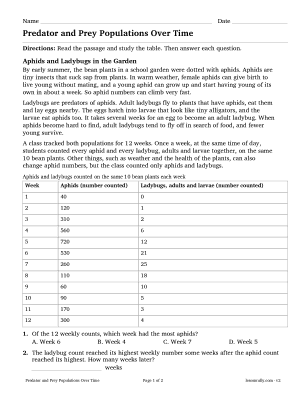
Predator and Prey Populations Over Time (opens in a new tab)
- Grade 7
- 9 questions
- Estimated reading level 6.7
Made by Myra Jefferson · LessonRally (AI-assisted)
- ScienceFeatured
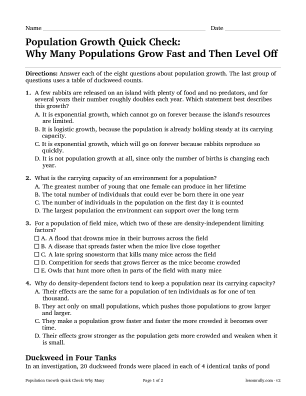
Population Growth Quick Check: Why Many Populations Grow Fast and Then Level Off (opens in a new tab)
- Grades 9–10
- 8 questions
- Estimated reading level 7.6
Common Core RST.9-10.7
Made by Leah Rosen · LessonRally (AI-assisted)
- ScienceFeatured
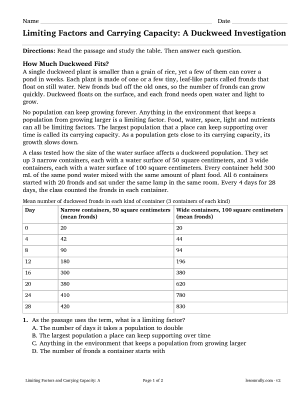
Limiting Factors and Carrying Capacity: A Duckweed Investigation (opens in a new tab)
- Grade 7
- 9 questions
- Estimated reading level 7.8
Common Core RST.6-8.7
Made by Myra Jefferson · LessonRally (AI-assisted)
- ScienceFeatured
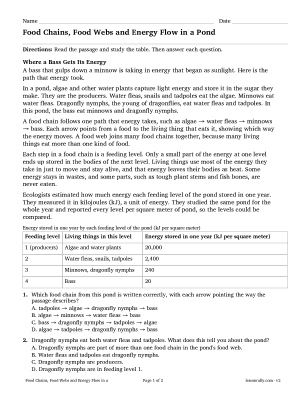
Food Chains, Food Webs and Energy Flow in a Pond (opens in a new tab)
- Grade 7
- 9 questions
- Estimated reading level 7.5
Common Core RST.6-8.7
Made by Myra Jefferson · LessonRally (AI-assisted)
About teaching Populations
- What students practice
- Telling a J-shaped curve from an S-shaped one that levels off at carrying capacity, sorting disease and competition for food as density-dependent and a flood as density-independent, and noticing that predator peaks usually follow prey peaks.
- Common mistakes
- Students often treat carrying capacity as fixed, but a drought can lower it. Many confuse exponential growth with adding the same number each year, when it multiplies by the same factor. Others expect predators to wipe out their prey; in many systems, falling prey numbers cause the predators to decline too.
- Ways to use these activities
- Use one of these activities before students grow duckweed in cups with different amounts of fertilizer and count the fronds each week. In pairs, students graph a population data set, mark where growth slows and estimate the carrying capacity. For an exit ticket, ask for one density-dependent and one density-independent factor.