Limiting Factors and Carrying Capacity: A Duckweed Investigation

9 questions · 9 points · Grade 7 · English · Preview the 9 questions

Made by Myra Jefferson · LessonRally (AI-assisted)

Digital classroom activity

What is a digital classroom activity?

Teachers who sign in can assign LessonRally activities to their Google Classroom classes: students open them in Classroom and answer online, and their grades go to the teacher's Classroom gradebook. Practice lets you try it first, the way students see it.

Free for teachers. Sign in to assign activities to your Google Classroom classes.

Printable worksheet

Students read about duckweed grown in narrow and wide containers and use a table of frond counts to identify a limiting factor, estimate a carrying capacity and choose the claim the counts support. Questions also cover the independent variable, a fair test and how population growth changes over time.

Learning goal: Use evidence from a population investigation to explain how limiting factors set the carrying capacity of an environment.

Estimated reading level 7.8

  1. Grade 5Hard
  2. Grade 6Stretch
  3. Grade 7On level
  4. Grade 8Easier
  5. Grade 9Easy
About this estimate

The estimate is halfway between the two middle scores of four readability formulas. Their scores run from 7.0 to 9.7.

  • Flesch-Kincaid GradeSentence length and syllables per word7.0
  • Gunning FogSentence length and words of three or more syllables9.7
  • Coleman-Liau Middle scoreLetters per word and sentences per 100 words8.1
  • Automated Readability Index Middle scoreCharacters per word and words per sentence7.5
Flesch Reading Ease
72.1 on a 0 to 100 scale where higher is easier: fairly easy. Not part of the estimate.
Text measured
688 words, 25 sentences

Adapted from common readability formulas (Flesch-Kincaid, Gunning Fog, Coleman-Liau and ARI, plus SMOG for long texts), which look at sentence length and word length. Answer choices count toward word length only. Grades below the estimate will likely find the text harder, grades above it easier. It does not measure ideas, background knowledge or images.

Common Core

Closest anchor: CCRA.R.7 Integrate and evaluate content presented in diverse media and formats, including visually and quantitatively, as well as in words.Anchor Standards for ReadingShow 2 matched standardsHide matched standards

Matched standards

  • RST.6-8.7

    Integrate quantitative or technical information expressed in words in a text with a version of that information expressed visually (e.g., in a flowchart, diagram, model, graph, or table).

    Student preview questions 5, 6, 9

  • RST.6-8.4

    Determine the meaning of symbols, key terms, and other domain-specific words and phrases as they are used in a specific scientific or technical context relevant to grades 6-8 texts and topics.

    Student preview question 1

Matched independently by two AI models from this activity's questions.

© Copyright 2010. National Governors Association Center for Best Practices and Council of Chief State School Officers. All rights reserved.

Topics: Populations, Experimental Design Chosen by LessonRally

Question types: multiple choice, number answer.

Student preview

The questions as students see them, without the answers.

Read the passage and study the table. Then answer each question.

How Much Duckweed Fits?

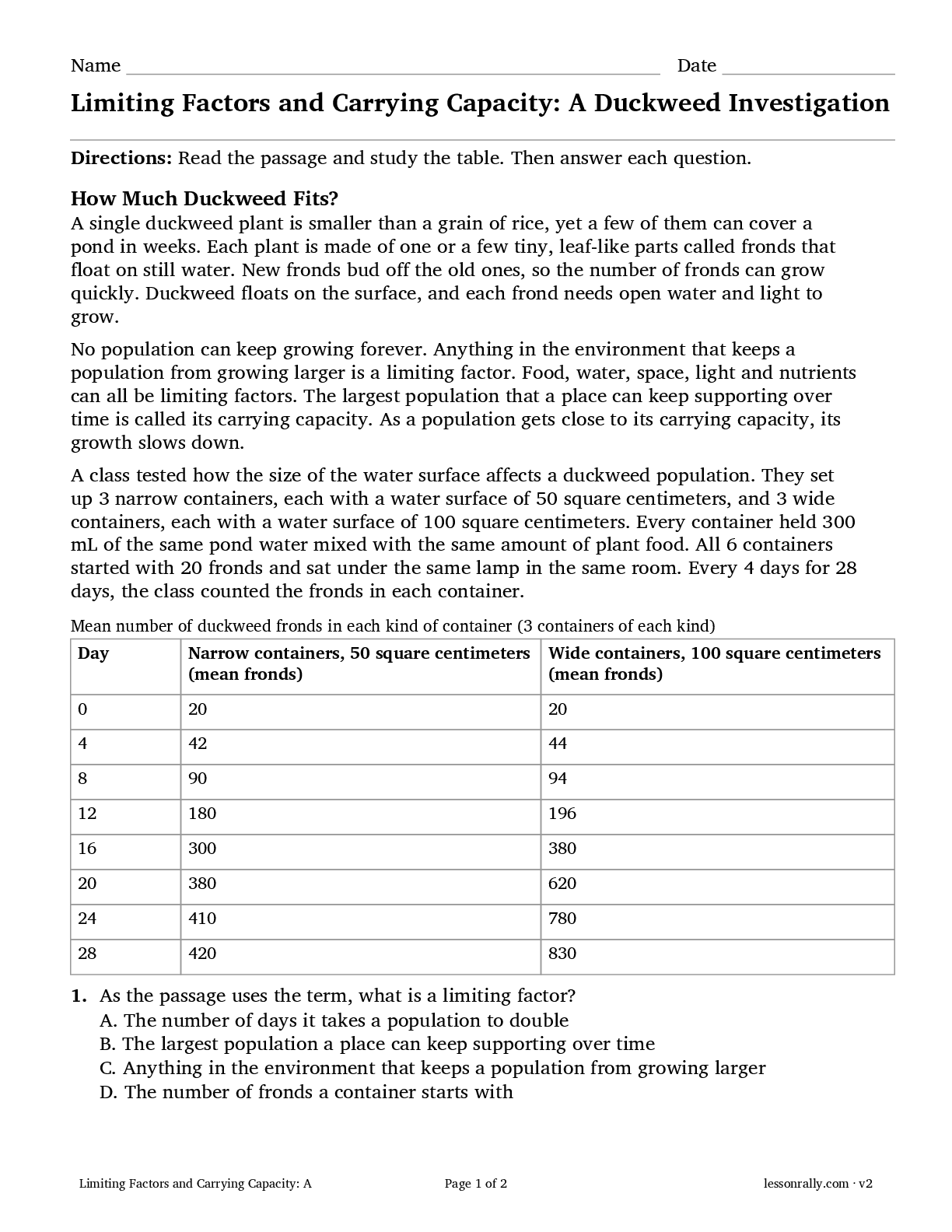
A single duckweed plant is smaller than a grain of rice, yet a few of them can cover a pond in weeks. Each plant is made of one or a few tiny, leaf-like parts called fronds that float on still water. New fronds bud off the old ones, so the number of fronds can grow quickly. Duckweed floats on the surface, and each frond needs open water and light to grow.

No population can keep growing forever. Anything in the environment that keeps a population from growing larger is a limiting factor. Food, water, space, light and nutrients can all be limiting factors. The largest population that a place can keep supporting over time is called its carrying capacity. As a population gets close to its carrying capacity, its growth slows down.

A class tested how the size of the water surface affects a duckweed population. They set up 3 narrow containers, each with a water surface of 50 square centimeters, and 3 wide containers, each with a water surface of 100 square centimeters. Every container held 300 mL of the same pond water mixed with the same amount of plant food. All 6 containers started with 20 fronds and sat under the same lamp in the same room. Every 4 days for 28 days, the class counted the fronds in each container.


Mean number of duckweed fronds in each kind of container (3 containers of each kind)
DayNarrow containers, 50 square centimeters (mean fronds)Wide containers, 100 square centimeters (mean fronds)
02020
44244
89094
12180196
16300380
20380620
24410780
28420830

Question 1

As the passage uses the term, what is a limiting factor?

Choose one answer.

  • Anything in the environment that keeps a population from growing larger
  • The largest population a place can keep supporting over time
  • The number of fronds a container starts with
  • The number of days it takes a population to double

Question 2

Which factor was the independent variable in this investigation, the one the class set differently on purpose?

Choose one answer.

  • The lamp the containers sat under
  • The amount of pond water in each container
  • The number of fronds counted on day 28
  • The size of each container's water surface

Question 3

Why did every container hold 300 mL of the same pond water with the same amount of plant food?

Choose one answer.

  • So the duckweed could grow without needing light
  • So the water and nutrients would match, letting the class compare the two surface sizes
  • So every container would end up with the same number of fronds
  • So the fronds would bud off more slowly

Question 4

By how many fronds did the mean in the wide containers grow from day 16 to day 20?

Enter a number.

fronds

Question 5

Which evidence from the table shows that, early in the investigation, the size of the water surface was not yet limiting growth?

Choose one answer.

  • From day 24 to day 28, the narrow containers grew by 10 fronds.
  • Every container started with 20 fronds.
  • Through day 8, both kinds of containers had nearly the same mean, 90 and 94 fronds.
  • On day 28, the wide containers had a mean of 830 fronds.

Question 6

Based on the table, which number is closest to the carrying capacity of the narrow containers?

Choose one answer.

  • About 420 fronds
  • About 830 fronds
  • About 20 fronds
  • About 180 fronds

Question 7

Which choice uses the passage to give the most likely reason the narrow containers leveled off at fewer fronds than the wide containers?

Choose one answer.

  • Their smaller water surface filled up, leaving little open water and light for new fronds.
  • Snails in the narrow containers ate the new fronds.
  • Duckweed in narrow containers made new fronds more slowly from the very start.
  • The narrow containers had less water, so they ran out of water first.

Question 8

Which claim do the frond counts support?

Choose one answer.

  • In this investigation, the wide containers held about twice as many fronds as the narrow containers by day 28.
  • Duckweed populations keep doubling every 4 days no matter how much space they have.
  • In this investigation, the narrow containers ran out of plant food before they ran out of space.
  • Every pond can hold exactly 420 duckweed fronds.

Question 9

If the class kept counting the narrow containers until day 40, what would their mean most likely be?

Choose one answer.

  • Back down to 20 fronds
  • About 830 fronds, like the wide containers
  • About 1,700 fronds, after doubling a few more times
  • Close to 420 fronds

Reviews

No reviews yet.

Reviews come from teachers who assigned this activity to a class.

Sign in to write a review

Have a topic of your own? Make a printable worksheet and online quiz, free.

Create an activity

Answer key

Answer keys come with Premium

Print this worksheet with the correct answers marked. The key includes any explanations, sample answers, and rubrics supplied with the activity.

Answer keys aren't public: only teachers with Premium and the people who can edit an activity can download one, so students can't get a ready-to-print key from this page.

Premium includes:

  • No ads for you, and no ads for your students on the assignments you post.
  • Answer keys for printable worksheets, with the correct answers marked and any explanations, sample answers, and rubrics.
  • Create with AI: up to 100 activities a year (5 during the free trial), with every answer checked before you see the draft.

$29 a year, plus sales tax where it applies.

New Premium teachers can try it free for 7 days. A card or other payment method is needed to start. Unless you cancel before the trial ends, you are charged then and the plan renews every year.

Already have Premium or edit this activity? Sign in