Question 1
Average speed = distance ÷ time. Luis rides his skateboard 60 meters along a flat path in 15 seconds. What is his average speed?
Enter a number.
m/s


Teachers who sign in can assign LessonRally activities to their Google Classroom classes: students open them in Classroom and answer online, and their grades go to the teacher's Classroom gradebook. Practice lets you try it first, the way students see it.
Free for teachers. Sign in to assign activities to your Google Classroom classes.
 (opens in a new tab)
2 pages · Student copy, no answers
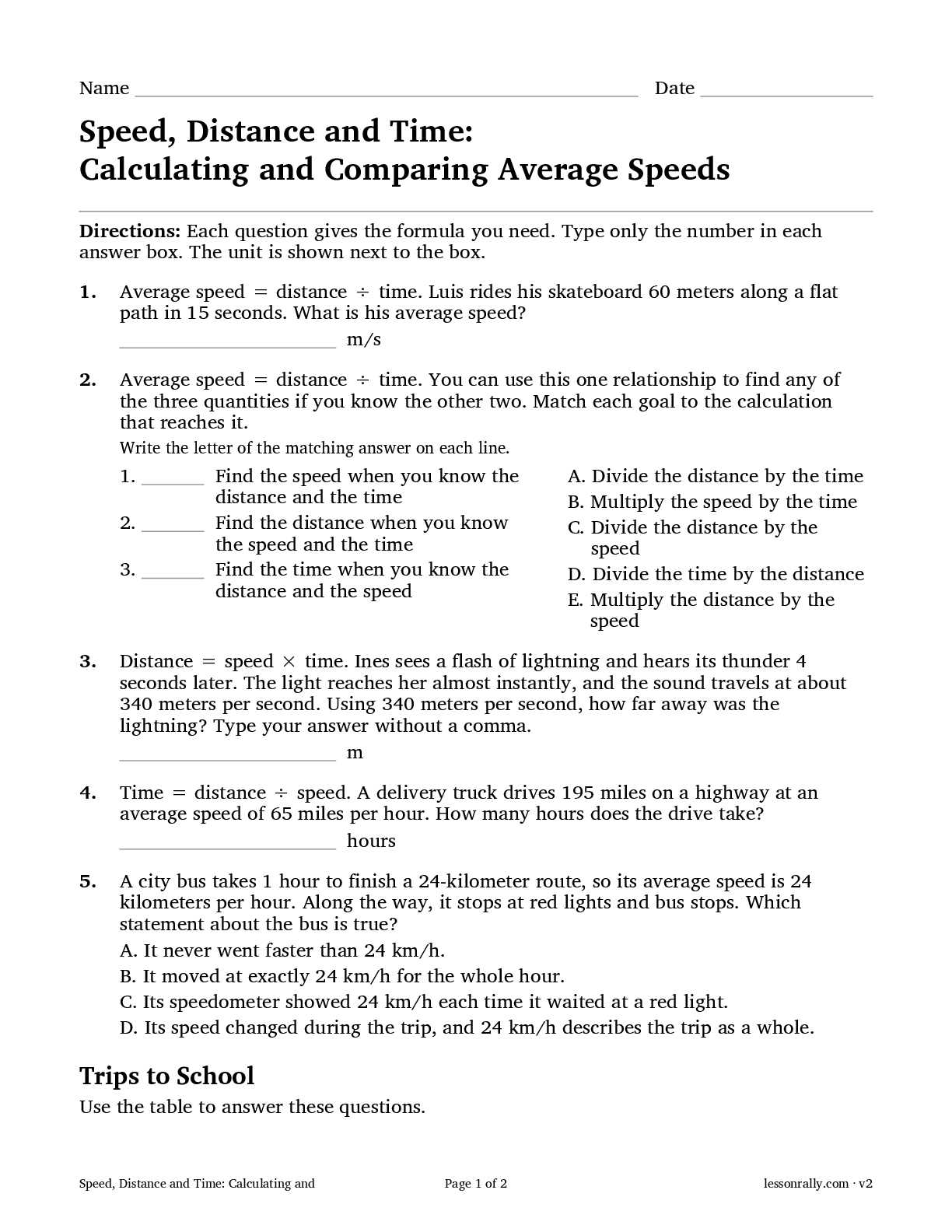
Print worksheet (opens in a new tab)Answer keyPremiumStudents use the speed formula, given in each question, to calculate speed, distance and time for a skateboard ride, a thunderclap, a truck trip and toy cars, then read a table of trips to school to compare average speeds. Concept questions take on common mix-ups, such as averaging two speeds or thinking a longer trip is always slower.
Learning goal: Calculate speed, distance or time from the other two quantities and compare the speeds of moving objects.
The estimate is the middle score of five readability formulas. Their scores run from 3.3 to 8.4.
Adapted from common readability formulas (Flesch-Kincaid, Gunning Fog, Coleman-Liau and ARI, plus SMOG for long texts), which look at sentence length and word length. Answer choices count toward word length only. Grades below the estimate will likely find the text harder, grades above it easier. It does not measure ideas, background knowledge or images.
Topic: Forces and Motion Chosen by LessonRally
Question types: number answer, matching, multiple choice, select all that apply.
The questions as students see them, without the answers.
Each question gives the formula you need. Type only the number in each answer box. The unit is shown next to the box.
Average speed = distance ÷ time. Luis rides his skateboard 60 meters along a flat path in 15 seconds. What is his average speed?
Enter a number.
m/s
Average speed = distance ÷ time. You can use this one relationship to find any of the three quantities if you know the other two. Match each goal to the calculation that reaches it.
Match each item to an option.
Items
Options
Distance = speed × time. Ines sees a flash of lightning and hears its thunder 4 seconds later. The light reaches her almost instantly, and the sound travels at about 340 meters per second. Using 340 meters per second, how far away was the lightning? Type your answer without a comma.
Enter a number.
m
Time = distance ÷ speed. A delivery truck drives 195 miles on a highway at an average speed of 65 miles per hour. How many hours does the drive take?
Enter a number.
hours
A city bus takes 1 hour to finish a 24-kilometer route, so its average speed is 24 kilometers per hour. Along the way, it stops at red lights and bus stops. Which statement about the bus is true?
Choose one answer.
Use the table to answer these questions.
| Student | How the student travels | Distance (meters) | Time (minutes) |
|---|---|---|---|
| Rosa | Walks | 1,200 | 15 |
| Dev | Rides a bike | 3,000 | 12 |
| Kenji | Rides a scooter | 1,800 | 12 |
| Amara | Rides the bus | 6,000 | 20 |
Average speed = distance ÷ time. What was Kenji's average speed on his scooter ride to school, in meters per minute?
Enter a number.
m/min
Dev and Kenji each took 12 minutes to get to school. Which statement about their average speeds is true?
Choose one answer.
Amara's trip took more time than any other trip in the table. Of the four students, who had the greatest average speed?
Choose one answer.
Average speed = total distance ÷ total time. Mei's family drives 240 kilometers on a highway in 3 hours. Then they drive 60 kilometers through a city in 2 hours. What is their average speed for the whole trip?
Choose one answer.
Average speed = distance ÷ time. Students time five toy cars, and each car rolls a different distance. Which two cars have the same average speed?
Choose 2 answers.
No reviews yet.
Reviews come from teachers who assigned this activity to a class.
Have a topic of your own? Make a printable worksheet and online quiz, free.
Create an activityCommon Core RST.6-8.7
Made by Theo Nakamura · LessonRally (AI-assisted)
Common Core RST.6-8.3
Made by Myra Jefferson · LessonRally (AI-assisted)
Common Core RST.6-8.4
Made by Myra Jefferson · LessonRally (AI-assisted)
Common Core RST.6-8.4
Made by Myra Jefferson · LessonRally (AI-assisted)