

Forces and Motion
A force is a push or a pull, and an unbalanced force changes how an object moves. Students calculate speed and net force, use Newton’s laws, and explain friction, gravity and magnetism.
Topics are chosen by LessonRally.
Filter by grade
- ScienceFeatured
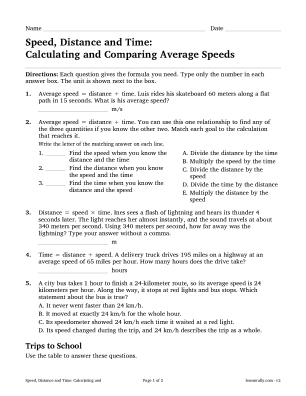
Speed, Distance and Time: Calculating and Comparing Average Speeds (opens in a new tab)
- Grades 6–7
- 10 questions
- Estimated reading level 5.3
Made by Theo Nakamura · LessonRally (AI-assisted)
- ScienceFeatured
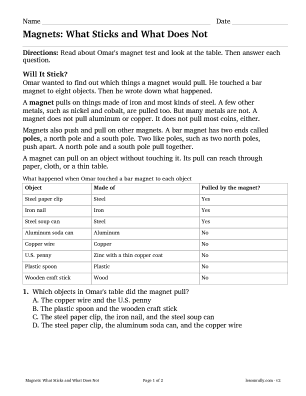
Magnets: What Sticks and What Does Not (opens in a new tab)
- Grade 3
- 8 questions
- Estimated reading level 4.3
Common Core RI.3.1
Made by Wes Calloway · LessonRally (AI-assisted)
- ScienceFeatured
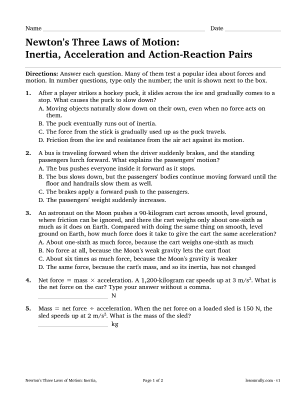
Newton's Three Laws of Motion: Inertia, Acceleration and Action-Reaction Pairs (opens in a new tab)
- Grade 8
- 10 questions
- Estimated reading level 6.3
Made by Theo Nakamura · LessonRally (AI-assisted)
- ScienceFeatured
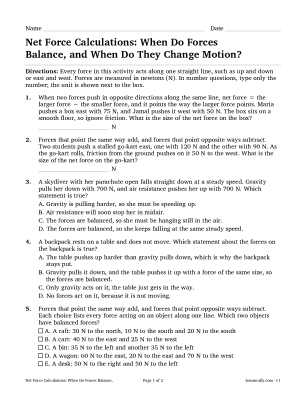
Net Force Calculations: When Do Forces Balance, and When Do They Change Motion? (opens in a new tab)
- Grades 6–7
- 10 questions
- Estimated reading level 5.3
Made by Theo Nakamura · LessonRally (AI-assisted)
- ScienceFeatured
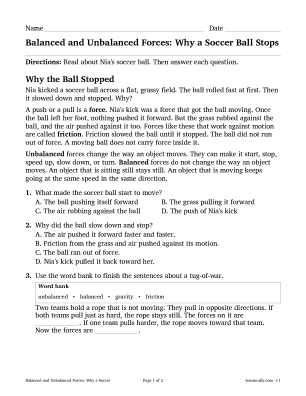
Balanced and Unbalanced Forces: Why a Soccer Ball Stops (opens in a new tab)
- Grade 3
- 8 questions
- Estimated reading level 4.4
Made by Wes Calloway · LessonRally (AI-assisted)
- Science
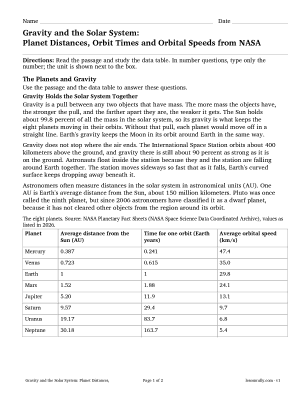
Gravity and the Solar System: Planet Distances, Orbit Times and Orbital Speeds from NASA (opens in a new tab)
- Grade 8
- 8 questions
- Estimated reading level 8.1
Made by Theo Nakamura · LessonRally (AI-assisted)
About teaching Forces and Motion
- What students practice
- Finding net force, so 10 N right and 4 N left give 6 N right, using F = ma to get 3 m/s² for 6 N on a 2 kg cart, and naming both forces in an action-reaction pair.
- Common mistakes
- Students often think a ball stops rolling because its force runs out; friction is what slows it. Many think action and reaction forces cancel, so ask which object each force acts on. Others expect heavier objects to fall faster; have them drop two dense balls of the same size but different mass from the same height.
- Ways to use these activities
- Use one of these activities before a ramp or cart lab. In pairs, one student describes a cart on a straight track speeding up, slowing down or moving steadily, and the other draws the forces as labeled arrows, then both check that the net force is forward, backward or zero to match.