Teachers who sign in can assign LessonRally activities to their Google Classroom classes: students open them in Classroom and answer online, and their grades go to the teacher's Classroom gradebook. Practice lets you try it first, the way students see it.
Students add and subtract forces in newtons along one straight line to find the net force on boxes, sleds, crates, a skydiver and a towed trailer, then decide whether the forces are balanced or unbalanced and how the motion will change. Concept questions take on the ideas that balanced forces mean an object is not moving and that the largest single force always wins.
Learning goal: Calculate the net force on an object from forces acting along one straight line, decide whether the forces are balanced or unbalanced, and predict how the object's motion will change.
Estimated reading level5.3
Grade 3Hard
Grade 4Stretch
Grade 5On level
Grade 6Easier
Grade 7Easy
About this estimate
The estimate is the middle score of five readability formulas. Their scores run from 4.7 to 7.7.
Flesch-Kincaid Grade Middle scoreSentence length and syllables per word5.3
Gunning FogSentence length and words of three or more syllables7.7
Coleman-LiauLetters per word and sentences per 100 words4.9
Automated Readability IndexCharacters per word and words per sentence4.7
SMOGWords of three or more syllables, for texts of 30 sentences or more7.7
Grade 181216
Flesch Reading Ease
84.1 on a 0 to 100 scale where higher is easier: easy. Not part of the estimate.
Text measured
817 words, 35 sentences
Adapted from common readability formulas (Flesch-Kincaid, Gunning Fog, Coleman-Liau and ARI, plus SMOG for long texts), which look at sentence length and word length. Answer choices count toward word length only. Grades below the estimate will likely find the text harder, grades above it easier. It does not measure ideas, background knowledge or images.
Question types: number answer, multiple choice, select all that apply.
Student preview
The questions as students see them, without the answers.
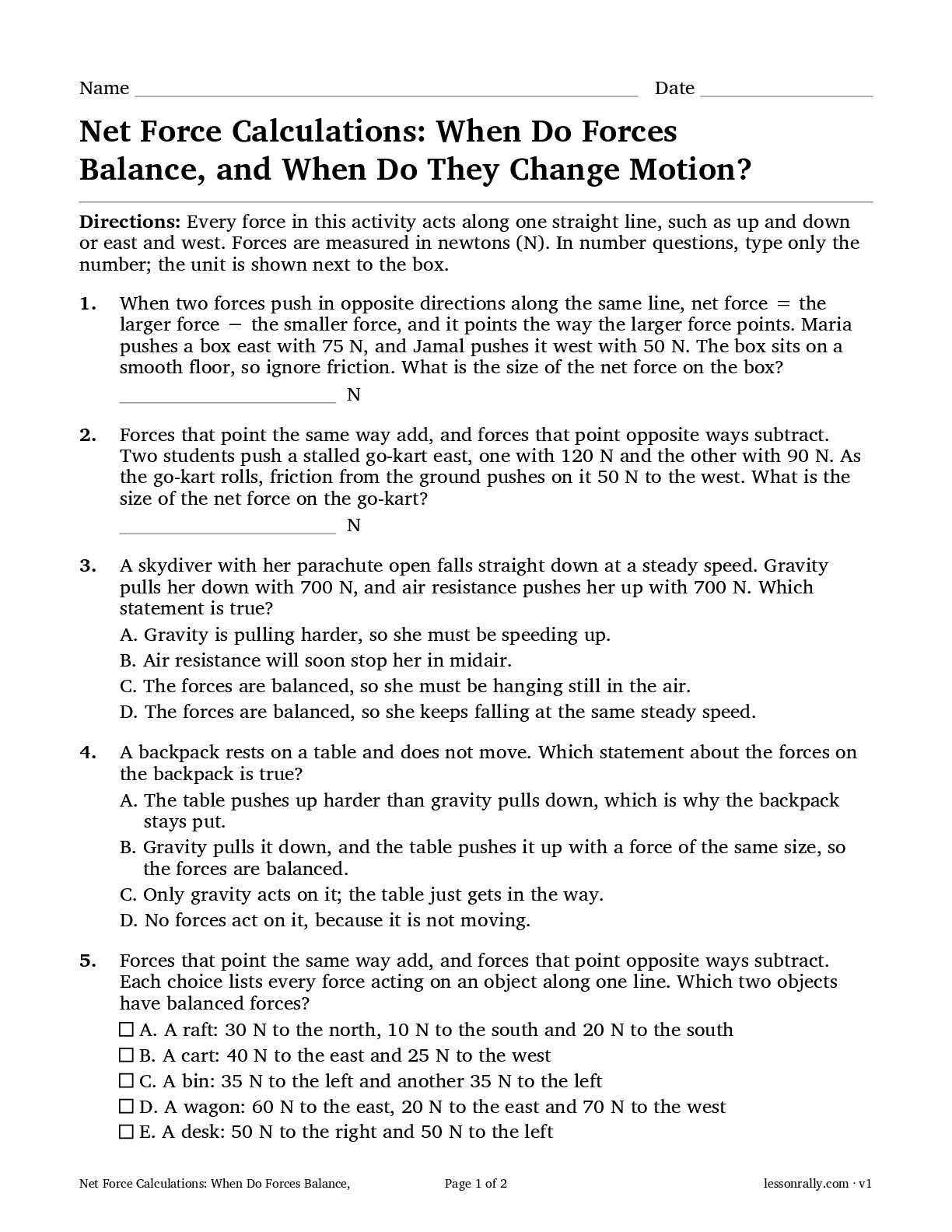
Every force in this activity acts along one straight line, such as up and down or east and west. Forces are measured in newtons (N). In number questions, type only the number; the unit is shown next to the box.
Question 1
When two forces push in opposite directions along the same line, net force = the larger force − the smaller force, and it points the way the larger force points. Maria pushes a box east with 75 N, and Jamal pushes it west with 50 N. The box sits on a smooth floor, so ignore friction. What is the size of the net force on the box?
Enter a number.
N
Question 2
Forces that point the same way add, and forces that point opposite ways subtract. Two students push a stalled go-kart east, one with 120 N and the other with 90 N. As the go-kart rolls, friction from the ground pushes on it 50 N to the west. What is the size of the net force on the go-kart?
Enter a number.
N
Question 3
A skydiver with her parachute open falls straight down at a steady speed. Gravity pulls her down with 700 N, and air resistance pushes her up with 700 N. Which statement is true?
Choose one answer.
Gravity is pulling harder, so she must be speeding up.
Air resistance will soon stop her in midair.
The forces are balanced, so she must be hanging still in the air.
The forces are balanced, so she keeps falling at the same steady speed.
Question 4
A backpack rests on a table and does not move. Which statement about the forces on the backpack is true?
Choose one answer.
No forces act on it, because it is not moving.
Gravity pulls it down, and the table pushes it up with a force of the same size, so the forces are balanced.
The table pushes up harder than gravity pulls down, which is why the backpack stays put.
Only gravity acts on it; the table just gets in the way.
Question 5
Forces that point the same way add, and forces that point opposite ways subtract. Each choice lists every force acting on an object along one line. Which two objects have balanced forces?
Choose 2 answers.
A cart: 40 N to the east and 25 N to the west
A wagon: 60 N to the east, 20 N to the east and 70 N to the west
A raft: 30 N to the north, 10 N to the south and 20 N to the south
A bin: 35 N to the left and another 35 N to the left
A desk: 50 N to the right and 50 N to the left
Question 6
Forces that point the same way add, and forces that point opposite ways subtract. A sled is sliding north across the snow. Alex pulls it north with 70 N, Bea pulls it south with 40 N, and friction from the snow pushes it south with 50 N. What is happening to the sled's speed?
Choose one answer.
It is speeding up, because the sled is already moving north.
It is speeding up, because the largest single force, Alex's 70 N pull, points north.
It is slowing down, because the net force is 20 N to the south, against the sled's motion.
It stays the same, because forces are pulling it both ways.
Question 7
When a push and friction point in opposite directions, net force = push − friction. Kim pushes a crate east across the floor. Friction from the floor pushes west on the crate with 60 N, and the net force on the crate is 25 N to the east. How hard is Kim pushing?
Enter a number.
N
Question 8
When two forces act in opposite directions, net force = the larger force − the smaller force. A crane lifts a crate straight up. The cable pulls up on the crate with 5,300 N, and gravity pulls down on it with 5,000 N. Ignore air resistance. What is the size of the net force on the crate?
Enter a number.
N
Question 9
Kofi tosses a ball straight up. At the very top of its path, the ball stops for an instant before it falls back down. Ignore air resistance. Which statement about the forces on the ball at that instant is true?
Choose one answer.
The upward force from Kofi's throw is still there and exactly balances gravity.
The forces are balanced, because the ball is not moving.
No forces act on it, because it is not moving.
Only gravity acts on it, so the forces are unbalanced, and the ball starts to speed up downward.
Question 10
When an object moves at a steady speed in a straight line, the forces on it are balanced, so the forces pointing one way add up to the forces pointing the other way. A pickup truck tows a camper trailer east at a steady speed. Friction from the road pushes west on the trailer with 400 N, and air resistance pushes west on it with 600 N. How hard does the truck pull east on the trailer? Type your answer without a comma.