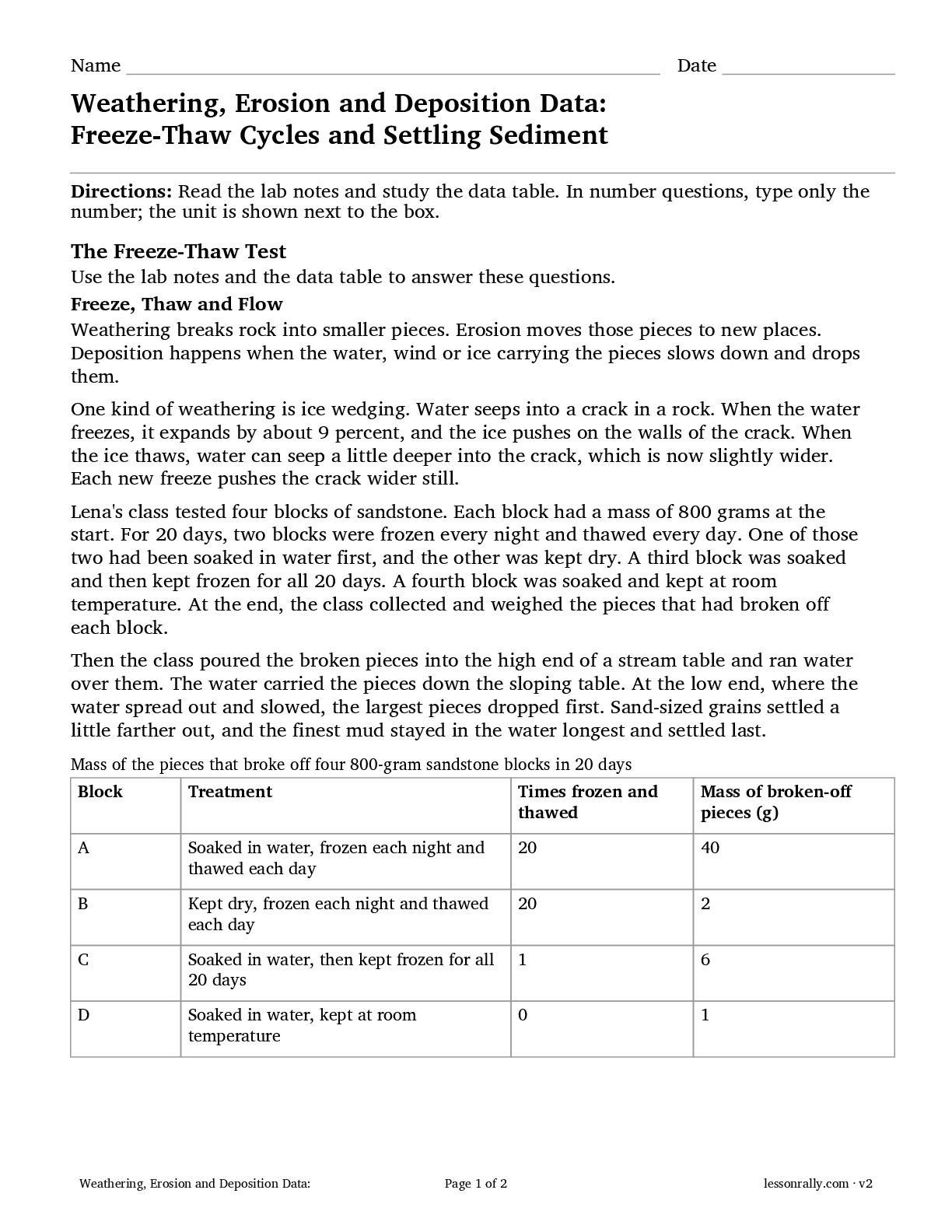
Weathering breaks rock into smaller pieces. Erosion moves those pieces to new places. Deposition happens when the water, wind or ice carrying the pieces slows down and drops them.
One kind of weathering is ice wedging. Water seeps into a crack in a rock. When the water freezes, it expands by about 9 percent, and the ice pushes on the walls of the crack. When the ice thaws, water can seep a little deeper into the crack, which is now slightly wider. Each new freeze pushes the crack wider still.
Lena's class tested four blocks of sandstone. Each block had a mass of 800 grams at the start. For 20 days, two blocks were frozen every night and thawed every day. One of those two had been soaked in water first, and the other was kept dry. A third block was soaked and then kept frozen for all 20 days. A fourth block was soaked and kept at room temperature. At the end, the class collected and weighed the pieces that had broken off each block.
Then the class poured the broken pieces into the high end of a stream table and ran water over them. The water carried the pieces down the sloping table. At the low end, where the water spread out and slowed, the largest pieces dropped first. Sand-sized grains settled a little farther out, and the finest mud stayed in the water longest and settled last.