Magnets: What Sticks and What Does Not

8 questions · 9 points · Grade 3 · English · Preview the 8 questions

Made by Wes Calloway · LessonRally (AI-assisted)

Digital classroom activity

What is a digital classroom activity?

Teachers who sign in can assign LessonRally activities to their Google Classroom classes: students open them in Classroom and answer online, and their grades go to the teacher's Classroom gradebook. Practice lets you try it first, the way students see it.

Free for teachers. Sign in to assign activities to your Google Classroom classes.

Printable worksheet

Students read how a magnet pulls iron and most steel but not aluminum, copper, or most coins, then use a table of eight objects that Omar tested. Questions ask which objects were pulled, why a steel soup can sticks and an aluminum soda can does not, how two bar magnets push and pull, and how a magnet's pull reaches through a thin table.

Learning goal: Use test results to tell which objects a magnet pulls, and describe how magnets push and pull on each other and can act without touching.

Estimated reading level 4.3

  1. Grade 2Hard
  2. Grade 3Stretch
  3. Grade 4On level
  4. Grade 5Easier
  5. Grade 6Easy
About this estimate

The estimate is the middle score of five readability formulas. Their scores run from 2.3 to 5.3.

  • Flesch-Kincaid GradeSentence length and syllables per word3.1
  • Gunning Fog Middle scoreSentence length and words of three or more syllables4.3
  • Coleman-LiauLetters per word and sentences per 100 words4.8
  • Automated Readability IndexCharacters per word and words per sentence2.3
  • SMOGWords of three or more syllables, for texts of 30 sentences or more5.3
Flesch Reading Ease
89.0 on a 0 to 100 scale where higher is easier: easy. Not part of the estimate.
Text measured
564 words, 35 sentences

Adapted from common readability formulas (Flesch-Kincaid, Gunning Fog, Coleman-Liau and ARI, plus SMOG for long texts), which look at sentence length and word length. Answer choices count toward word length only. Grades below the estimate will likely find the text harder, grades above it easier. It does not measure ideas, background knowledge or images.

Common Core

Closest anchor: CCRA.R.1 Read closely to determine what the text says explicitly and to make logical inferences from it; cite specific textual evidence when writing or speaking to support conclusions drawn from the text.Anchor Standards for ReadingShow 1 matched standardHide matched standard

Matched standard

  • RI.3.1

    Ask and answer questions to demonstrate understanding of a text, referring explicitly to the text as the basis for the answers.

    Student preview questions 1, 2, 4, 5, 7

Matched independently by two AI models from this activity's questions.

© Copyright 2010. National Governors Association Center for Best Practices and Council of Chief State School Officers. All rights reserved.

Topic: Forces and Motion Chosen by LessonRally

Question types: multiple choice, fill in the blank.

Student preview

The questions as students see them, without the answers.

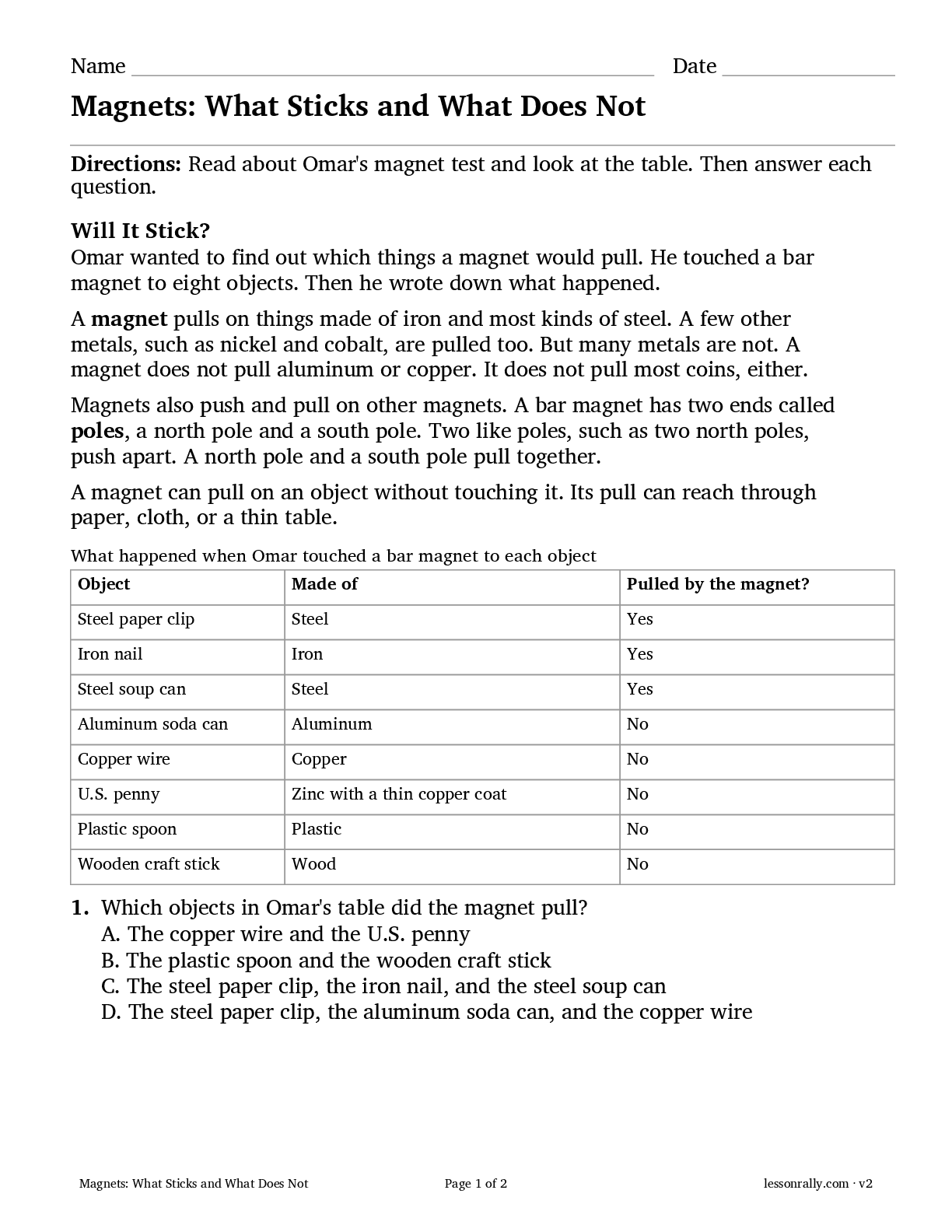
Read about Omar's magnet test and look at the table. Then answer each question.

Will It Stick?

Omar wanted to find out which things a magnet would pull. He touched a bar magnet to eight objects. Then he wrote down what happened.

A magnet pulls on things made of iron and most kinds of steel. A few other metals, such as nickel and cobalt, are pulled too. But many metals are not. A magnet does not pull aluminum or copper. It does not pull most coins, either.

Magnets also push and pull on other magnets. A bar magnet has two ends called poles, a north pole and a south pole. Two like poles, such as two north poles, push apart. A north pole and a south pole pull together.

A magnet can pull on an object without touching it. Its pull can reach through paper, cloth, or a thin table.


What happened when Omar touched a bar magnet to each object
ObjectMade ofPulled by the magnet?
Steel paper clipSteelYes
Iron nailIronYes
Steel soup canSteelYes
Aluminum soda canAluminumNo
Copper wireCopperNo
U.S. pennyZinc with a thin copper coatNo
Plastic spoonPlasticNo
Wooden craft stickWoodNo

Question 1

Which objects in Omar's table did the magnet pull?

Choose one answer.

  • The copper wire and the U.S. penny
  • The plastic spoon and the wooden craft stick
  • The steel paper clip, the aluminum soda can, and the copper wire
  • The steel paper clip, the iron nail, and the steel soup can

Question 2

The steel soup can and the aluminum soda can are both metal cans. Why did the magnet pull only one of them?

Choose one answer.

  • The soup can was bigger than the soda can.
  • The magnet pulls steel, but it does not pull aluminum.
  • The magnet pulls only cans that have food in them.
  • The soda can was too heavy for the magnet.

Question 3

Use the word bank to finish the sentences about two bar magnets.

Fill in each blank.

Omar holds two bar magnets so that their south poles face each other. The two poles blank 1 each other away. Then he turns one magnet around, so a north pole faces a south pole. Now the poles blank 2 toward each other.

Word bank

  • spin
  • stick
  • push
  • pull

Question 4

Omar sets a steel paper clip on top of a thin wooden table. He moves the magnet under the table. The clip slides along with it. What does this show?

Choose one answer.

  • The wooden table pulls the paper clip.
  • A magnet's pull can reach through the thin table.
  • A magnet must touch an object to pull it.
  • The table was shaking, and that moved the clip.

Question 5

Omar's sister says, "A magnet pulls all metals." Which object in the table shows she is wrong?

Choose one answer.

  • The steel paper clip, a metal that the magnet pulled
  • The plastic spoon, which is not a metal
  • The iron nail, a metal that the magnet pulled
  • The copper wire, a metal that the magnet did not pull

Question 6

Omar finds a coin from Canada. How can he find out if a magnet will pull it?

Choose one answer.

  • Look at the coin's color.
  • Count how many coins he has.
  • Touch the magnet to the coin and see if it is pulled.
  • Check whether the coin is shiny.

Question 7

Which of these would a magnet pull?

Choose one answer.

  • A wooden spoon
  • A plastic cup
  • A cast-iron frying pan
  • A rubber ball

Question 8

Omar mixes some steel paper clips into a pile of plastic beads. What would happen if he moved the magnet over the pile?

Choose one answer.

  • The magnet would pick up the plastic beads and leave the paper clips.
  • The magnet would pull nothing, because the objects are mixed.
  • The magnet would probably pull out the steel paper clips and leave the plastic beads.
  • The magnet would pick up the whole pile.

Reviews

No reviews yet.

Reviews come from teachers who assigned this activity to a class.

Sign in to write a review

Have a topic of your own? Make a printable worksheet and online quiz, free.

Create an activity

Answer key

Answer keys come with Premium

Print this worksheet with the correct answers marked. The key includes any explanations, sample answers, and rubrics supplied with the activity.

Answer keys aren't public: only teachers with Premium and the people who can edit an activity can download one, so students can't get a ready-to-print key from this page.

Premium includes:

  • No ads for you, and no ads for your students on the assignments you post.
  • Answer keys for printable worksheets, with the correct answers marked and any explanations, sample answers, and rubrics.
  • Create with AI: up to 100 activities a year (5 during the free trial), with every answer checked before you see the draft.

$29 a year, plus sales tax where it applies.

New Premium teachers can try it free for 7 days. A card or other payment method is needed to start. Unless you cancel before the trial ends, you are charged then and the plan renews every year.

Already have Premium or edit this activity? Sign in