Question 1
Which day had the warmest high?
Choose one answer.
- Wednesday
- Tuesday
- Friday
- Monday


Teachers who sign in can assign LessonRally activities to their Google Classroom classes: students open them in Classroom and answer online, and their grades go to the teacher's Classroom gradebook. Practice lets you try it first, the way students see it.
Free for teachers. Sign in to assign activities to your Google Classroom classes.
 (opens in a new tab)
2 pages · Student copy, no answers
Print worksheet (opens in a new tab)Answer keyPremiumStudents read about a girl who records the weather for one school week in January in a town where winters are usually cold and snowy, then use a table of daily high temperatures. Questions ask students to read the table, tell weather from climate, compare a warm day with the usual January high, and explain why one cold day does not tell a town's climate.
Learning goal: Explain that weather is what the air is like in one place at one time and climate is the usual weather pattern in a place over many years.
The estimate is halfway between the two middle scores of four readability formulas. Their scores run from 3.5 to 5.8.
Adapted from common readability formulas (Flesch-Kincaid, Gunning Fog, Coleman-Liau and ARI, plus SMOG for long texts), which look at sentence length and word length. Answer choices count toward word length only. Grades below the estimate will likely find the text harder, grades above it easier. It does not measure ideas, background knowledge or images.
© Copyright 2010. National Governors Association Center for Best Practices and Council of Chief State School Officers. All rights reserved.
Topic: Weather and Climate Chosen by LessonRally
Question types: multiple choice, fill in the blank.
The questions as students see them, without the answers.
Read about Priya's weather record and look at the table. Then answer each question.
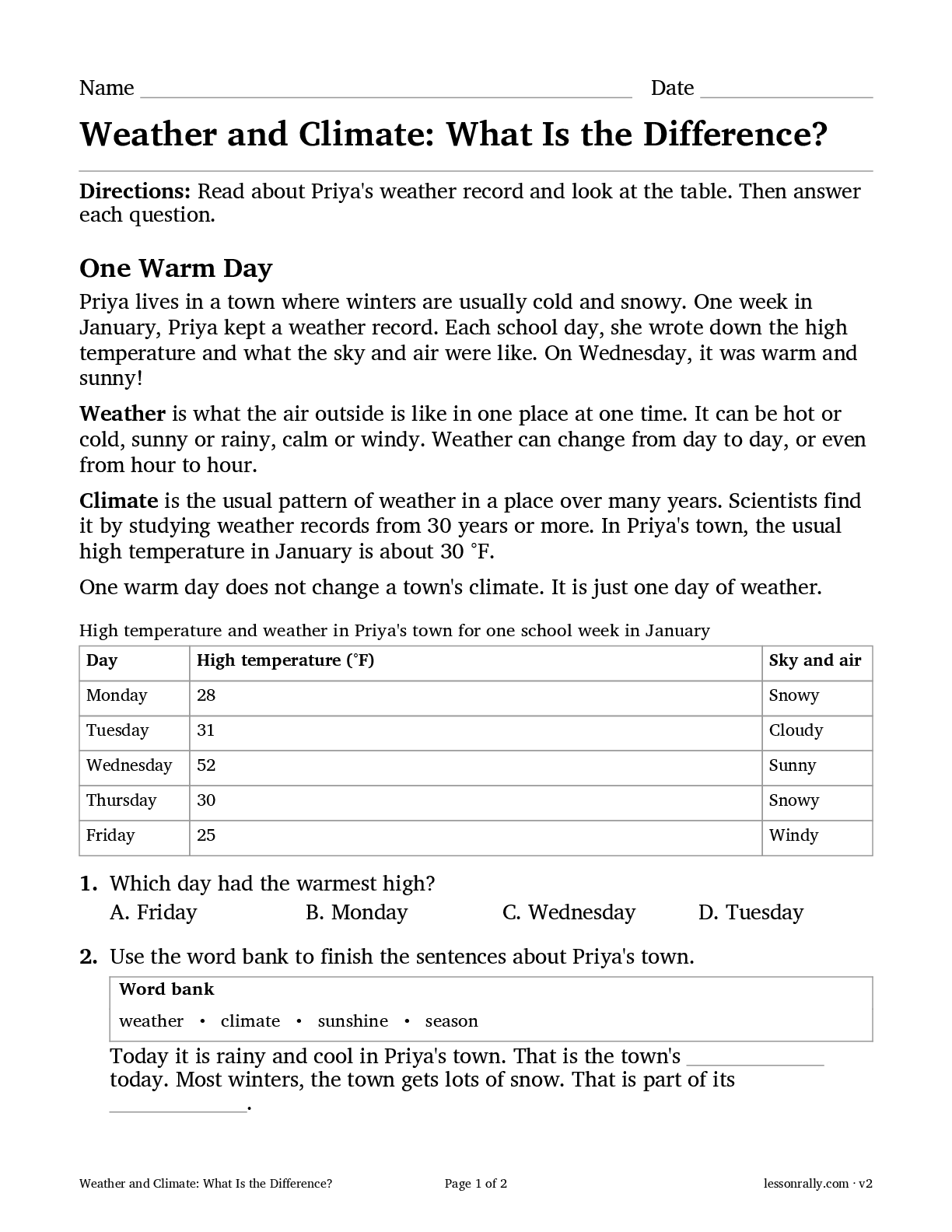
Priya lives in a town where winters are usually cold and snowy. One week in January, Priya kept a weather record. Each school day, she wrote down the high temperature and what the sky and air were like. On Wednesday, it was warm and sunny!
Weather is what the air outside is like in one place at one time. It can be hot or cold, sunny or rainy, calm or windy. Weather can change from day to day, or even from hour to hour.
Climate is the usual pattern of weather in a place over many years. Scientists find it by studying weather records from 30 years or more. In Priya's town, the usual high temperature in January is about 30 °F.
One warm day does not change a town's climate. It is just one day of weather.
| Day | High temperature (°F) | Sky and air |
|---|---|---|
| Monday | 28 | Snowy |
| Tuesday | 31 | Cloudy |
| Wednesday | 52 | Sunny |
| Thursday | 30 | Snowy |
| Friday | 25 | Windy |
Which day had the warmest high?
Choose one answer.
Use the word bank to finish the sentences about Priya's town.
Fill in each blank.
Today it is rainy and cool in Priya's town. That is the town's blank 1 today. Most winters, the town gets lots of snow. That is part of its blank 2.
Word bank
Is Priya's table about weather or about climate?
Choose one answer.
What does Priya's table show about the weather that week?
Choose one answer.
How much warmer was Wednesday's high than the usual January high in Priya's town?
Choose one answer.
Which sentence describes climate, not weather?
Choose one answer.
Priya's cousin lives in a town where winters are usually warm. One winter day there, the air was cold and frosty. What does this cold day tell about the cousin's town?
Choose one answer.
What would happen if Priya wrote down her town's weather each day for 30 years?
Choose one answer.
No reviews yet.
Reviews come from teachers who assigned this activity to a class.
Have a topic of your own? Make a printable worksheet and online quiz, free.
Create an activityCommon Core RI.3.1
Made by Wes Calloway · LessonRally (AI-assisted)
Common Core RI.3.1
Made by Wes Calloway · LessonRally (AI-assisted)
Made by Wes Calloway · LessonRally (AI-assisted)
Common Core RI.3.3
Made by Wes Calloway · LessonRally (AI-assisted)