Question 1
Match each word from the puppy passage with what it means.
Match each item to an option.
Items
- trait
- inherited
- learned behavior
- environment
Options


Teachers who sign in can assign LessonRally activities to their Google Classroom classes: students open them in Classroom and answer online, and their grades go to the teacher's Classroom gradebook. Practice lets you try it first, the way students see it.
Free for teachers. Sign in to assign activities to your Google Classroom classes.
 (opens in a new tab)
2 pages · Student copy, no answers
Print worksheet (opens in a new tab)Answer keyPremiumStudents read about a puppy who got her brown eyes from her parents and learned to sit from training, and learn four words: trait, inherited, learned behavior, and environment. Questions ask students to match the words, sort clear examples of inherited traits and learned behaviors, and explain how food, exercise, and water can change a living thing's traits.
Learning goal: Use the words trait, inherited, learned behavior, and environment to tell inherited traits from learned behaviors and to explain how the environment can change some traits.
The estimate is the middle score of five readability formulas. Their scores run from 3.2 to 6.2.
Adapted from common readability formulas (Flesch-Kincaid, Gunning Fog, Coleman-Liau and ARI, plus SMOG for long texts), which look at sentence length and word length. Answer choices count toward word length only. Grades below the estimate will likely find the text harder, grades above it easier. It does not measure ideas, background knowledge or images.
Ask and answer questions to demonstrate understanding of a text, referring explicitly to the text as the basis for the answers.
Determine the meaning of general academic and domain-specific words and phrases in a text relevant to a grade 3 topic or subject area.
Matched independently by two AI models from this activity's questions.
© Copyright 2010. National Governors Association Center for Best Practices and Council of Chief State School Officers. All rights reserved.
Topic: Genetics and Heredity Chosen by LessonRally
Question types: matching, fill in the blank, multiple choice.
The questions as students see them, without the answers.
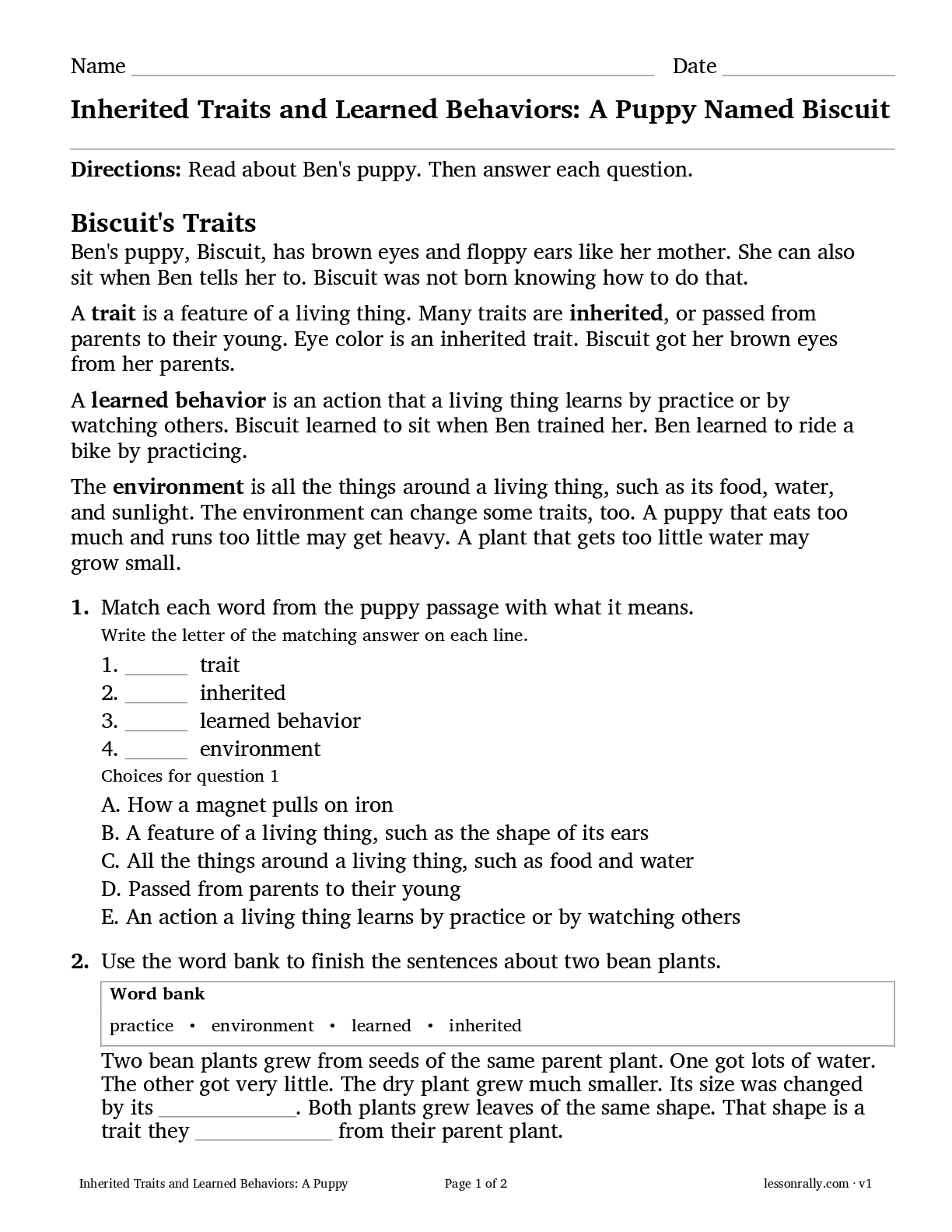
Read about Ben's puppy. Then answer each question.
Ben's puppy, Biscuit, has brown eyes and floppy ears like her mother. She can also sit when Ben tells her to. Biscuit was not born knowing how to do that.
A trait is a feature of a living thing. Many traits are inherited, or passed from parents to their young. Eye color is an inherited trait. Biscuit got her brown eyes from her parents.
A learned behavior is an action that a living thing learns by practice or by watching others. Biscuit learned to sit when Ben trained her. Ben learned to ride a bike by practicing.
The environment is all the things around a living thing, such as its food, water, and sunlight. The environment can change some traits, too. A puppy that eats too much and runs too little may get heavy. A plant that gets too little water may grow small.
Match each word from the puppy passage with what it means.
Match each item to an option.
Items
Options
Use the word bank to finish the sentences about two bean plants.
Fill in each blank.
Two bean plants grew from seeds of the same parent plant. One got lots of water. The other got very little. The dry plant grew much smaller. Its size was changed by its blank 1. Both plants grew leaves of the same shape. That shape is a trait they blank 2 from their parent plant.
Word bank
Which of these is an inherited trait?
Choose one answer.
Which of these is a learned behavior?
Choose one answer.
Biscuit's sister, Pepper, has the same parents. Pepper gets too much food and few walks. Now she is much heavier than Biscuit. What is the best reason?
Choose one answer.
Ben says, "Biscuit learned to have brown eyes." Why is Ben wrong?
Choose one answer.
Which sentence is best supported by the passage?
Choose one answer.
What would happen if Biscuit had puppies one day?
Choose one answer.
No reviews yet.
Reviews come from teachers who assigned this activity to a class.
Have a topic of your own? Make a printable worksheet and online quiz, free.
Create an activityCommon Core RI.3.1
Made by Wes Calloway · LessonRally (AI-assisted)
Made by Wes Calloway · LessonRally (AI-assisted)
Common Core RI.3.1
Made by Wes Calloway · LessonRally (AI-assisted)
Common Core RI.3.3
Made by Wes Calloway · LessonRally (AI-assisted)