Question 1
What made the soccer ball start to move?
Choose one answer.
- The air rubbing against the ball
- The grass pulling it forward
- The push of Nia's kick
- The ball pushing itself forward


Teachers who sign in can assign LessonRally activities to their Google Classroom classes: students open them in Classroom and answer online, and their grades go to the teacher's Classroom gradebook. Practice lets you try it first, the way students see it.
Free for teachers. Sign in to assign activities to your Google Classroom classes.
 (opens in a new tab)
2 pages · Student copy, no answers
Print worksheet (opens in a new tab)Answer keyPremiumStudents read about a soccer ball that slows down and stops on a grassy field and explain how forces change motion. Questions cover the kick that starts the ball, the friction that stops it, a tug-of-war, balanced forces on a ball sitting still and on a wagon rolling at a steady speed, and what would happen to a rolling ball with nothing pushing against it.
Learning goal: Explain that unbalanced forces change an object's motion and balanced forces leave it the same, and that a rolling ball stops because friction pushes against its motion.
The estimate is the middle score of five readability formulas. Their scores run from 2.3 to 5.8.
Adapted from common readability formulas (Flesch-Kincaid, Gunning Fog, Coleman-Liau and ARI, plus SMOG for long texts), which look at sentence length and word length. Answer choices count toward word length only. Grades below the estimate will likely find the text harder, grades above it easier. It does not measure ideas, background knowledge or images.
Topic: Forces and Motion Chosen by LessonRally
Question types: multiple choice, fill in the blank.
The questions as students see them, without the answers.
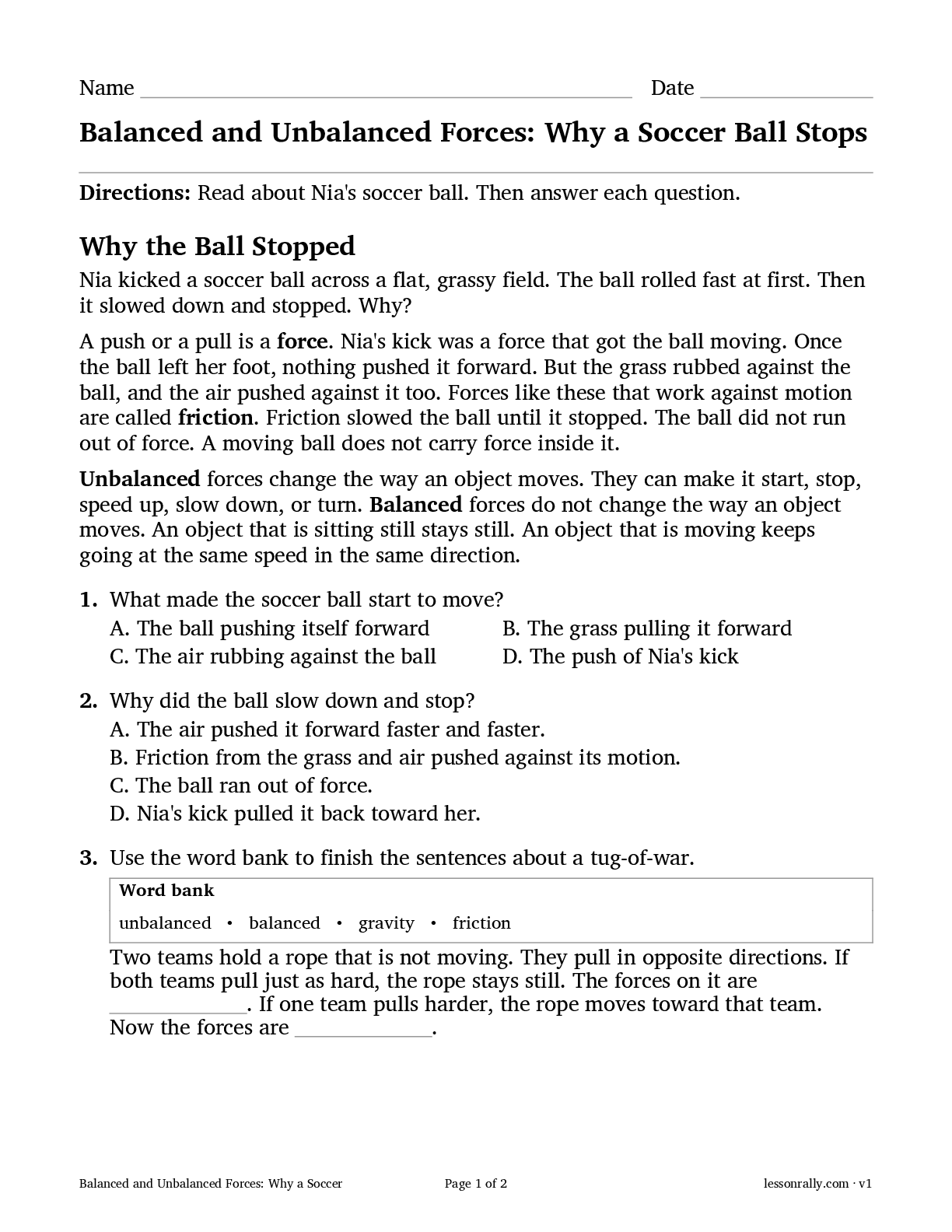
Read about Nia's soccer ball. Then answer each question.
Nia kicked a soccer ball across a flat, grassy field. The ball rolled fast at first. Then it slowed down and stopped. Why?
A push or a pull is a force. Nia's kick was a force that got the ball moving. Once the ball left her foot, nothing pushed it forward. But the grass rubbed against the ball, and the air pushed against it too. Forces like these that work against motion are called friction. Friction slowed the ball until it stopped. The ball did not run out of force. A moving ball does not carry force inside it.
Unbalanced forces change the way an object moves. They can make it start, stop, speed up, slow down, or turn. Balanced forces do not change the way an object moves. An object that is sitting still stays still. An object that is moving keeps going at the same speed in the same direction.
What made the soccer ball start to move?
Choose one answer.
Why did the ball slow down and stop?
Choose one answer.
Use the word bank to finish the sentences about a tug-of-war.
Fill in each blank.
Two teams hold a rope that is not moving. They pull in opposite directions. If both teams pull just as hard, the rope stays still. The forces on it are blank 1. If one team pulls harder, the rope moves toward that team. Now the forces are blank 2.
Word bank
Before Nia kicked it, the ball sat still on the grass. Which sentence best describes the forces on it then?
Choose one answer.
Jalen pulls a wagon that is already rolling. He pulls it forward just as hard as friction pushes back on it. What happens to the wagon?
Choose one answer.
Nia rolls the same ball, just as hard, across a smooth gym floor. It rolls much farther than it did on the grass. What most likely explains this?
Choose one answer.
Which of these shows unbalanced forces changing an object's motion?
Choose one answer.
What would happen if no grass or air pushed against Nia's rolling ball?
Choose one answer.
No reviews yet.
Reviews come from teachers who assigned this activity to a class.
Have a topic of your own? Make a printable worksheet and online quiz, free.
Create an activityCommon Core RI.3.1
Made by Wes Calloway · LessonRally (AI-assisted)
Common Core RI.3.1
Made by Wes Calloway · LessonRally (AI-assisted)
Common Core RI.3.1
Made by Wes Calloway · LessonRally (AI-assisted)
Common Core RI.3.3
Made by Wes Calloway · LessonRally (AI-assisted)