Life Cycles: From Egg to Frog

8 questions · 9 points · Grade 3 · English · Preview the 8 questions

Made by Wes Calloway · LessonRally (AI-assisted)

Digital classroom activity

What is a digital classroom activity?

Teachers who sign in can assign LessonRally activities to their Google Classroom classes: students open them in Classroom and answer online, and their grades go to the teacher's Classroom gradebook. Practice lets you try it first, the way students see it.

Free for teachers. Sign in to assign activities to your Google Classroom classes.

Printable worksheet

Students read about a pond where eggs turn into tadpoles, froglets, and adult frogs, and describe the stages of most frogs' life cycle in order. Questions cover the words froglet and metamorphosis, how tadpoles and adult frogs differ, which legs grow first, what happens to the tail, the coquí frog that skips the swimming tadpole stage, and why a chick does not go through metamorphosis.

Learning goal: Describe the stages of most frogs' life cycle in order, and explain that metamorphosis is a big change in body form.

Estimated reading level 4.3

  1. Grade 2Hard
  2. Grade 3Stretch
  3. Grade 4On level
  4. Grade 5Easier
  5. Grade 6Easy
About this estimate

The estimate is the middle score of five readability formulas. Their scores run from 2.3 to 5.2.

  • Flesch-Kincaid GradeSentence length and syllables per word2.8
  • Gunning Fog Middle scoreSentence length and words of three or more syllables4.3
  • Coleman-LiauLetters per word and sentences per 100 words4.8
  • Automated Readability IndexCharacters per word and words per sentence2.3
  • SMOGWords of three or more syllables, for texts of 30 sentences or more5.2
Flesch Reading Ease
91.6 on a 0 to 100 scale where higher is easier: very easy. Not part of the estimate.
Text measured
499 words, 30 sentences

Adapted from common readability formulas (Flesch-Kincaid, Gunning Fog, Coleman-Liau and ARI, plus SMOG for long texts), which look at sentence length and word length. Answer choices count toward word length only. Grades below the estimate will likely find the text harder, grades above it easier. It does not measure ideas, background knowledge or images.

Common Core

Closest anchor: CCRA.R.3 Analyze how and why individuals, events, or ideas develop and interact over the course of a text.Anchor Standards for ReadingShow 2 matched standardsHide matched standards

Matched standards

  • RI.3.3

    Describe the relationship between a series of historical events, scientific ideas or concepts, or steps in technical procedures in a text, using language that pertains to time, sequence, and cause/effect.

    Student preview questions 2, 4, 5, 6

  • RI.3.4

    Determine the meaning of general academic and domain-specific words and phrases in a text relevant to a grade 3 topic or subject area.

    Student preview question 1

Matched independently by two AI models from this activity's questions.

© Copyright 2010. National Governors Association Center for Best Practices and Council of Chief State School Officers. All rights reserved.

Question types: fill in the blank, multiple choice.

Student preview

The questions as students see them, without the answers.

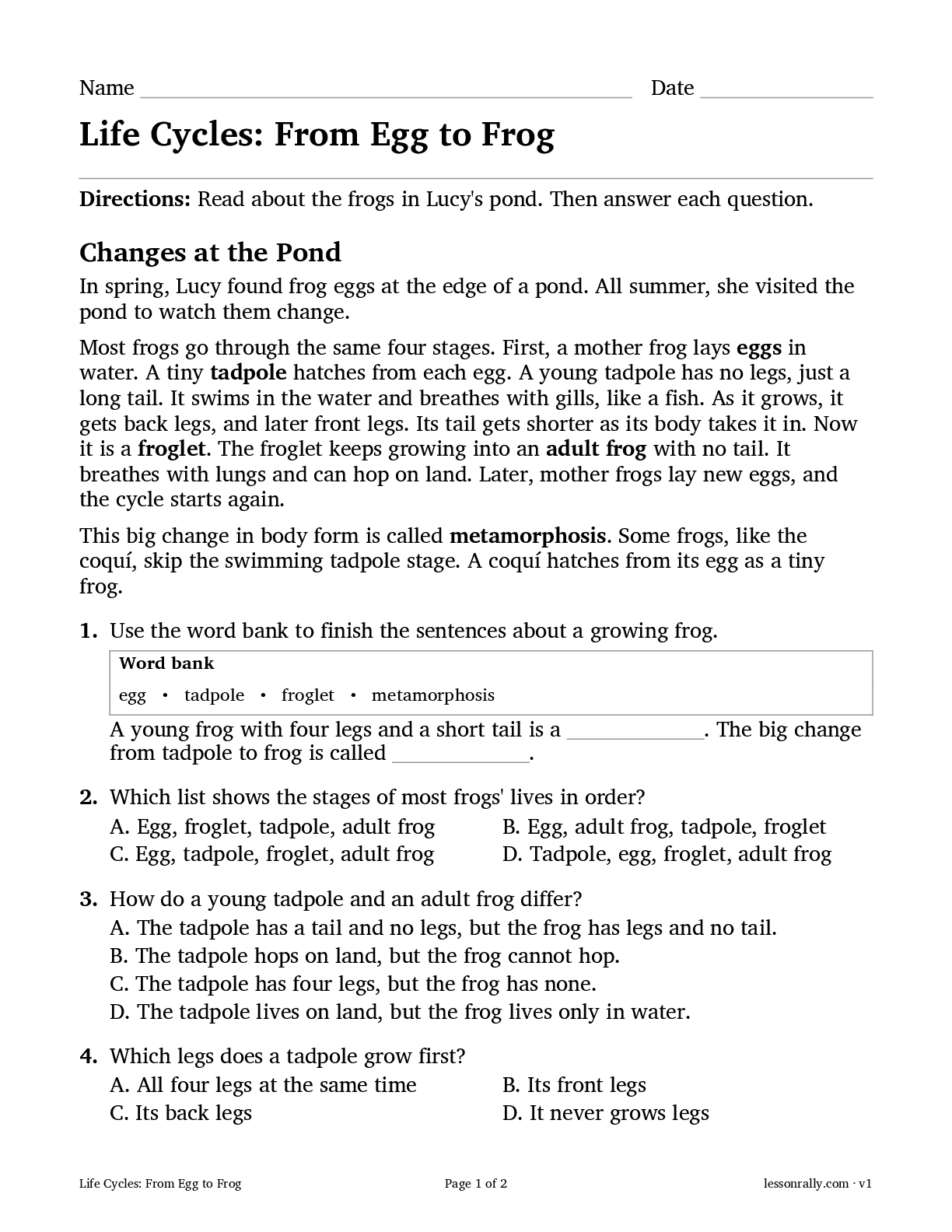
Read about the frogs in Lucy's pond. Then answer each question.

Changes at the Pond

In spring, Lucy found frog eggs at the edge of a pond. All summer, she visited the pond to watch them change.

Most frogs go through the same four stages. First, a mother frog lays eggs in water. A tiny tadpole hatches from each egg. A young tadpole has no legs, just a long tail. It swims in the water and breathes with gills, like a fish. As it grows, it gets back legs, and later front legs. Its tail gets shorter as its body takes it in. Now it is a froglet. The froglet keeps growing into an adult frog with no tail. It breathes with lungs and can hop on land. Later, mother frogs lay new eggs, and the cycle starts again.

This big change in body form is called metamorphosis. Some frogs, like the coquí, skip the swimming tadpole stage. A coquí hatches from its egg as a tiny frog.


Question 1

Use the word bank to finish the sentences about a growing frog.

Fill in each blank.

A young frog with four legs and a short tail is a blank 1. The big change from tadpole to frog is called blank 2.

Word bank

  • froglet
  • egg
  • metamorphosis
  • tadpole

Question 2

Which list shows the stages of most frogs' lives in order?

Choose one answer.

  • Egg, froglet, tadpole, adult frog
  • Tadpole, egg, froglet, adult frog
  • Egg, tadpole, froglet, adult frog
  • Egg, adult frog, tadpole, froglet

Question 3

How do a young tadpole and an adult frog differ?

Choose one answer.

  • The tadpole has four legs, but the frog has none.
  • The tadpole hops on land, but the frog cannot hop.
  • The tadpole has a tail and no legs, but the frog has legs and no tail.
  • The tadpole lives on land, but the frog lives only in water.

Question 4

Which legs does a tadpole grow first?

Choose one answer.

  • All four legs at the same time
  • Its back legs
  • Its front legs
  • It never grows legs

Question 5

What happens to a tadpole's tail as it changes into a frog?

Choose one answer.

  • It falls off in one piece.
  • It gets shorter as the body takes it in.
  • It turns into the back legs.
  • It grows longer and stronger.

Question 6

How does a coquí frog's life differ from most frogs' lives?

Choose one answer.

  • A coquí hatches as a tiny frog, so it skips the swimming tadpole stage.
  • A coquí grows back legs only as an adult.
  • A coquí stays a tadpole its whole life.
  • A coquí never hatches from an egg.

Question 7

A chick hatches looking like a small, fluffy chicken. As it grows, its body keeps the same shape. Why is this not metamorphosis?

Choose one answer.

  • Chicks never grow.
  • Chicks do not hatch from eggs.
  • Only things that live in water can grow.
  • The chick's body form does not go through a big change.

Question 8

What would happen if Lucy's pond dried up before the tadpoles had legs?

Choose one answer.

  • They would grow lungs fast and live on dry land.
  • They would hop away to a new pond.
  • They would probably die, because they need water to live.
  • They would turn back into eggs.

Reviews

No reviews yet.

Reviews come from teachers who assigned this activity to a class.

Sign in to write a review

Have a topic of your own? Make a printable worksheet and online quiz, free.

Create an activity

Answer key

Answer keys come with Premium

Print this worksheet with the correct answers marked. The key includes any explanations, sample answers, and rubrics supplied with the activity.

Answer keys aren't public: only teachers with Premium and the people who can edit an activity can download one, so students can't get a ready-to-print key from this page.

Premium includes:

  • No ads for you, and no ads for your students on the assignments you post.
  • Answer keys for printable worksheets, with the correct answers marked and any explanations, sample answers, and rubrics.
  • Create with AI: up to 100 activities a year (5 during the free trial), with every answer checked before you see the draft.

$29 a year, plus sales tax where it applies.

New Premium teachers can try it free for 7 days. A card or other payment method is needed to start. Unless you cancel before the trial ends, you are charged then and the plan renews every year.

Already have Premium or edit this activity? Sign in