Teachers who sign in can assign LessonRally activities to their Google Classroom classes: students open them in Classroom and answer online, and their grades go to the teacher's Classroom gradebook. Practice lets you try it first, the way students see it.
Students test popular ideas about Newton's first, second and third laws: why a sliding puck slows down, why inertia depends on mass and not weight, how net force, mass and acceleration connect (F = m × a), and why action and reaction forces are equal yet never cancel. Includes calculations with newtons, kilograms and m/s².
Learning goal: Apply Newton's three laws of motion to explain everyday motion, calculate force, mass or acceleration with net force = mass × acceleration, and describe the forces in an action and reaction pair.
Estimated reading level6.3
Grade 4Hard
Grade 5Stretch
Grade 6On level
Grade 7Easier
Grade 8Easy
About this estimate
The estimate is halfway between the two middle scores of four readability formulas. Their scores run from 5.6 to 7.9.
Flesch-Kincaid GradeSentence length and syllables per word5.6
Gunning FogSentence length and words of three or more syllables7.9
Coleman-Liau Middle scoreLetters per word and sentences per 100 words6.9
Automated Readability Index Middle scoreCharacters per word and words per sentence5.6
Grade 181216
Flesch Reading Ease
79.6 on a 0 to 100 scale where higher is easier: fairly easy. Not part of the estimate.
Text measured
776 words, 28 sentences
Adapted from common readability formulas (Flesch-Kincaid, Gunning Fog, Coleman-Liau and ARI, plus SMOG for long texts), which look at sentence length and word length. Answer choices count toward word length only. Grades below the estimate will likely find the text harder, grades above it easier. It does not measure ideas, background knowledge or images.
The questions as students see them, without the answers.
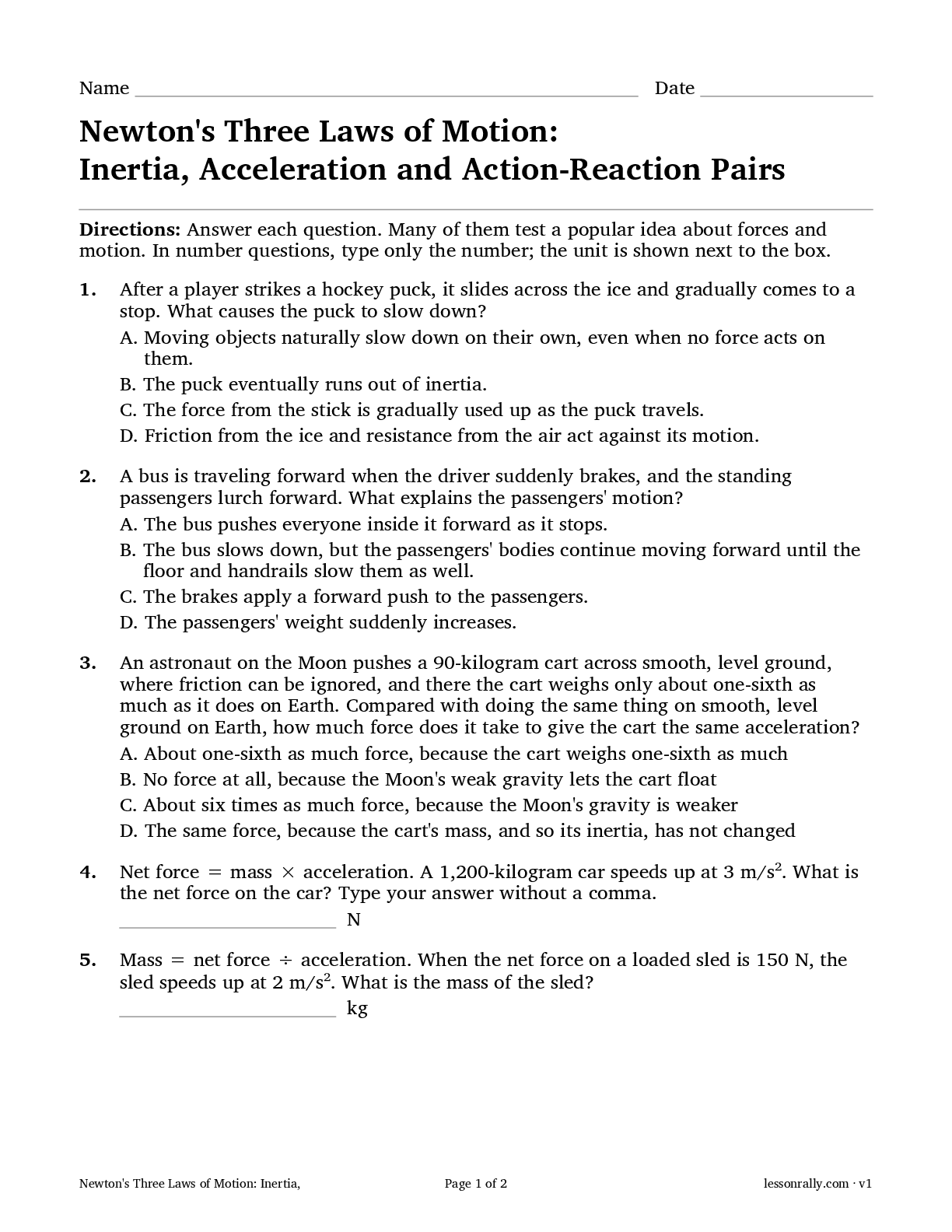
Answer each question. Many of them test a popular idea about forces and motion. In number questions, type only the number; the unit is shown next to the box.
Question 1
After a player strikes a hockey puck, it slides across the ice and gradually comes to a stop. What causes the puck to slow down?
Choose one answer.
The force from the stick is gradually used up as the puck travels.
Moving objects naturally slow down on their own, even when no force acts on them.
Friction from the ice and resistance from the air act against its motion.
The puck eventually runs out of inertia.
Question 2
A bus is traveling forward when the driver suddenly brakes, and the standing passengers lurch forward. What explains the passengers' motion?
Choose one answer.
The brakes apply a forward push to the passengers.
The bus slows down, but the passengers' bodies continue moving forward until the floor and handrails slow them as well.
The bus pushes everyone inside it forward as it stops.
The passengers' weight suddenly increases.
Question 3
An astronaut on the Moon pushes a 90-kilogram cart across smooth, level ground, where friction can be ignored, and there the cart weighs only about one-sixth as much as it does on Earth. Compared with doing the same thing on smooth, level ground on Earth, how much force does it take to give the cart the same acceleration?
Choose one answer.
No force at all, because the Moon's weak gravity lets the cart float
The same force, because the cart's mass, and so its inertia, has not changed
About one-sixth as much force, because the cart weighs one-sixth as much
About six times as much force, because the Moon's gravity is weaker
Question 4
Net force = mass × acceleration. A 1,200-kilogram car speeds up at 3 m/s². What is the net force on the car? Type your answer without a comma.
Enter a number.
N
Question 5
Mass = net force ÷ acceleration. When the net force on a loaded sled is 150 N, the sled speeds up at 2 m/s². What is the mass of the sled?
Enter a number.
kg
Question 6
Two solid steel balls, one with a mass of 1 kilogram and one with a mass of 5 kilograms, are dropped at the same moment from the same height, and air resistance can be ignored. Which statement is true?
Choose one answer.
The 5-kilogram ball lands first, because it has more inertia.
They land at the same time, because gravity pulls 5 times harder on the bigger ball, but that ball also has 5 times the mass to speed up.
The 5-kilogram ball lands first, because heavier objects fall faster.
The 1-kilogram ball lands first, because it is easier to move.
Question 7
A bug strikes the windshield of a moving car and splatters. Compare the force the bug exerts on the windshield with the force the windshield exerts on the bug.
Choose one answer.
The windshield pushes much harder, because the car is much bigger.
There is no force on the windshield, because the car does not seem to slow down.
The windshield's force comes first, and the bug's force comes a moment later.
The forces are equal in size and opposite in direction, but the bug's motion changes far more because its mass is so small.
Question 8
Lena says: "When a horse pulls a cart forward, the cart pulls back on the horse with an equal force. Those forces cancel, so the horse and cart can never get moving." What is wrong with her reasoning?
Choose one answer.
The two forces act on different objects, so they cannot cancel; the cart speeds up if the horse's pull on it is greater than the friction holding it back.
Nothing is wrong; a horse and cart can move only if something else pushes them.
The forces cancel only while the cart is standing still.
The cart actually pulls back with a smaller force than the horse pulls forward.
Question 9
A rocket traveling far out in space, where there is no air, fires its engine and speeds up. What actually pushes the rocket forward?
Choose one answer.
The engine pushes hot gas out the back, and the gas pushes the rocket forward with an equal force.
The empty space around the rocket pulls it forward.
Nothing; a rocket cannot really speed up where there is no air to push against.
The flame pushes against the air behind the rocket.
Question 10
Two ice skaters stand face to face on smooth ice, where friction can be ignored, and push off each other. Skater A has a mass of 40 kg, skater B has a mass of 80 kg, and while they push, skater A pushes on skater B with a force of 120 N. Acceleration = net force ÷ mass. What is skater A's acceleration while they push?