

DNA and Protein Synthesis
DNA stores instructions in the order of its bases, which pair A with T and C with G. Students explain replication, transcription and translation, and how mutations can change a protein.
Topics are chosen by LessonRally.
Filter by grade
- ScienceFeatured
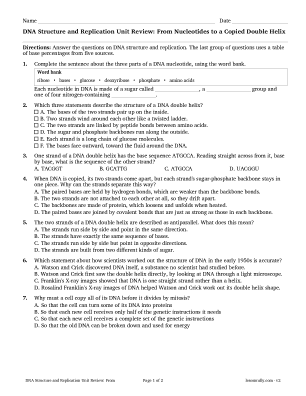
DNA Structure and Replication Unit Review: From Nucleotides to a Copied Double Helix (opens in a new tab)
- Grades 9–10
- 14 questions
- Estimated reading level 7.8
Common Core RST.9-10.7
Made by Leah Rosen · LessonRally (AI-assisted)
- ScienceFeatured
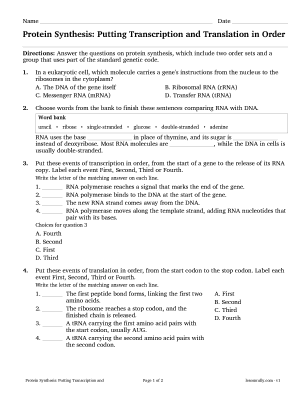
Protein Synthesis: Putting Transcription and Translation in Order (opens in a new tab)
- Grades 9–10
- 10 questions
- Estimated reading level 8.1
Made by Leah Rosen · LessonRally (AI-assisted)
- ScienceFeatured
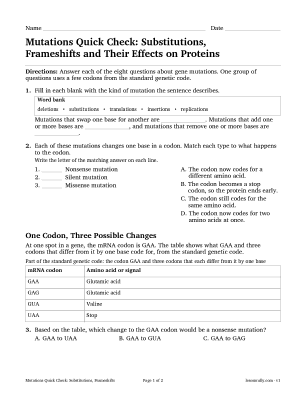
Mutations Quick Check: Substitutions, Frameshifts and Their Effects on Proteins (opens in a new tab)
- Grades 9–10
- 8 questions
- Estimated reading level 7.8
Made by Leah Rosen · LessonRally (AI-assisted)
About teaching DNA and Protein Synthesis
- What students practice
- Pairing ATGC with TACG, transcribing the template strand 3'-TAC-5' into the mRNA codon 5'-AUG-3' with U in place of T, reading mRNA three bases at a time with a codon chart, and showing why deleting one base in a coding sequence shifts every codon after it.
- Common mistakes
- Students often write T in mRNA; have them use U wherever A appears in the template. Many think every mutation is harmful, but some change no amino acid at all. Others think a skin cell mutation can be passed to children, but only changes in eggs, sperm or the cells that make them can.
- Ways to use these activities
- Use one of these activities after students model replication by unzipping a paper DNA ladder and pairing new bases on each half. In pairs, one student writes a short template strand, labeled 3' to 5', and the other transcribes and translates it with a codon chart, then they swap roles.