Question 1
In a eukaryotic cell, which molecule carries a gene's instructions from the nucleus to the ribosomes in the cytoplasm?
Choose one answer.
- Transfer RNA (tRNA)
- Ribosomal RNA (rRNA)
- Messenger RNA (mRNA)
- The DNA of the gene itself


Teachers who sign in can assign LessonRally activities to their Google Classroom classes: students open them in Classroom and answer online, and their grades go to the teacher's Classroom gradebook. Practice lets you try it first, the way students see it.
Free for teachers. Sign in to assign activities to your Google Classroom classes.
 (opens in a new tab)
2 pages · Student copy, no answers
Print worksheet (opens in a new tab)Answer keyPremiumStudents review protein synthesis: what mRNA carries, how RNA differs from DNA, the steps of transcription and of translation in order, codons and anticodons, genes whose RNA is never translated, and a short excerpt of the standard genetic code (codon table) used to read mRNA.
Learning goal: Put the steps of transcription and translation in order and use base pairing and the genetic code to predict the mRNA and amino acids made from a gene.
The estimate is halfway between the two middle scores of four readability formulas. Their scores run from 7.2 to 9.9.
Adapted from common readability formulas (Flesch-Kincaid, Gunning Fog, Coleman-Liau and ARI, plus SMOG for long texts), which look at sentence length and word length. Answer choices count toward word length only. Grades below the estimate will likely find the text harder, grades above it easier. It does not measure ideas, background knowledge or images.
Topic: DNA and Protein Synthesis Chosen by LessonRally
Question types: multiple choice, fill in the blank, matching.
The questions as students see them, without the answers.
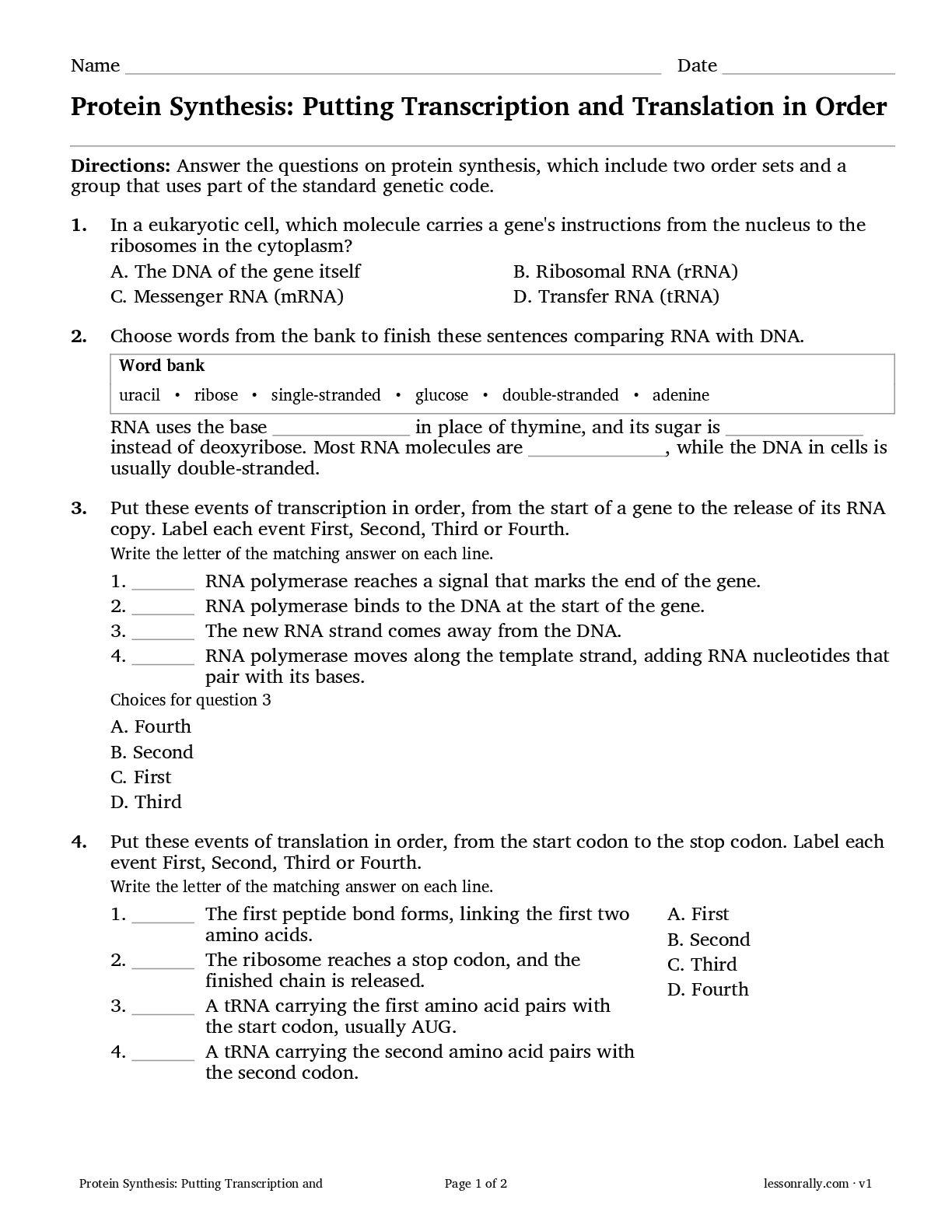
Answer the questions on protein synthesis, which include two order sets and a group that uses part of the standard genetic code.
In a eukaryotic cell, which molecule carries a gene's instructions from the nucleus to the ribosomes in the cytoplasm?
Choose one answer.
Choose words from the bank to finish these sentences comparing RNA with DNA.
Fill in each blank.
RNA uses the base blank 1 in place of thymine, and its sugar is blank 2 instead of deoxyribose. Most RNA molecules are blank 3, while the DNA in cells is usually double-stranded.
Word bank
Put these events of transcription in order, from the start of a gene to the release of its RNA copy. Label each event First, Second, Third or Fourth.
Match each item to an option.
Items
Options
Put these events of translation in order, from the start codon to the stop codon. Label each event First, Second, Third or Fourth.
Match each item to an option.
Items
Options
An mRNA has 30 bases from the first base of its start codon through the last base of its stop codon. How many amino acids will the chain contain when the ribosome releases it?
Choose one answer.
An mRNA codon reads UGG. Which tRNA anticodon would pair with it, matching each base to its partner in order?
Choose one answer.
Some genes are transcribed into tRNA or rRNA molecules, which do their jobs without ever being translated. What does this show?
Choose one answer.
The table shows five codons from the standard genetic code, the codon table that most living things use for most of their genes.
| mRNA codon | Amino acid or signal |
|---|---|
| AUG | Methionine (also the usual start codon) |
| UUU | Phenylalanine |
| GGC | Glycine |
| GGA | Glycine |
| UAA | Stop |
Using the table, which amino acids does the mRNA sequence AUG UUU GGC UAA code for, in order?
Choose one answer.
In the table, GGC and GGA both code for glycine. What does this tell you about the genetic code?
Choose one answer.
At one spot, a DNA template strand has the bases TAC. Matching each base to its partner in order, which mRNA codon is copied from it, and what does that codon code for?
Choose one answer.
No reviews yet.
Reviews come from teachers who assigned this activity to a class.
Have a topic of your own? Make a printable worksheet and online quiz, free.
Create an activityMade by Leah Rosen · LessonRally (AI-assisted)
Common Core RST.9-10.7
Made by Leah Rosen · LessonRally (AI-assisted)
Made by Leah Rosen · LessonRally (AI-assisted)
Made by Leah Rosen · LessonRally (AI-assisted)