Teachers who sign in can assign LessonRally activities to their Google Classroom classes: students open them in Classroom and answer online, and their grades go to the teacher's Classroom gradebook. Practice lets you try it first, the way students see it.
Students answer eight questions on gene mutations: substitutions, insertions and deletions, silent, missense and nonsense mutations, codon changes read from part of the standard genetic code, frameshifts, the range of effects mutations have, how mutations arise by chance, and which mutations can be inherited.
Learning goal: Classify gene mutations by type and by effect on the protein, and explain how mutations arise and which ones can be passed to offspring.
Estimated reading level7.8
Grade 5Hard
Grade 6Stretch
Grade 7On level
Grade 8Easier
Grade 9Easy
About this estimate
The estimate is halfway between the two middle scores of four readability formulas. Their scores run from 6.3 to 10.0.
Flesch-Kincaid Grade Middle scoreSentence length and syllables per word7.0
Gunning FogSentence length and words of three or more syllables10.0
Coleman-Liau Middle scoreLetters per word and sentences per 100 words8.6
Automated Readability IndexCharacters per word and words per sentence6.3
Grade 181216
Flesch Reading Ease
67.5 on a 0 to 100 scale where higher is easier: standard. Not part of the estimate.
Text measured
595 words, 20 sentences
Adapted from common readability formulas (Flesch-Kincaid, Gunning Fog, Coleman-Liau and ARI, plus SMOG for long texts), which look at sentence length and word length. Answer choices count toward word length only. Grades below the estimate will likely find the text harder, grades above it easier. It does not measure ideas, background knowledge or images.
Question types: fill in the blank, matching, multiple choice.
Student preview
The questions as students see them, without the answers.
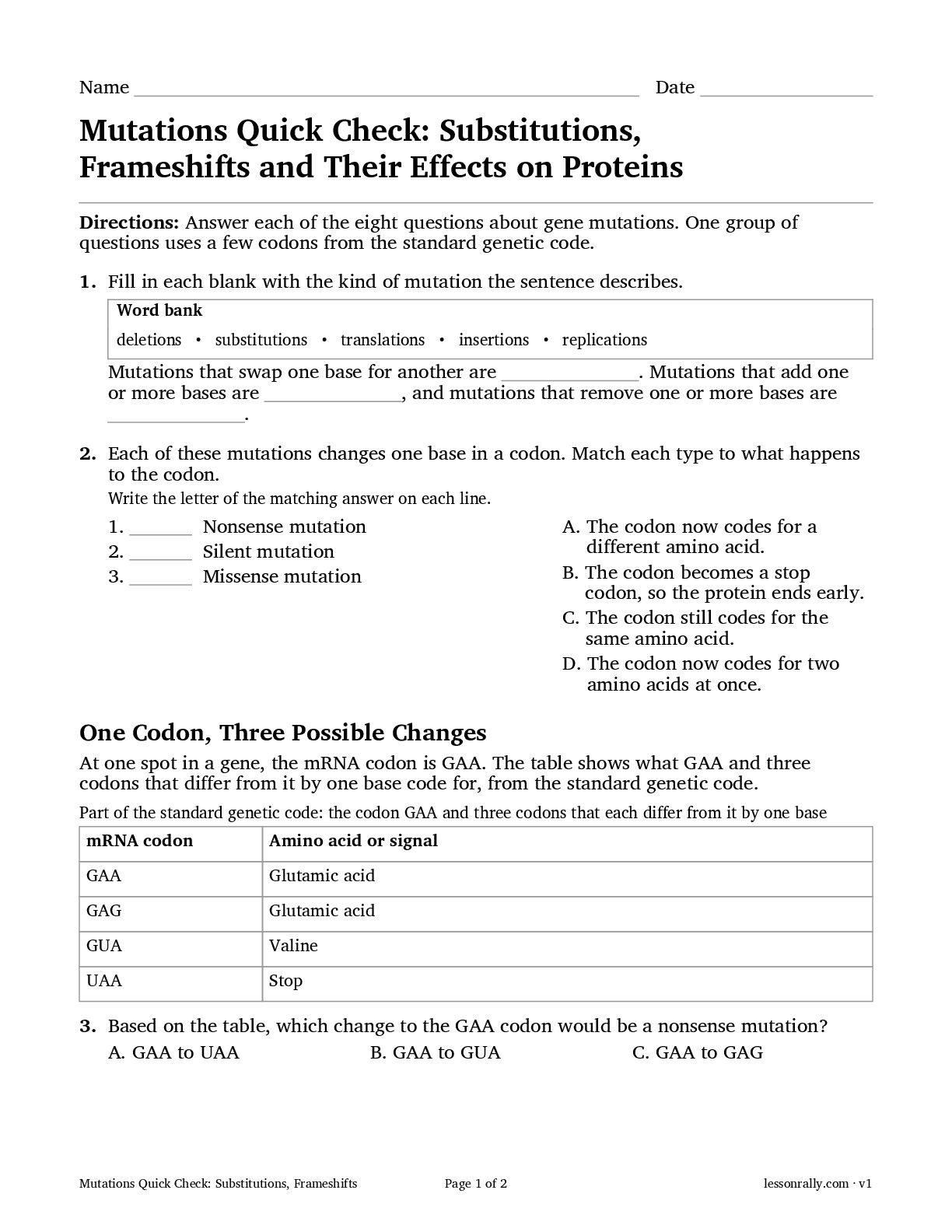
Answer each of the eight questions about gene mutations. One group of questions uses a few codons from the standard genetic code.
Question 1
Fill in each blank with the kind of mutation the sentence describes.
Fill in each blank.
Mutations that swap one base for another are blank 1. Mutations that add one or more bases are blank 2, and mutations that remove one or more bases are blank 3.
Word bank
substitutions
translations
replications
insertions
deletions
Question 2
Each of these mutations changes one base in a codon. Match each type to what happens to the codon.
Match each item to an option.
Items
Nonsense mutation
Silent mutation
Missense mutation
Options
The codon now codes for two amino acids at once.
The codon now codes for a different amino acid.
The codon becomes a stop codon, so the protein ends early.
The codon still codes for the same amino acid.
One Codon, Three Possible Changes
At one spot in a gene, the mRNA codon is GAA. The table shows what GAA and three codons that differ from it by one base code for, from the standard genetic code.
Part of the standard genetic code: the codon GAA and three codons that each differ from it by one base
mRNA codon
Amino acid or signal
GAA
Glutamic acid
GAG
Glutamic acid
GUA
Valine
UAA
Stop
Question 3
Based on the table, which change to the GAA codon would be a nonsense mutation?
Choose one answer.
GAA to GUA
GAA to UAA
GAA to GAG
Question 4
A mutation changes this codon from GAA to GUA in the gene for an enzyme. Which statement about the effect fits what is known about mutations?
Choose one answer.
It changes every amino acid that comes after this codon, all the way to the end of the enzyme.
Changing a single base can never affect how well an enzyme works.
Any change to one amino acid always stops an enzyme from working.
It changes one amino acid, which may or may not affect how well the enzyme works.
Question 5
A single base is deleted from a codon near the beginning of a gene. Why does this usually change the protein much more than a single-base substitution does?
Choose one answer.
Deletions always switch the whole gene off, no matter where in the gene they happen to occur.
It removes exactly one amino acid and leaves the rest of the protein unchanged.
The ribosome skips the entire gene whenever a single base is missing from it.
It shifts the reading frame, so the bases after it are grouped into different codons.
Question 6
Scientists who study many mutations find that their effects vary widely. Which description of that range is accurate?
Choose one answer.
Most mutations are helpful, which is how organisms get the traits they need.
Many mutations have little or no effect, some are harmful and a few are helpful.
Mutations have an effect only when an organism's environment changes.
Every mutation harms the organism that carries it in some way.
Question 7
Bacteria in a population are treated with an antibiotic, and a few survive because they carry a mutation that protects them. Which statement about how that mutation arose fits what is known about mutations?
Choose one answer.
The antibiotic caused exactly the mutation each bacterium needed to survive.
The bacteria changed their own DNA on purpose once they sensed the antibiotic.
Each survivor gained the mutation because it needed the change to live through the treatment.
It arose by chance as a random change in DNA, most likely before the treatment began.
Question 8
A mutation happens in one skin cell on a person's arm. Could the person pass this mutation to their children?
Choose one answer.
No, because a mutation in a skin cell disappears as soon as that cell divides.
No, because only mutations in eggs, sperm or the cells that make them are inherited.
Yes, because every mutation anywhere in the body is soon copied into the person's eggs or sperm.
Yes, but only if the mutation turns out to be harmful rather than helpful.