

Cells
Cells are the basic units of life. Students name organelles and their jobs, compare plant and animal cells, tell prokaryotic from eukaryotic cells, and trace how cells form tissues, organs and organ systems in many-celled organisms.
Topics are chosen by LessonRally.
Filter by grade
- ScienceFeatured
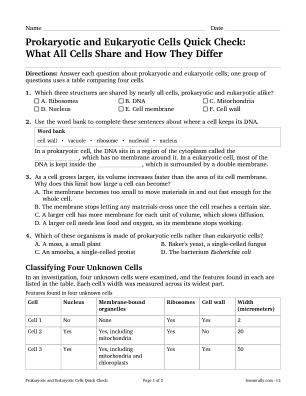
Prokaryotic and Eukaryotic Cells Quick Check: What All Cells Share and How They Differ (opens in a new tab)
- Grades 9–10
- 8 questions
- Estimated reading level 8.1
Made by Leah Rosen · LessonRally (AI-assisted)
- ScienceFeatured
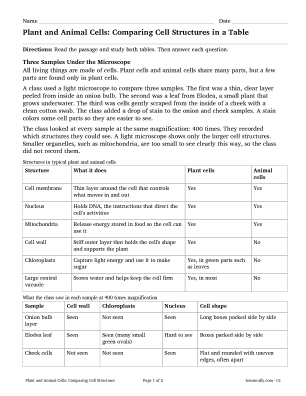
Plant and Animal Cells: Comparing Cell Structures in a Table (opens in a new tab)
- Grade 7
- 8 questions
- Estimated reading level 7.0
Common Core RST.6-8.7
Made by Myra Jefferson · LessonRally (AI-assisted)
- ScienceFeatured
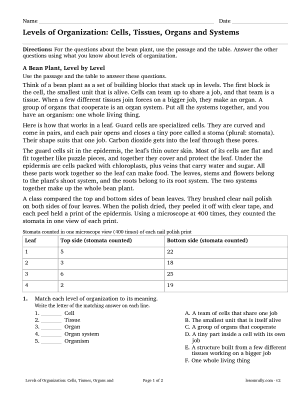
Levels of Organization: Cells, Tissues, Organs and Systems (opens in a new tab)
- Grade 7
- 10 questions
- Estimated reading level 7.5
Common Core RST.6-8.4
Made by Myra Jefferson · LessonRally (AI-assisted)
- ScienceFeatured
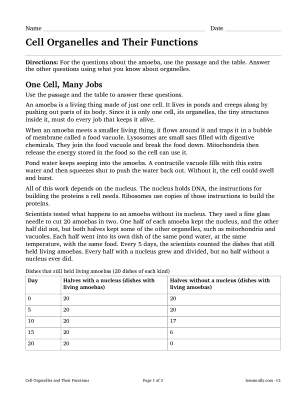
Cell Organelles and Their Functions (opens in a new tab)
- Grade 7
- 10 questions
- Estimated reading level 9.4
Made by Myra Jefferson · LessonRally (AI-assisted)
About teaching Cells
- What students practice
- Matching cell structures to jobs, such as ribosomes building proteins and the membrane controlling what enters and leaves, noting that plant cells have cell walls and many have chloroplasts, telling prokaryotic cells, which lack a nucleus, from eukaryotic cells, and starting on low power when focusing a microscope.
- Common mistakes
- Students often think plant cells have chloroplasts instead of mitochondria, but plant cells have mitochondria too. Many think the cell wall replaces the membrane, but it surrounds it. Flat drawings suggest flat cells, so have students model one in a sealed bag of gelatin.
- Ways to use these activities
- Use one of these activities before a microscope lab comparing onion skin with an Elodea leaf. In pairs, one student names an organelle from a class list and the other gives its job and whether plant cells, animal cells or both have it. For an exit ticket, ask why most root cells lack chloroplasts.