Question 1
Match each organelle to its job.
Match each item to an option.
Items
- Nucleus
- Ribosomes
- Mitochondria
- Lysosomes
- Contractile vacuole
Options


Teachers who sign in can assign LessonRally activities to their Google Classroom classes: students open them in Classroom and answer online, and their grades go to the teacher's Classroom gradebook. Practice lets you try it first, the way students see it.
Free for teachers. Sign in to assign activities to your Google Classroom classes.
 (opens in a new tab)
3 pages · Student copy, no answers
Print worksheet (opens in a new tab)Answer keyPremiumStudents match organelles such as the nucleus, ribosomes, mitochondria, lysosomes and the contractile vacuole to their functions, then apply each organelle's job to new cells. A passage about an amoeba and an experiment on amoeba halves with and without a nucleus show the organelles at work.
Learning goal: Describe the function of key cell organelles and use those functions to explain how cells stay alive, grow and do specialized jobs.
The estimate is the middle score of five readability formulas. Their scores run from 7.0 to 10.1.
Adapted from common readability formulas (Flesch-Kincaid, Gunning Fog, Coleman-Liau and ARI, plus SMOG for long texts), which look at sentence length and word length. Answer choices count toward word length only. Grades below the estimate will likely find the text harder, grades above it easier. It does not measure ideas, background knowledge or images.
Topic: Cells Chosen by LessonRally
Question types: matching, multiple choice, number answer.
The questions as students see them, without the answers.
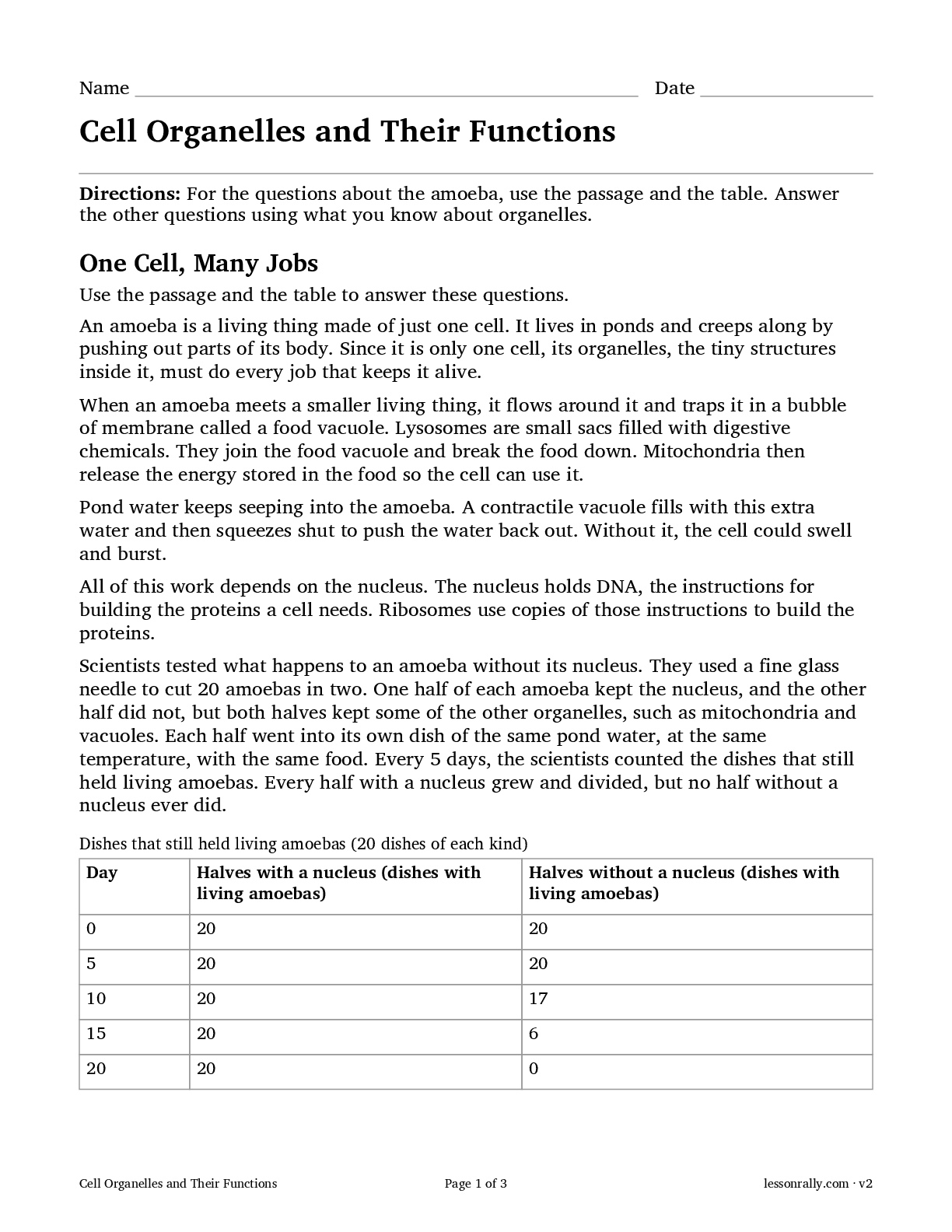
For the questions about the amoeba, use the passage and the table. Answer the other questions using what you know about organelles.
Use the passage and the table to answer these questions.
An amoeba is a living thing made of just one cell. It lives in ponds and creeps along by pushing out parts of its body. Since it is only one cell, its organelles, the tiny structures inside it, must do every job that keeps it alive.
When an amoeba meets a smaller living thing, it flows around it and traps it in a bubble of membrane called a food vacuole. Lysosomes are small sacs filled with digestive chemicals. They join the food vacuole and break the food down. Mitochondria then release the energy stored in the food so the cell can use it.
Pond water keeps seeping into the amoeba. A contractile vacuole fills with this extra water and then squeezes shut to push the water back out. Without it, the cell could swell and burst.
All of this work depends on the nucleus. The nucleus holds DNA, the instructions for building the proteins a cell needs. Ribosomes use copies of those instructions to build the proteins.
Scientists tested what happens to an amoeba without its nucleus. They used a fine glass needle to cut 20 amoebas in two. One half of each amoeba kept the nucleus, and the other half did not, but both halves kept some of the other organelles, such as mitochondria and vacuoles. Each half went into its own dish of the same pond water, at the same temperature, with the same food. Every 5 days, the scientists counted the dishes that still held living amoebas. Every half with a nucleus grew and divided, but no half without a nucleus ever did.
| Day | Halves with a nucleus (dishes with living amoebas) | Halves without a nucleus (dishes with living amoebas) |
|---|---|---|
| 0 | 20 | 20 |
| 5 | 20 | 20 |
| 10 | 20 | 17 |
| 15 | 20 | 6 |
| 20 | 20 | 0 |
Match each organelle to its job.
Match each item to an option.
Items
Options
Based on how the passage describes it, why is the contractile vacuole called contractile?
Choose one answer.
In the experiment, what did the scientists change on purpose between the two kinds of halves?
Choose one answer.
How many halves without a nucleus died between day 10 and day 15?
Enter a number.
halves
Which claim does the evidence from this experiment support?
Choose one answer.
The halves without a nucleus still had mitochondria and vacuoles. Which choice uses what the passage says about the nucleus to explain why they did not survive?
Choose one answer.
Suppose an amoeba is moved into water with salt dissolved in it, so much less water seeps into the cell. What would its contractile vacuole most likely do?
Choose one answer.
Heart muscle cells work without stopping, day and night, and use a lot of energy. Which organelle would you expect to find in large numbers in these cells?
Choose one answer.
A white blood cell traps a bacterium inside a bubble of membrane. Which organelles would join that bubble and break the bacterium down?
Choose one answer.
Some cells in the pancreas build large amounts of protein that help digest food in the intestine. Which organelle would these cells need in large numbers?
Choose one answer.
No reviews yet.
Reviews come from teachers who assigned this activity to a class.
Have a topic of your own? Make a printable worksheet and online quiz, free.
Create an activityCommon Core RST.6-8.7
Made by Theo Nakamura · LessonRally (AI-assisted)
Common Core RST.6-8.4
Made by Myra Jefferson · LessonRally (AI-assisted)
Made by Theo Nakamura · LessonRally (AI-assisted)
Common Core RST.6-8.4
Made by Myra Jefferson · LessonRally (AI-assisted)