Question 1
According to the table of cell structures, which three structures are found in plant cells but not in animal cells?
Choose 3 answers.
- Cell membrane
- Nucleus
- Chloroplasts
- Mitochondria
- Cell wall
- Large central vacuole


Teachers who sign in can assign LessonRally activities to their Google Classroom classes: students open them in Classroom and answer online, and their grades go to the teacher's Classroom gradebook. Practice lets you try it first, the way students see it.
Free for teachers. Sign in to assign activities to your Google Classroom classes.
 (opens in a new tab)
2 pages · Student copy, no answers
Print worksheet (opens in a new tab)Answer keyPremiumStudents compare plant and animal cells using a table of cell structures, including organelles such as the nucleus, mitochondria and chloroplasts, and a table of microscope observations of onion, Elodea and cheek cells. They decide which structures each kind of cell has and what each organelle does.
Learning goal: Use a table and microscope observations to compare plant and animal cells and explain what their main structures do.
The estimate is halfway between the two middle scores of four readability formulas. Their scores run from 5.1 to 8.3.
Adapted from common readability formulas (Flesch-Kincaid, Gunning Fog, Coleman-Liau and ARI, plus SMOG for long texts), which look at sentence length and word length. Answer choices count toward word length only. Grades below the estimate will likely find the text harder, grades above it easier. It does not measure ideas, background knowledge or images.
Integrate quantitative or technical information expressed in words in a text with a version of that information expressed visually (e.g., in a flowchart, diagram, model, graph, or table).
Matched independently by two AI models from this activity's questions.
© Copyright 2010. National Governors Association Center for Best Practices and Council of Chief State School Officers. All rights reserved.
Topic: Cells Chosen by LessonRally
Question types: select all that apply, multiple choice, matching.
The questions as students see them, without the answers.
Read the passage and study both tables. Then answer each question.
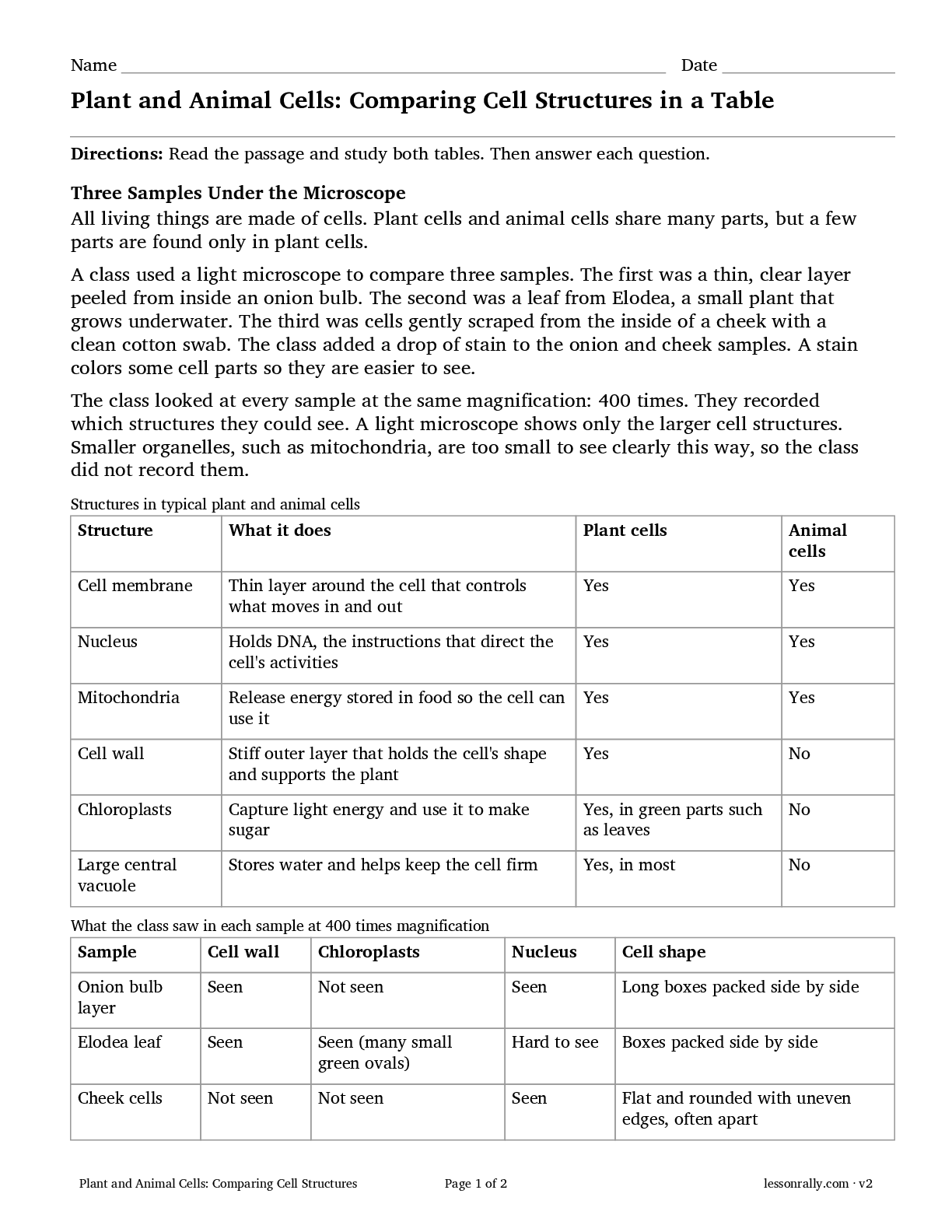
All living things are made of cells. Plant cells and animal cells share many parts, but a few parts are found only in plant cells.
A class used a light microscope to compare three samples. The first was a thin, clear layer peeled from inside an onion bulb. The second was a leaf from Elodea, a small plant that grows underwater. The third was cells gently scraped from the inside of a cheek with a clean cotton swab. The class added a drop of stain to the onion and cheek samples. A stain colors some cell parts so they are easier to see.
The class looked at every sample at the same magnification: 400 times. They recorded which structures they could see. A light microscope shows only the larger cell structures. Smaller organelles, such as mitochondria, are too small to see clearly this way, so the class did not record them.
| Structure | What it does | Plant cells | Animal cells |
|---|---|---|---|
| Cell membrane | Thin layer around the cell that controls what moves in and out | Yes | Yes |
| Nucleus | Holds DNA, the instructions that direct the cell's activities | Yes | Yes |
| Mitochondria | Release energy stored in food so the cell can use it | Yes | Yes |
| Cell wall | Stiff outer layer that holds the cell's shape and supports the plant | Yes | No |
| Chloroplasts | Capture light energy and use it to make sugar | Yes, in green parts such as leaves | No |
| Large central vacuole | Stores water and helps keep the cell firm | Yes, in most | No |
| Sample | Cell wall | Chloroplasts | Nucleus | Cell shape |
|---|---|---|---|---|
| Onion bulb layer | Seen | Not seen | Seen | Long boxes packed side by side |
| Elodea leaf | Seen | Seen (many small green ovals) | Hard to see | Boxes packed side by side |
| Cheek cells | Not seen | Not seen | Seen | Flat and rounded with uneven edges, often apart |
According to the table of cell structures, which three structures are found in plant cells but not in animal cells?
Choose 3 answers.
The class did not record mitochondria. Using the passage and the table of cell structures, which statement about the three samples is correct?
Choose one answer.
Using the passage and both tables, which claim is supported?
Choose one answer.
Suppose the class had viewed the onion at 40 times magnification and the Elodea at 400 times. Why would that make the chloroplast comparison unfair?
Choose one answer.
Which observation in the class's table tells you that a sample is made of animal cells, not plant cells?
Choose one answer.
A plant goes a week without water, and its cells lose water from their large central vacuoles. Based on the table of cell structures, what most likely happens?
Choose one answer.
Match each cell structure to the job it does.
Match each item to an option.
Items
Options
A student views a new sample at 400 times. The cells have a cell wall and a nucleus but no chloroplasts. Which sample could these cells come from?
Choose one answer.
No reviews yet.
Reviews come from teachers who assigned this activity to a class.
Have a topic of your own? Make a printable worksheet and online quiz, free.
Create an activityCommon Core RST.6-8.7
Made by Theo Nakamura · LessonRally (AI-assisted)
Common Core RST.6-8.4
Made by Myra Jefferson · LessonRally (AI-assisted)
Made by Theo Nakamura · LessonRally (AI-assisted)
Common Core RST.6-8.4
Made by Myra Jefferson · LessonRally (AI-assisted)