Question 1
Match each level of organization to its meaning.
Match each item to an option.
Items
- Cell
- Tissue
- Organ
- Organ system
- Organism
Options


Teachers who sign in can assign LessonRally activities to their Google Classroom classes: students open them in Classroom and answer online, and their grades go to the teacher's Classroom gradebook. Practice lets you try it first, the way students see it.
Free for teachers. Sign in to assign activities to your Google Classroom classes.
 (opens in a new tab)
2 pages · Student copy, no answers
Print worksheet (opens in a new tab)Answer keyPremiumStudents match each level of organization (cell, tissue, organ, organ system and organism) to its meaning, then apply the terms to a bean leaf, the heart and circulatory system, and the cells of large and small animals. A short passage and a count of leaf stomata let students use each level in context.
Learning goal: Describe how cells form tissues, tissues form organs, and organs form organ systems, and use these terms to classify parts of plants and animals.
The estimate is the middle score of five readability formulas. Their scores run from 5.2 to 8.4.
Adapted from common readability formulas (Flesch-Kincaid, Gunning Fog, Coleman-Liau and ARI, plus SMOG for long texts), which look at sentence length and word length. Answer choices count toward word length only. Grades below the estimate will likely find the text harder, grades above it easier. It does not measure ideas, background knowledge or images.
Determine the meaning of symbols, key terms, and other domain-specific words and phrases as they are used in a specific scientific or technical context relevant to grades 6-8 texts and topics.
Integrate quantitative or technical information expressed in words in a text with a version of that information expressed visually (e.g., in a flowchart, diagram, model, graph, or table).
Chosen by LessonRally.
© Copyright 2010. National Governors Association Center for Best Practices and Council of Chief State School Officers. All rights reserved.
Topic: Cells Chosen by LessonRally
Question types: matching, multiple choice, number answer.
The questions as students see them, without the answers.
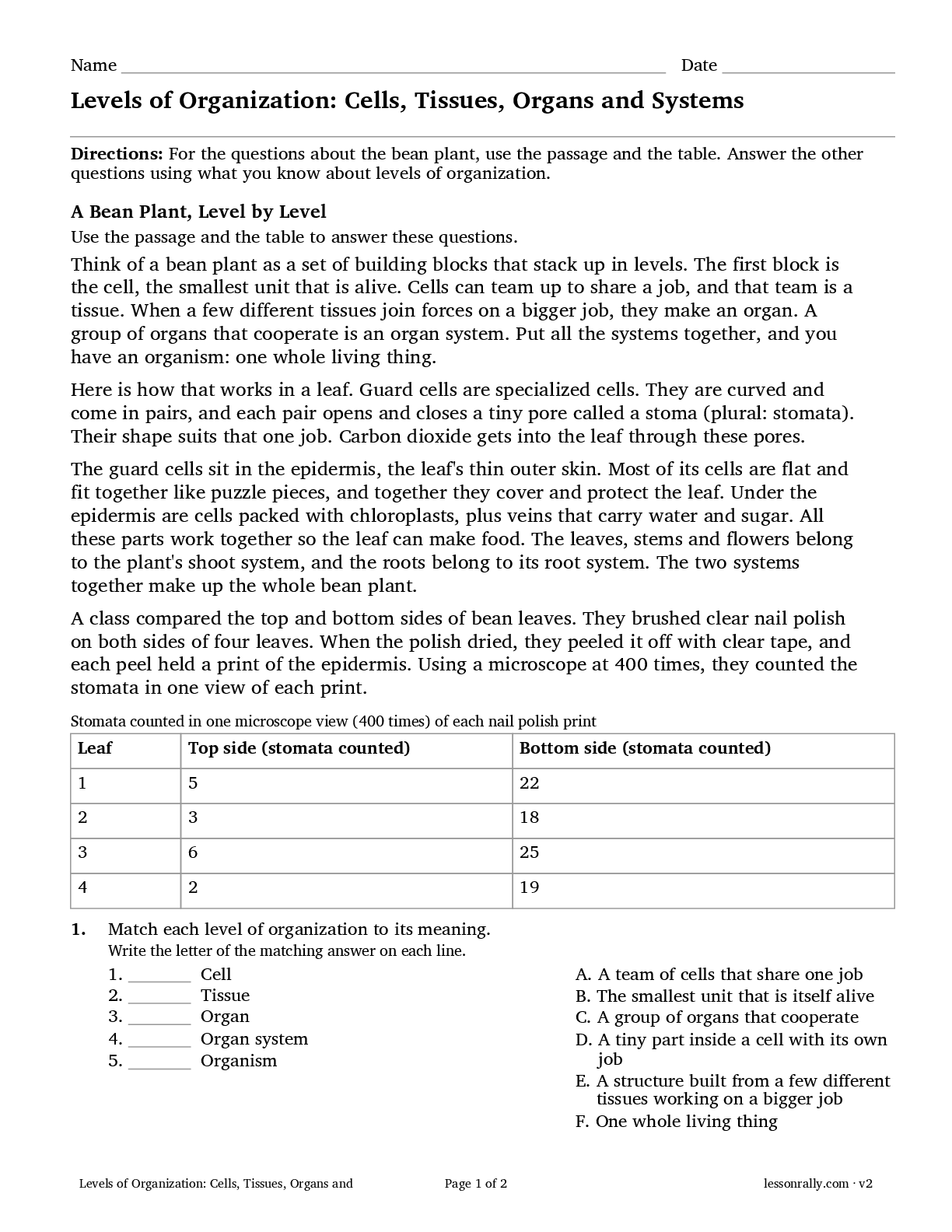
For the questions about the bean plant, use the passage and the table. Answer the other questions using what you know about levels of organization.
Use the passage and the table to answer these questions.
Think of a bean plant as a set of building blocks that stack up in levels. The first block is the cell, the smallest unit that is alive. Cells can team up to share a job, and that team is a tissue. When a few different tissues join forces on a bigger job, they make an organ. A group of organs that cooperate is an organ system. Put all the systems together, and you have an organism: one whole living thing.
Here is how that works in a leaf. Guard cells are specialized cells. They are curved and come in pairs, and each pair opens and closes a tiny pore called a stoma (plural: stomata). Their shape suits that one job. Carbon dioxide gets into the leaf through these pores.
The guard cells sit in the epidermis, the leaf's thin outer skin. Most of its cells are flat and fit together like puzzle pieces, and together they cover and protect the leaf. Under the epidermis are cells packed with chloroplasts, plus veins that carry water and sugar. All these parts work together so the leaf can make food. The leaves, stems and flowers belong to the plant's shoot system, and the roots belong to its root system. The two systems together make up the whole bean plant.
A class compared the top and bottom sides of bean leaves. They brushed clear nail polish on both sides of four leaves. When the polish dried, they peeled it off with clear tape, and each peel held a print of the epidermis. Using a microscope at 400 times, they counted the stomata in one view of each print.
| Leaf | Top side (stomata counted) | Bottom side (stomata counted) |
|---|---|---|
| 1 | 5 | 22 |
| 2 | 3 | 18 |
| 3 | 6 | 25 |
| 4 | 2 | 19 |
Match each level of organization to its meaning.
Match each item to an option.
Items
Options
As the passage uses the word, what does it mean for a cell to be "specialized"?
Choose one answer.
Which level of organization best describes the epidermis of a bean leaf?
Choose one answer.
Which list goes from the smallest level of organization to the largest?
Choose one answer.
Each leaf gave two prints. What did the class change on purpose between the two prints from the same leaf?
Choose one answer.
What was the mean number of stomata counted on the bottom side of leaves 1 to 4?
Enter a number.
stomata
Which claim does the evidence from the four leaves support?
Choose one answer.
The heart has muscle tissue that squeezes, nerve tissue that carries signals and connective tissue that holds it together. Which level of organization is the heart?
Choose one answer.
Which example describes an organ system?
Choose one answer.
An elephant is much larger than a mouse. Which statement about their cells is most accurate?
Choose one answer.
No reviews yet.
Reviews come from teachers who assigned this activity to a class.
Have a topic of your own? Make a printable worksheet and online quiz, free.
Create an activityCommon Core RST.6-8.7
Made by Theo Nakamura · LessonRally (AI-assisted)
Common Core RST.6-8.4
Made by Myra Jefferson · LessonRally (AI-assisted)
Made by Theo Nakamura · LessonRally (AI-assisted)
Common Core RST.6-8.4
Made by Myra Jefferson · LessonRally (AI-assisted)