Teachers who sign in can assign LessonRally activities to their Google Classroom classes: students open them in Classroom and answer online, and their grades go to the teacher's Classroom gradebook. Practice lets you try it first, the way students see it.
Students review DNA structure and replication: the parts of a nucleotide, the double helix, base pairing (A with T, G with C) and hydrogen bonds, antiparallel strands, how Rosalind Franklin's X-ray images helped Watson and Crick, why cells copy DNA, the enzymes of replication, how a new strand is matched to its template and semiconservative replication, then interpret a table of base percentages.
Learning goal: Describe the structure of DNA, apply the base-pairing rules for double-stranded DNA, and explain how DNA is copied by semiconservative replication.
Estimated reading level7.8
Grade 5Hard
Grade 6Stretch
Grade 7On level
Grade 8Easier
Grade 9Easy
About this estimate
The estimate is halfway between the two middle scores of four readability formulas. Their scores run from 6.6 to 8.6.
Flesch-Kincaid GradeSentence length and syllables per word6.6
Gunning Fog Middle scoreSentence length and words of three or more syllables8.6
Coleman-LiauLetters per word and sentences per 100 words8.6
Automated Readability Index Middle scoreCharacters per word and words per sentence7.0
Grade 181216
Flesch Reading Ease
72.9 on a 0 to 100 scale where higher is easier: fairly easy. Not part of the estimate.
Text measured
845 words, 25 sentences
Adapted from common readability formulas (Flesch-Kincaid, Gunning Fog, Coleman-Liau and ARI, plus SMOG for long texts), which look at sentence length and word length. Answer choices count toward word length only. Grades below the estimate will likely find the text harder, grades above it easier. It does not measure ideas, background knowledge or images.
Common Core
Press Ctrl+C or Command+C to copy.
Closest anchor:CCRA.R.7Integrate and evaluate content presented in diverse media and formats, including visually and quantitatively, as well as in words.Anchor Standards for ReadingShow 1 matched standardHide matched standard
Translate quantitative or technical information expressed in words in a text into visual form (e.g., a table or chart) and translate information expressed visually or mathematically (e.g., in an equation) into words.
Question types: fill in the blank, select all that apply, multiple choice, matching.
Student preview
The questions as students see them, without the answers.
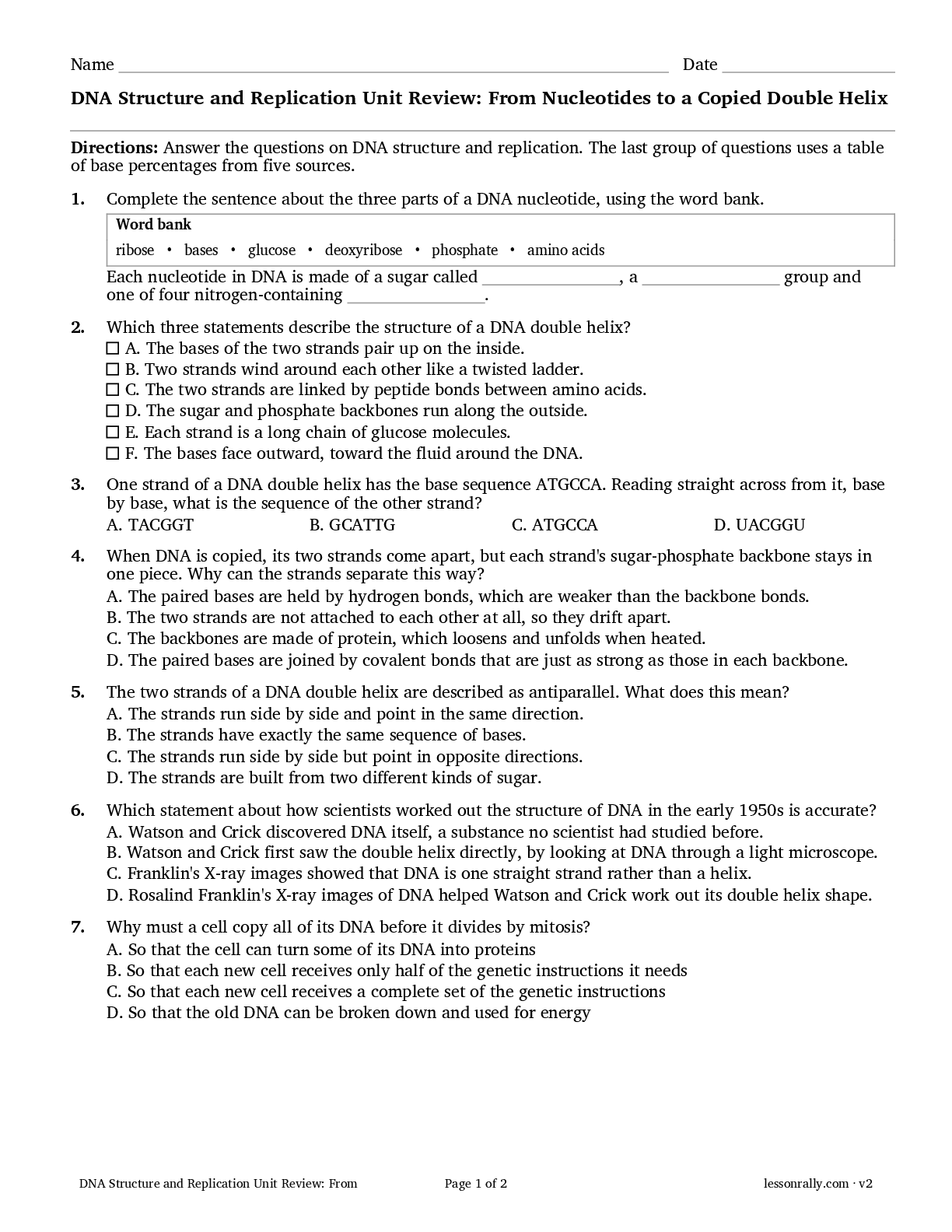
Answer the questions on DNA structure and replication. The last group of questions uses a table of base percentages from five sources.
Question 1
Complete the sentence about the three parts of a DNA nucleotide, using the word bank.
Fill in each blank.
Each nucleotide in DNA is made of a sugar called blank 1, a blank 2 group and one of four nitrogen-containing blank 3.
Word bank
ribose
deoxyribose
bases
glucose
amino acids
phosphate
Question 2
Which three statements describe the structure of a DNA double helix?
Choose 3 answers.
Two strands wind around each other like a twisted ladder.
The two strands are linked by peptide bonds between amino acids.
Each strand is a long chain of glucose molecules.
The bases face outward, toward the fluid around the DNA.
The bases of the two strands pair up on the inside.
The sugar and phosphate backbones run along the outside.
Question 3
One strand of a DNA double helix has the base sequence ATGCCA. Reading straight across from it, base by base, what is the sequence of the other strand?
Choose one answer.
TACGGT
UACGGU
GCATTG
ATGCCA
Question 4
When DNA is copied, its two strands come apart, but each strand's sugar-phosphate backbone stays in one piece. Why can the strands separate this way?
Choose one answer.
The backbones are made of protein, which loosens and unfolds when heated.
The two strands are not attached to each other at all, so they drift apart.
The paired bases are held by hydrogen bonds, which are weaker than the backbone bonds.
The paired bases are joined by covalent bonds that are just as strong as those in each backbone.
Question 5
The two strands of a DNA double helix are described as antiparallel. What does this mean?
Choose one answer.
The strands run side by side but point in opposite directions.
The strands are built from two different kinds of sugar.
The strands run side by side and point in the same direction.
The strands have exactly the same sequence of bases.
Question 6
Which statement about how scientists worked out the structure of DNA in the early 1950s is accurate?
Choose one answer.
Watson and Crick discovered DNA itself, a substance no scientist had studied before.
Watson and Crick first saw the double helix directly, by looking at DNA through a light microscope.
Rosalind Franklin's X-ray images of DNA helped Watson and Crick work out its double helix shape.
Franklin's X-ray images showed that DNA is one straight strand rather than a helix.
Question 7
Why must a cell copy all of its DNA before it divides by mitosis?
Choose one answer.
So that the cell can turn some of its DNA into proteins
So that each new cell receives only half of the genetic instructions it needs
So that the old DNA can be broken down and used for energy
So that each new cell receives a complete set of the genetic instructions
Question 8
Match each enzyme to the job it does during DNA replication.
Match each item to an option.
Items
DNA ligase
Helicase
DNA polymerase
Options
Joins amino acids into a protein chain
Seals the gaps between pieces of new DNA
Unwinds the double helix and separates the two strands
Adds nucleotides one by one to build a new strand
Question 9
As DNA is copied, how does the cell decide which base to place at each spot in a new strand?
Choose one answer.
Each base on the old strand pairs with one matching base in the new strand.
The cell reads the protein made from the gene to choose each base.
Bases are added in random order, and mistakes are sorted out later.
The new strand copies the old strand's sequence exactly, base for base, in order.
Question 10
Bacteria were grown for many generations in a medium containing heavy nitrogen, so both strands of their DNA were heavy. They were then moved to a medium with only ordinary light nitrogen and allowed to copy their DNA once. If DNA replication is semiconservative, what would each new double helix contain?
Choose one answer.
Two heavy strands, or else two light strands
One heavy strand and one light strand
Two light strands only, with the heavy DNA broken down
Strands that are each a mix of heavy and light pieces
Base Percentages in Five Sources
In an investigation, DNA was taken from five sources, and the percent of each of the four bases in each sample was measured. Each value in the table is the mean of 3 samples from that source.
Percent of each base in DNA from five sources (each value is the mean of 3 samples)
Source of DNA
Adenine (%)
Thymine (%)
Guanine (%)
Cytosine (%)
Human liver
30.3
30.1
19.5
20.1
Wheat
27.2
27.4
22.6
22.8
Baker's yeast
31.6
31.8
18.3
18.3
The bacterium E. coli
24.7
24.9
25.3
25.1
Virus Q
24.1
31.0
25.6
19.3
Question 11
Guanine and cytosine together make up about what percent of the bases in the human liver DNA?
Choose one answer.
About 60 percent
About 50 percent
About 20 percent
About 40 percent
Question 12
Which statement about the five sources is supported by these results?
Choose one answer.
Adenine was the most common base in every source.
Every source had the same percent of each base.
Each of the four bases made up 25 percent of every source's DNA.
The percent of each base differed from one source to another.
Question 13
Which source's DNA is most likely single-stranded rather than a double helix?
Choose one answer.
Human liver
The bacterium E. coli
Virus Q
Baker's yeast
Question 14
Suppose a sixth row were added for double-stranded DNA from a fish, showing 28.0 percent adenine. Based on base pairing, about what percent guanine would that row most likely show?