Food Chains: Where a Hawk's Energy Comes From

8 questions · 9 points · Grade 5 · English · Preview the 8 questions

Made by Wes Calloway · LessonRally (AI-assisted)

Digital classroom activity

What is a digital classroom activity?

Teachers who sign in can assign LessonRally activities to their Google Classroom classes: students open them in Classroom and answer online, and their grades go to the teacher's Classroom gradebook. Practice lets you try it first, the way students see it.

Free for teachers. Sign in to assign activities to your Google Classroom classes.

Printable worksheet

Students read about a red-tailed hawk catching a mouse and follow a grassland food chain to explain where the hawk's energy comes from. Questions cover producers and consumers, what the arrows in a food chain mean, how plants make food using energy from sunlight, and what happens to the food chain when the grass dies. Students also decide whether a living thing is a producer or a consumer.

Learning goal: Explain that the energy in a hawk's food started as sunlight captured by plants and then passed along a food chain.

Estimated reading level 5.7

  1. Grade 3Hard
  2. Grade 4Stretch
  3. Grade 5On level
  4. Grade 6Easier
  5. Grade 7Easy
About this estimate

The estimate is the middle score of five readability formulas. Their scores run from 3.1 to 7.9.

  • Flesch-Kincaid GradeSentence length and syllables per word3.3
  • Gunning FogSentence length and words of three or more syllables6.9
  • Coleman-Liau Middle scoreLetters per word and sentences per 100 words5.7
  • Automated Readability IndexCharacters per word and words per sentence3.1
  • SMOGWords of three or more syllables, for texts of 30 sentences or more7.9
Flesch Reading Ease
88.8 on a 0 to 100 scale where higher is easier: easy. Not part of the estimate.
Text measured
540 words, 30 sentences

Adapted from common readability formulas (Flesch-Kincaid, Gunning Fog, Coleman-Liau and ARI, plus SMOG for long texts), which look at sentence length and word length. Answer choices count toward word length only. Grades below the estimate will likely find the text harder, grades above it easier. It does not measure ideas, background knowledge or images.

Topic: Ecosystems and Food Webs Chosen by LessonRally

Question types: multiple choice, fill in the blank.

Student preview

The questions as students see them, without the answers.

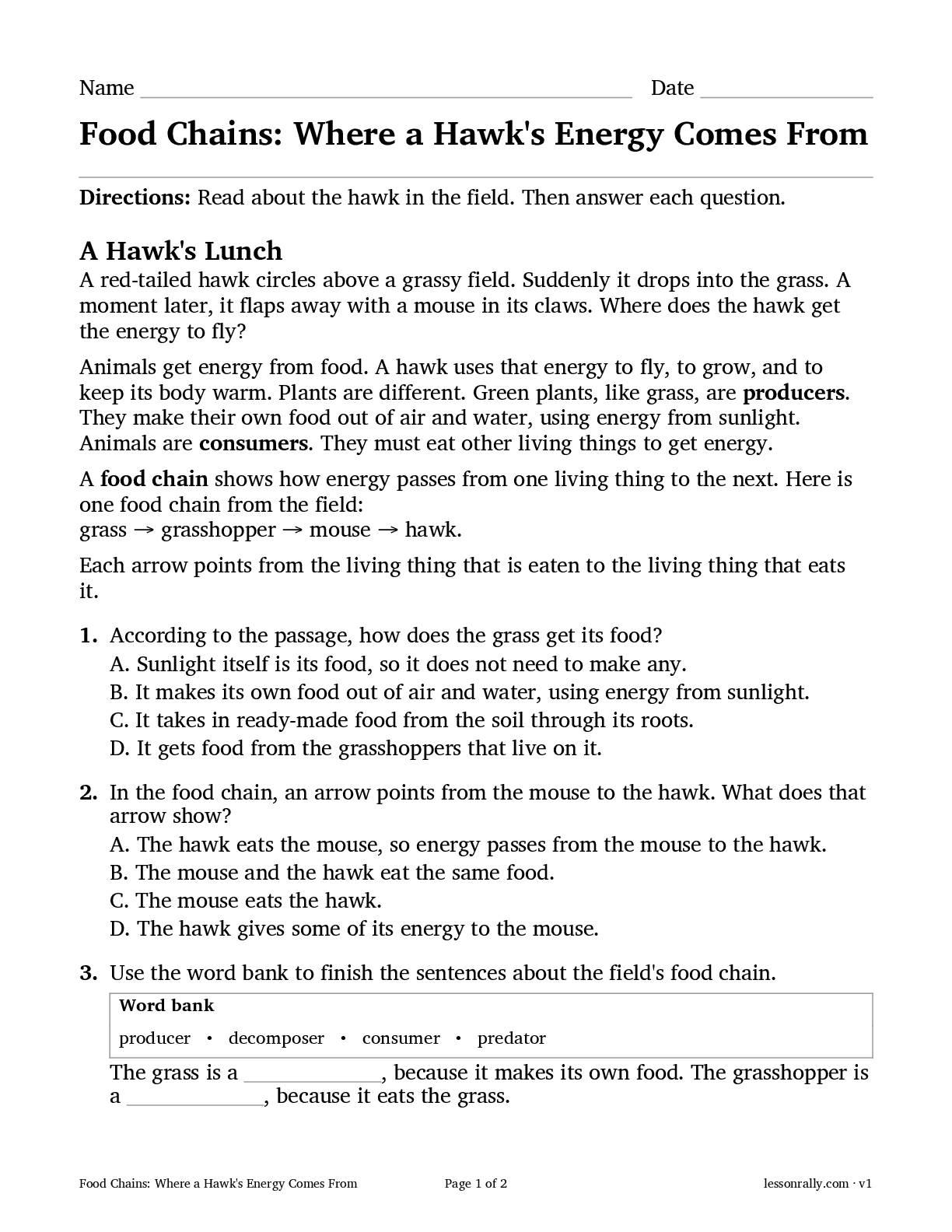
Read about the hawk in the field. Then answer each question.

A Hawk's Lunch

A red-tailed hawk circles above a grassy field. Suddenly it drops into the grass. A moment later, it flaps away with a mouse in its claws. Where does the hawk get the energy to fly?

Animals get energy from food. A hawk uses that energy to fly, to grow, and to keep its body warm. Plants are different. Green plants, like grass, are producers. They make their own food out of air and water, using energy from sunlight. Animals are consumers. They must eat other living things to get energy.

A food chain shows how energy passes from one living thing to the next. Here is one food chain from the field:
grass → grasshopper → mouse → hawk.

Each arrow points from the living thing that is eaten to the living thing that eats it.

Question 1

According to the passage, how does the grass get its food?

Choose one answer.

  • Sunlight itself is its food, so it does not need to make any.
  • It gets food from the grasshoppers that live on it.
  • It takes in ready-made food from the soil through its roots.
  • It makes its own food out of air and water, using energy from sunlight.

Question 2

In the food chain, an arrow points from the mouse to the hawk. What does that arrow show?

Choose one answer.

  • The mouse and the hawk eat the same food.
  • The hawk gives some of its energy to the mouse.
  • The mouse eats the hawk.
  • The hawk eats the mouse, so energy passes from the mouse to the hawk.

Question 3

Use the word bank to finish the sentences about the field's food chain.

Fill in each blank.

The grass is a blank 1, because it makes its own food. The grasshopper is a blank 2, because it eats the grass.

Word bank

  • producer
  • decomposer
  • predator
  • consumer

Question 4

How many consumers are in the field's food chain?

Choose one answer.

  • Four: the grass, the grasshopper, the mouse, and the hawk
  • Two: the mouse and the hawk
  • Three: the grasshopper, the mouse, and the hawk
  • One: only the hawk

Question 5

Where did the energy in the hawk's food first come from?

Choose one answer.

  • The soil
  • The Sun
  • The hawk's own body
  • The mouse

Question 6

In a pond, tadpoles eat algae, and fish eat tadpoles. Algae make their own food using energy from sunlight. Which food chain matches these facts?

Choose one answer.

  • tadpole → algae → fish
  • algae → fish → tadpole
  • fish → tadpole → algae
  • algae → tadpole → fish

Question 7

On a very cold day, a hawk needs more food energy than it does on a mild day. Why?

Choose one answer.

  • Cold weather makes the mice in the field disappear.
  • The hawk makes its own food from sunlight, and cold days have less sunlight.
  • The hawk uses energy from its food to keep its body warm.
  • The grass in the field makes extra energy for hawks in cold weather.

Question 8

What would happen if a long dry spell killed most of the grass in the field, and the animals had nothing else to eat?

Choose one answer.

  • The hawks would have more energy, because the grass would no longer use it.
  • There would be less food energy for the grasshoppers, and then for the mice and the hawks.
  • The mice would start making their own food out of air and water.
  • Only the grasshoppers would be affected, because they are the only animals that eat grass.

Reviews

No reviews yet.

Reviews come from teachers who assigned this activity to a class.

Sign in to write a review

Have a topic of your own? Make a printable worksheet and online quiz, free.

Create an activity

Answer key

Answer keys come with Premium

Print this worksheet with the correct answers marked. The key includes any explanations, sample answers, and rubrics supplied with the activity.

Answer keys aren't public: only teachers with Premium and the people who can edit an activity can download one, so students can't get a ready-to-print key from this page.

Premium includes:

  • No ads for you, and no ads for your students on the assignments you post.
  • Answer keys for printable worksheets, with the correct answers marked and any explanations, sample answers, and rubrics.
  • Create with AI: up to 100 activities a year (5 during the free trial), with every answer checked before you see the draft.

$29 a year, plus sales tax where it applies.

New Premium teachers can try it free for 7 days. A card or other payment method is needed to start. Unless you cancel before the trial ends, you are charged then and the plan renews every year.

Already have Premium or edit this activity? Sign in