Question 1
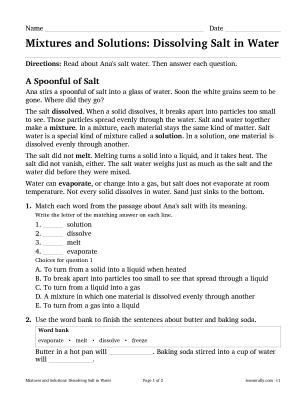
Match each word from the passage about Jada's bag with its meaning.
Match each item to an option.
Items
- magnetic
- conductor
- insulator
- transparent
Options


Teachers who sign in can assign LessonRally activities to their Google Classroom classes: students open them in Classroom and answer online, and their grades go to the teacher's Classroom gradebook. Practice lets you try it first, the way students see it.
Free for teachers. Sign in to assign activities to your Google Classroom classes.
 (opens in a new tab)
2 pages · Student copy, no answers
Print worksheet (opens in a new tab)Answer keyPremiumStudents read how Jada sorts a steel paper clip, aluminum foil, a plastic bead and a glass marble by testing each material's properties with a magnet and a circuit tester. They match key words (magnetic, conductor, insulator, transparent), then use the idea of a property to tell materials apart and to see why not every metal is magnetic.
Learning goal: Use properties such as magnetism, electrical conductivity and transparency to tell materials apart, and explain why not every metal is pulled by a magnet.
The estimate is the middle score of five readability formulas. Their scores run from 3.9 to 7.5.
Adapted from common readability formulas (Flesch-Kincaid, Gunning Fog, Coleman-Liau and ARI, plus SMOG for long texts), which look at sentence length and word length. Answer choices count toward word length only. Grades below the estimate will likely find the text harder, grades above it easier. It does not measure ideas, background knowledge or images.
© Copyright 2010. National Governors Association Center for Best Practices and Council of Chief State School Officers. All rights reserved.
Topic: Matter and Its Properties Chosen by LessonRally
Question types: matching, multiple choice, fill in the blank.
The questions as students see them, without the answers.
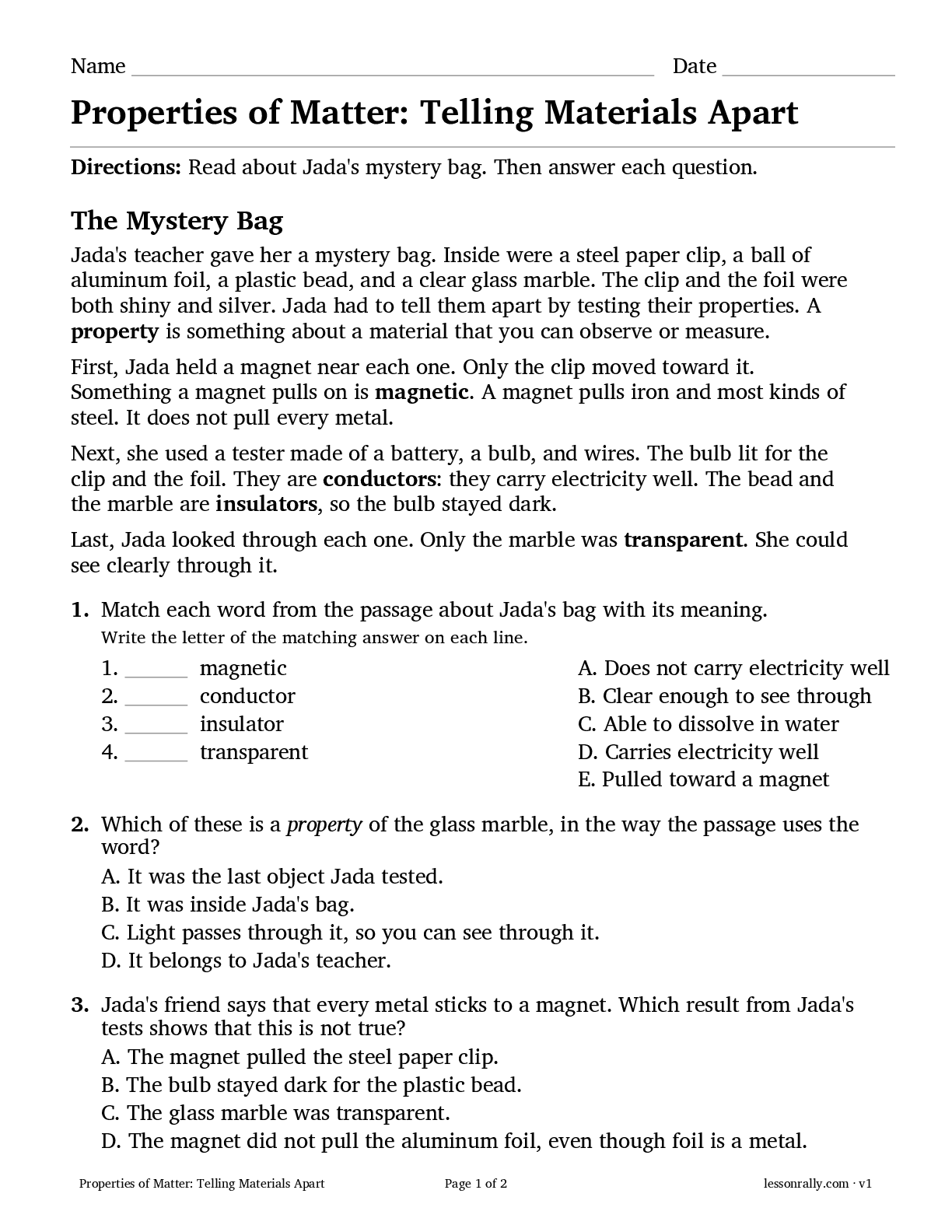
Read about Jada's mystery bag. Then answer each question.
Jada's teacher gave her a mystery bag. Inside were a steel paper clip, a ball of aluminum foil, a plastic bead, and a clear glass marble. The clip and the foil were both shiny and silver. Jada had to tell them apart by testing their properties. A property is something about a material that you can observe or measure.
First, Jada held a magnet near each one. Only the clip moved toward it. Something a magnet pulls on is magnetic. A magnet pulls iron and most kinds of steel. It does not pull every metal.
Next, she used a tester made of a battery, a bulb, and wires. The bulb lit for the clip and the foil. They are conductors: they carry electricity well. The bead and the marble are insulators, so the bulb stayed dark.
Last, Jada looked through each one. Only the marble was transparent. She could see clearly through it.
Match each word from the passage about Jada's bag with its meaning.
Match each item to an option.
Items
Options
Which of these is a property of the glass marble, in the way the passage uses the word?
Choose one answer.
Jada's friend says that every metal sticks to a magnet. Which result from Jada's tests shows that this is not true?
Choose one answer.
When Jada touched the tester's wires to the plastic bead, the bulb stayed dark. What does that result tell her?
Choose one answer.
Use the word bank to finish the sentences about a window and a rubber band.
Fill in each blank.
A clear window lets you see the yard, because its glass is blank 1. A rubber band does not carry electricity well, so rubber is one of the blank 2.
Word bank
Jada finds a second bead that looks just like the plastic one. When she tests it, the bulb lights. What idea does this test support?
Choose one answer.
Which two test results together tell the aluminum foil apart from every other object in the bag?
Choose one answer.
The paper clip, the foil ball, and the plastic bead spill onto a plate of dry rice. What would happen if Jada held the magnet just above the plate?
Choose one answer.
No reviews yet.
Reviews come from teachers who assigned this activity to a class.
Have a topic of your own? Make a printable worksheet and online quiz, free.
Create an activityCommon Core RI.5.3
Made by Wes Calloway · LessonRally (AI-assisted)
Common Core RI.5.3
Made by Wes Calloway · LessonRally (AI-assisted)
Common Core RI.5.4
Made by Wes Calloway · LessonRally (AI-assisted)
Common Core RI.5.4
Made by Wes Calloway · LessonRally (AI-assisted)