Question 1
According to the table, which pot had the heaviest bean plant after 8 weeks?
Choose one answer.
- Pot C
- Pot B
- All three plants weighed the same.
- Pot A


Teachers who sign in can assign LessonRally activities to their Google Classroom classes: students open them in Classroom and answer online, and their grades go to the teacher's Classroom gradebook. Practice lets you try it first, the way students see it.
Free for teachers. Sign in to assign activities to your Google Classroom classes.
 (opens in a new tab)
2 pages · Student copy, no answers
Print worksheet (opens in a new tab)Answer keyPremiumStudents read how a class grew bean plants in pots of weighed, oven-dried soil, then use a data table to explain what plants need to grow. Questions show that a plant's mass comes mostly from water and air (carbon dioxide), not from the soil, and that soil gives a plant only small amounts of minerals.
Learning goal: Use data from a bean plant experiment to explain that most of a growing plant's mass comes from water and air, not from soil.
The estimate is halfway between the two middle scores of four readability formulas. Their scores run from 3.5 to 6.4.
Adapted from common readability formulas (Flesch-Kincaid, Gunning Fog, Coleman-Liau and ARI, plus SMOG for long texts), which look at sentence length and word length. Answer choices count toward word length only. Grades below the estimate will likely find the text harder, grades above it easier. It does not measure ideas, background knowledge or images.
Explain the relationships or interactions between two or more individuals, events, ideas, or concepts in a historical, scientific, or technical text based on specific information in the text.
Matched independently by two AI models from this activity's questions.
© Copyright 2010. National Governors Association Center for Best Practices and Council of Chief State School Officers. All rights reserved.
Topic: Photosynthesis and Cellular Respiration Chosen by LessonRally
Question types: multiple choice, fill in the blank.
The questions as students see them, without the answers.
Read about the bean plant experiment and look at the table. Then answer each question.
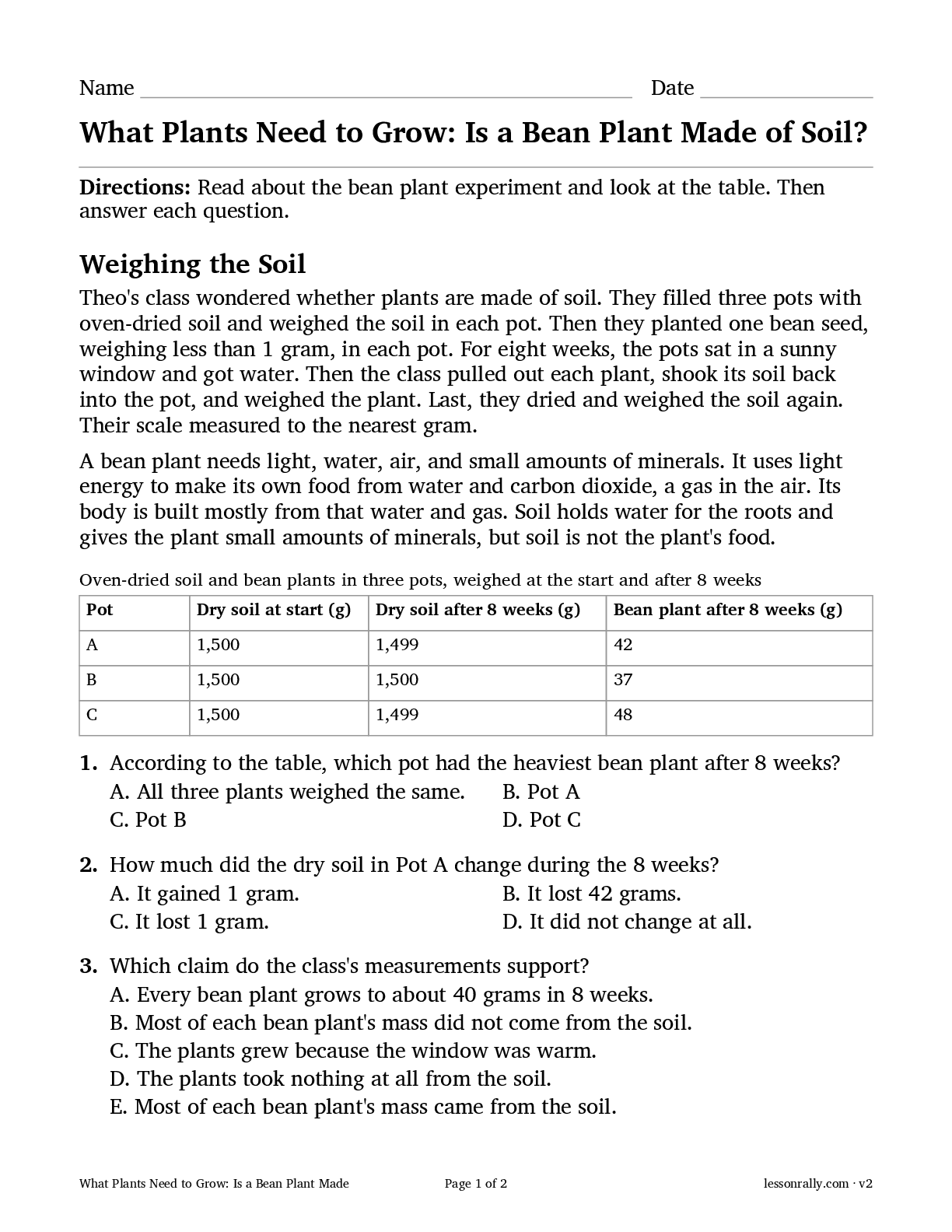
Theo's class wondered whether plants are made of soil. They filled three pots with oven-dried soil and weighed the soil in each pot. Then they planted one bean seed, weighing less than 1 gram, in each pot. For eight weeks, the pots sat in a sunny window and got water. Then the class pulled out each plant, shook its soil back into the pot, and weighed the plant. Last, they dried and weighed the soil again. Their scale measured to the nearest gram.
A bean plant needs light, water, air, and small amounts of minerals. It uses light energy to make its own food from water and carbon dioxide, a gas in the air. Its body is built mostly from that water and gas. Soil holds water for the roots and gives the plant small amounts of minerals, but soil is not the plant's food.
| Pot | Dry soil at start (g) | Dry soil after 8 weeks (g) | Bean plant after 8 weeks (g) |
|---|---|---|---|
| A | 1,500 | 1,499 | 42 |
| B | 1,500 | 1,500 | 37 |
| C | 1,500 | 1,499 | 48 |
According to the table, which pot had the heaviest bean plant after 8 weeks?
Choose one answer.
How much did the dry soil in Pot A change during the 8 weeks?
Choose one answer.
Which claim do the class's measurements support?
Choose one answer.
Use the word bank to finish the sentences about what Theo's bean plants needed.
Fill in each blank.
Each bean plant used energy from blank 1 to make its own food. Its roots took in water and small amounts of blank 2 from the soil.
Word bank
The plants gained far more mass than their soil lost. According to the passage, what was most of that new plant mass built from?
Choose one answer.
Pot B's soil weighed 1,500 grams at the start and at the end. Does that show the Pot B plant took nothing at all from the soil?
Choose one answer.
Why did the class dry the soil before weighing it at the start and at the end?
Choose one answer.
What would happen if Theo grew a bean plant in a sunny window with its roots in water that had a few minerals mixed in, and no soil at all?
Choose one answer.
No reviews yet.
Reviews come from teachers who assigned this activity to a class.
Have a topic of your own? Make a printable worksheet and online quiz, free.
Create an activityCommon Core RI.5.3
Made by Wes Calloway · LessonRally (AI-assisted)
Common Core RI.5.4
Made by Wes Calloway · LessonRally (AI-assisted)
Common Core RI.5.4
Made by Wes Calloway · LessonRally (AI-assisted)
Common Core RI.5.4
Made by Wes Calloway · LessonRally (AI-assisted)