Teachers who sign in can assign LessonRally activities to their Google Classroom classes: students open them in Classroom and answer online, and their grades go to the teacher's Classroom gradebook. Practice lets you try it first, the way students see it.
Students read about a rain puddle that dries up on the blacktop, then explain where the water went. Questions cover evaporation, water vapor, condensation, particles of matter too small to see, and the change from liquid to gas, so students see that matter still exists after a puddle evaporates.
Learning goal: Explain that water evaporates into water vapor and that matter still exists when it can no longer be seen.
Estimated reading level5.5
Grade 3Hard
Grade 4Stretch
Grade 5On level
Grade 6Easier
Grade 7Easy
About this estimate
The estimate is the middle score of five readability formulas. Their scores run from 3.2 to 6.5.
Flesch-Kincaid GradeSentence length and syllables per word4.3
Gunning Fog Middle scoreSentence length and words of three or more syllables5.5
Coleman-LiauLetters per word and sentences per 100 words6.0
Automated Readability IndexCharacters per word and words per sentence3.2
SMOGWords of three or more syllables, for texts of 30 sentences or more6.5
Grade 181216
Flesch Reading Ease
80.6 on a 0 to 100 scale where higher is easier: easy. Not part of the estimate.
Text measured
552 words, 34 sentences
Adapted from common readability formulas (Flesch-Kincaid, Gunning Fog, Coleman-Liau and ARI, plus SMOG for long texts), which look at sentence length and word length. Answer choices count toward word length only. Grades below the estimate will likely find the text harder, grades above it easier. It does not measure ideas, background knowledge or images.
Common Core
Press Ctrl+C or Command+C to copy.
Closest anchor:CCRA.R.4Interpret words and phrases as they are used in a text, including determining technical, connotative, and figurative meanings, and analyze how specific word choices shape meaning or tone.Anchor Standards for ReadingShow 2 matched standardsHide matched standards
Question types: multiple choice, fill in the blank, matching.
Student preview
The questions as students see them, without the answers.
Read about Nia's puddle. Then answer each question.
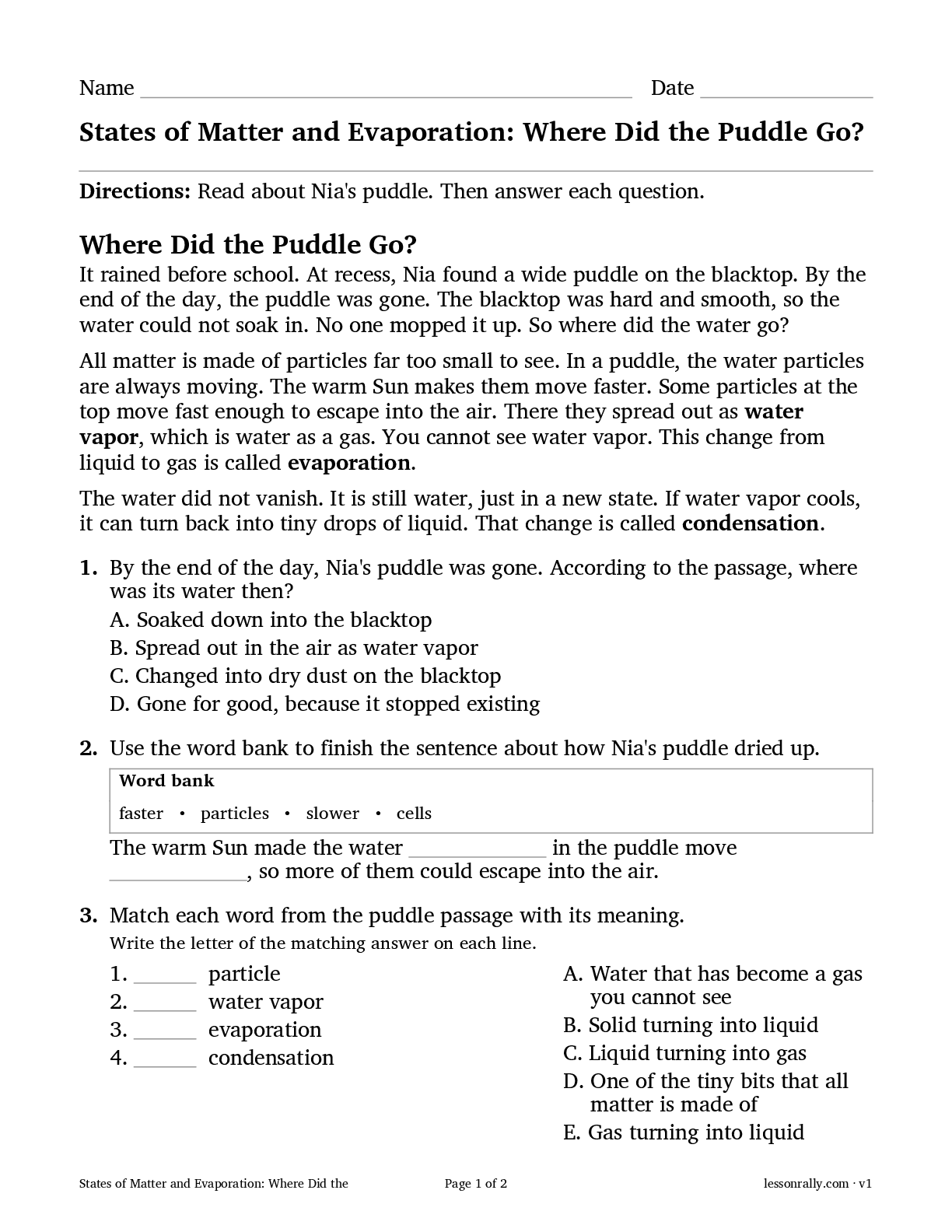
Where Did the Puddle Go?
It rained before school. At recess, Nia found a wide puddle on the blacktop. By the end of the day, the puddle was gone. The blacktop was hard and smooth, so the water could not soak in. No one mopped it up. So where did the water go?
All matter is made of particles far too small to see. In a puddle, the water particles are always moving. The warm Sun makes them move faster. Some particles at the top move fast enough to escape into the air. There they spread out as water vapor, which is water as a gas. You cannot see water vapor. This change from liquid to gas is called evaporation.
The water did not vanish. It is still water, just in a new state. If water vapor cools, it can turn back into tiny drops of liquid. That change is called condensation.
Question 1
By the end of the day, Nia's puddle was gone. According to the passage, where was its water then?
Choose one answer.
Gone for good, because it stopped existing
Soaked down into the blacktop
Spread out in the air as water vapor
Changed into dry dust on the blacktop
Question 2
Use the word bank to finish the sentence about how Nia's puddle dried up.
Fill in each blank.
The warm Sun made the water blank 1 in the puddle move blank 2, so more of them could escape into the air.
Word bank
faster
slower
particles
cells
Question 3
Match each word from the puddle passage with its meaning.
Match each item to an option.
Items
particle
water vapor
evaporation
condensation
Options
Gas turning into liquid
Liquid turning into gas
Solid turning into liquid
Water that has become a gas you cannot see
One of the tiny bits that all matter is made of
Question 4
The passage says the puddle's water is "still water, just in a new state." What does the word state mean in that sentence?
Choose one answer.
The form matter is in, such as solid, liquid, or gas
How much of something there is
A part of a country, such as Iowa or Texas
How warm or cold something is
Question 5
Nia's puddle never got hot enough to boil. What does that tell you about evaporation?
Choose one answer.
The puddle must have frozen into ice first.
Only boiling water can turn into a gas.
The water must have soaked into the blacktop instead.
Water can evaporate without boiling.
Question 6
Nia's puddle dried up because of evaporation. Which of these is another example of evaporation?
Choose one answer.
Sugar seeming to disappear as it is stirred into lemonade
Wet hair drying in warm air
An ice cube melting on a plate
A pond freezing on a cold night
Question 7
That afternoon, Nia pours ice water into a glass. Soon tiny drops of water cover the outside of the glass. Where did those drops come from?
Choose one answer.
The ice melted and climbed up the outside of the glass.
Water vapor in the air cooled on the cold glass and condensed.
The cold glass made brand-new water out of nothing.
Water from inside the glass leaked out through tiny holes.
Question 8
What would happen if a puddle just like Nia's formed on a cool, cloudy day instead of a warm, sunny one?
Choose one answer.
It would soak into the blacktop instead.
It would take longer to evaporate.
It would evaporate faster, because cool air pulls water up.
It would never evaporate, because there is no sunshine.