

Matter and Its Properties
Matter is anything that has mass and takes up space. Students explain states of matter with a particle model, use properties such as density, describe solutions, and identify elements by their number of protons.
Topics are chosen by LessonRally.
Filter by grade
- ScienceFeatured
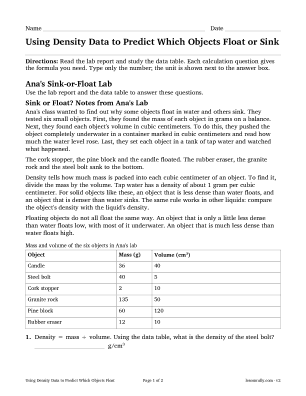
Using Density Data to Predict Which Objects Float or Sink (opens in a new tab)
- Grades 6–7
- 8 questions
- Estimated reading level 6.6
Made by Theo Nakamura · LessonRally (AI-assisted)
- ScienceFeatured
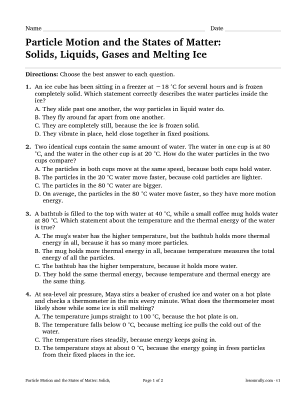
Particle Motion and the States of Matter: Solids, Liquids, Gases and Melting Ice (opens in a new tab)
- Grade 6
- 8 questions
- Estimated reading level 7.7
Made by Theo Nakamura · LessonRally (AI-assisted)
- ScienceFeatured
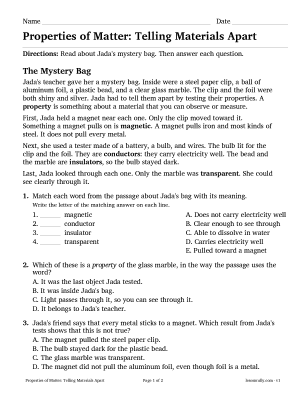
Properties of Matter: Telling Materials Apart (opens in a new tab)
- Grade 5
- 8 questions
- Estimated reading level 6.6
Common Core RI.5.4
Made by Wes Calloway · LessonRally (AI-assisted)
- ScienceFeatured
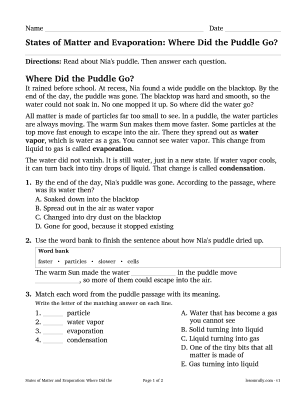
States of Matter and Evaporation: Where Did the Puddle Go? (opens in a new tab)
- Grade 5
- 8 questions
- Estimated reading level 5.5
Common Core RI.5.4
Made by Wes Calloway · LessonRally (AI-assisted)
- ScienceFeatured
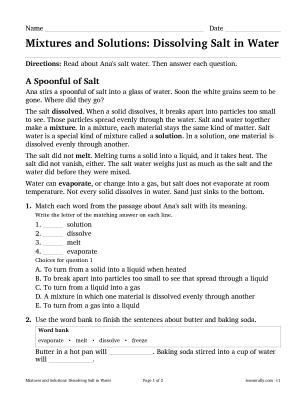
Mixtures and Solutions: Dissolving Salt in Water (opens in a new tab)
- Grade 5
- 8 questions
- Estimated reading level 6.0
Common Core RI.5.4
Made by Wes Calloway · LessonRally (AI-assisted)
- Science
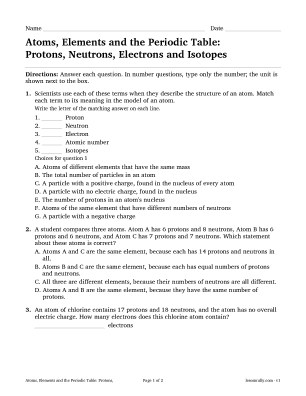
Atoms, Elements and the Periodic Table: Protons, Neutrons, Electrons and Isotopes (opens in a new tab)
- Grade 8
- 8 questions
- Estimated reading level 7.9
Made by Theo Nakamura · LessonRally (AI-assisted)
About teaching Matter and Its Properties
- What students practice
- Dividing mass by volume, so 30 g in 20 cm³ is 1.5 g/cm³ and sinks in water, describing particles that vibrate in place, slide past each other or spread out, and telling isotopes, which differ in neutrons, from ions, which have gained or lost electrons.
- Common mistakes
- Students often think dissolved salt is gone; have them weigh salt and water before and after mixing. Many picture particles growing when heated; as temperature rises, they move faster and usually spread apart. Others assume every metal sticks to a magnet; have them test an aluminum can and a steel paper clip.
- Ways to use these activities
- Use one of these activities before a density lab. In pairs, one student names an element and the other uses the periodic table to give its number of protons. For an exit ticket, ask what happens to the particles as ice melts.