Teachers who sign in can assign LessonRally activities to their Google Classroom classes: students open them in Classroom and answer online, and their grades go to the teacher's Classroom gradebook. Practice lets you try it first, the way students see it.
Students use a particle model to explain how particles move in solids, liquids and gases, what temperature measures, why an ice-water mix stays at 0 °C while the ice melts, and why matter expands when it is heated. Questions take on the ideas that particles in a solid do not move, that particles grow bigger when heated and that a melting ice-water mix keeps getting warmer.
Learning goal: Use a particle model to describe how particle motion, temperature and state change when thermal energy is added to or removed from a substance.
Estimated reading level7.7
Grade 5Hard
Grade 6Stretch
Grade 7On level
Grade 8Easier
Grade 9Easy
About this estimate
The estimate is halfway between the two middle scores of four readability formulas. Their scores run from 7.1 to 10.3.
Flesch-Kincaid Grade Middle scoreSentence length and syllables per word7.7
Gunning FogSentence length and words of three or more syllables10.3
Coleman-Liau Middle scoreLetters per word and sentences per 100 words7.7
Automated Readability IndexCharacters per word and words per sentence7.1
Grade 181216
Flesch Reading Ease
69.2 on a 0 to 100 scale where higher is easier: standard. Not part of the estimate.
Text measured
684 words, 17 sentences
Adapted from common readability formulas (Flesch-Kincaid, Gunning Fog, Coleman-Liau and ARI, plus SMOG for long texts), which look at sentence length and word length. Answer choices count toward word length only. Grades below the estimate will likely find the text harder, grades above it easier. It does not measure ideas, background knowledge or images.
The questions as students see them, without the answers.
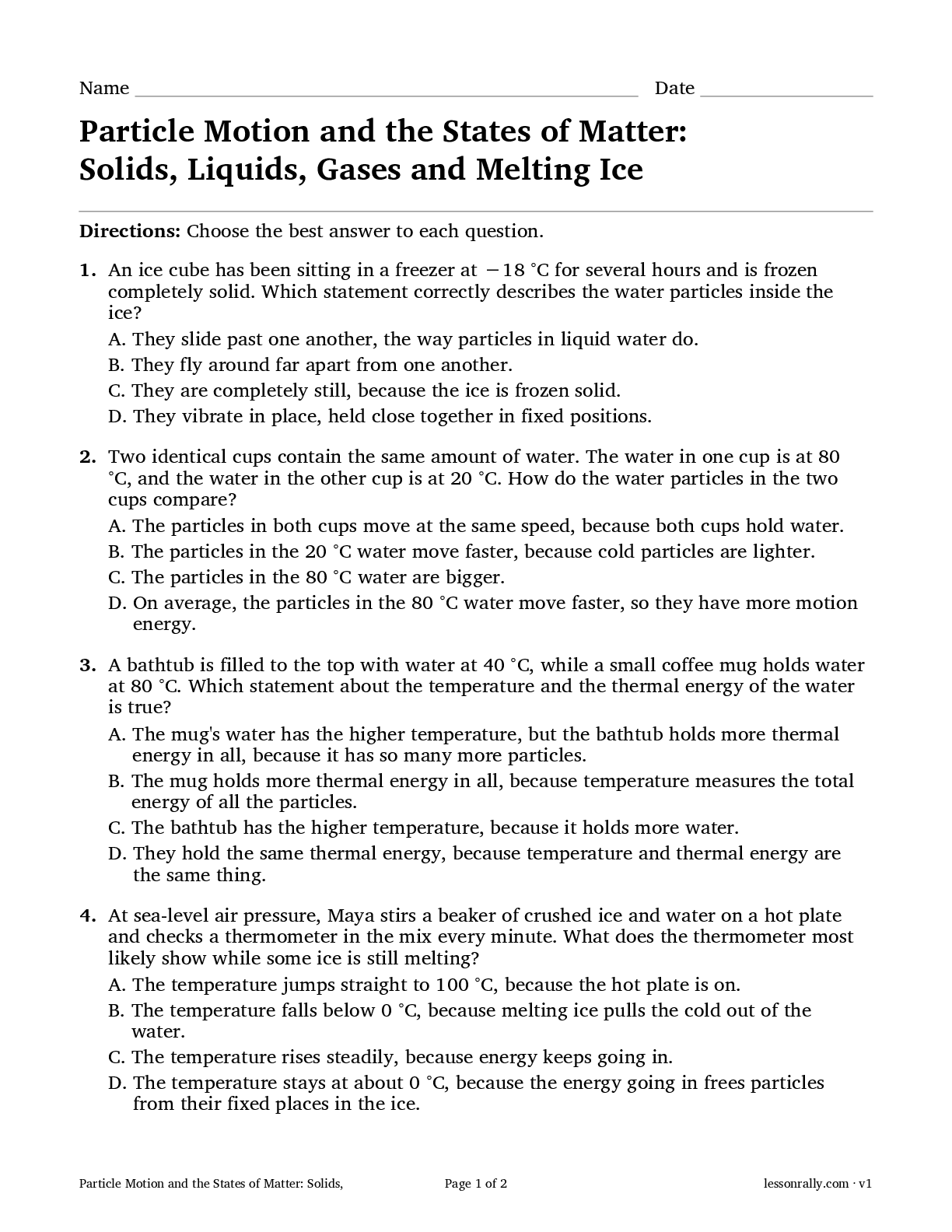
Choose the best answer to each question.
Question 1
An ice cube has been sitting in a freezer at −18 °C for several hours and is frozen completely solid. Which statement correctly describes the water particles inside the ice?
Choose one answer.
They slide past one another, the way particles in liquid water do.
They vibrate in place, held close together in fixed positions.
They fly around far apart from one another.
They are completely still, because the ice is frozen solid.
Question 2
Two identical cups contain the same amount of water. The water in one cup is at 80 °C, and the water in the other cup is at 20 °C. How do the water particles in the two cups compare?
Choose one answer.
The particles in the 20 °C water move faster, because cold particles are lighter.
The particles in the 80 °C water are bigger.
On average, the particles in the 80 °C water move faster, so they have more motion energy.
The particles in both cups move at the same speed, because both cups hold water.
Question 3
A bathtub is filled to the top with water at 40 °C, while a small coffee mug holds water at 80 °C. Which statement about the temperature and the thermal energy of the water is true?
Choose one answer.
The mug holds more thermal energy in all, because temperature measures the total energy of all the particles.
The mug's water has the higher temperature, but the bathtub holds more thermal energy in all, because it has so many more particles.
The bathtub has the higher temperature, because it holds more water.
They hold the same thermal energy, because temperature and thermal energy are the same thing.
Question 4
At sea-level air pressure, Maya stirs a beaker of crushed ice and water on a hot plate and checks a thermometer in the mix every minute. What does the thermometer most likely show while some ice is still melting?
Choose one answer.
The temperature stays at about 0 °C, because the energy going in frees particles from their fixed places in the ice.
The temperature rises steadily, because energy keeps going in.
The temperature jumps straight to 100 °C, because the hot plate is on.
The temperature falls below 0 °C, because melting ice pulls the cold out of the water.
Question 5
On a warm, humid afternoon, tiny drops of water appear on the outside of a glass filled with ice water. The glass has no cracks or holes, and its outside was wiped dry. Where does the water on the outside of the glass come from?
Choose one answer.
The ice melts through the glass wall.
Water vapor in the air touches the cold glass, slows down and condenses into liquid drops.
Water seeps out through tiny holes in the glass.
The cold glass changes the oxygen in the air into water.
Question 6
A metal lid is stuck tightly on a glass jar, but running hot water over the lid makes it much easier to twist open. What happens to the particles in the metal lid?
Choose one answer.
The hot water adds new metal particles to the lid.
The particles move faster and push slightly farther apart, so the lid expands a little.
Each particle swells up and gets bigger.
The particles melt, so the lid turns partly to liquid.
Question 7
A tied balloon is left inside a closed car parked in the sun on a hot afternoon, and it slowly gets a little bigger. What explains this change?
Choose one answer.
The air particles inside grow larger in the heat.
Heat is a substance that flows into the balloon and fills it.
The air particles stop moving and pile up against the rubber.
The air particles inside move faster and hit the inside of the balloon harder and more often, pushing it outward.
Question 8
Water boils in a pot on the stove. What happens to the water particles as liquid water becomes water vapor?
Choose one answer.
Each water particle splits into hydrogen gas and oxygen gas.
They gain enough energy to break away from one another and spread far apart, but each one is still a water particle.