Question 1
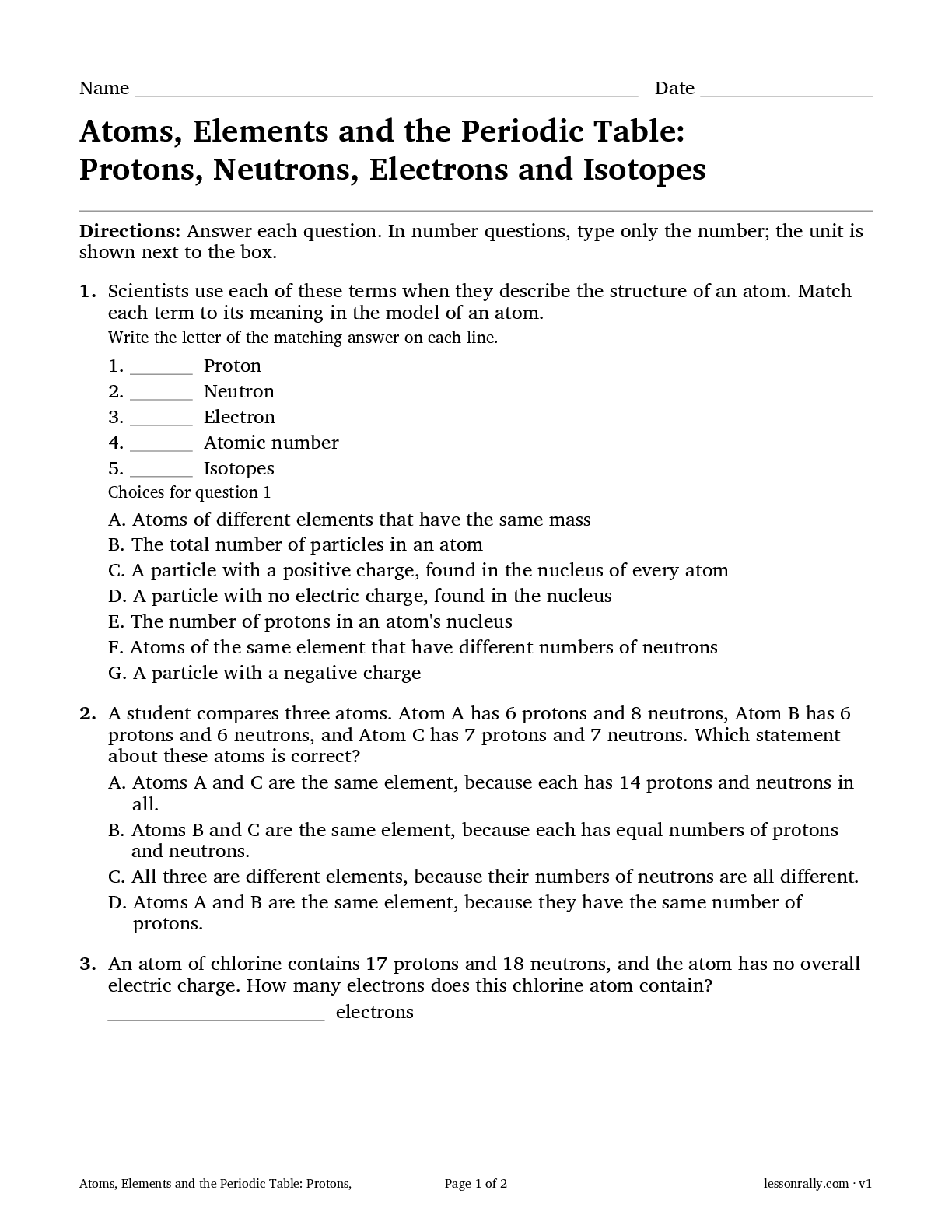
Scientists use each of these terms when they describe the structure of an atom. Match each term to its meaning in the model of an atom.
Match each item to an option.
Items
- Proton
- Neutron
- Electron
- Atomic number
- Isotopes
Options


Teachers who sign in can assign LessonRally activities to their Google Classroom classes: students open them in Classroom and answer online, and their grades go to the teacher's Classroom gradebook. Practice lets you try it first, the way students see it.
Free for teachers. Sign in to assign activities to your Google Classroom classes.
 (opens in a new tab)
2 pages · Student copy, no answers
Print worksheet (opens in a new tab)Answer keyPremiumStudents match the parts of an atom and key terms to their meanings, then use protons, neutrons and electrons to identify elements, isotopes and ions, count the atoms in a molecule and explain how the periodic table is organized. Questions take on the ideas that electrons orbit like planets and that an atom's mass or its electrons decide which element it is.
Learning goal: Describe the structure of an atom, use the number of protons to identify an element, explain isotopes and ions, and relate atoms to molecules and to the organization of the periodic table.
The estimate is halfway between the two middle scores of four readability formulas. Their scores run from 6.3 to 10.7.
Adapted from common readability formulas (Flesch-Kincaid, Gunning Fog, Coleman-Liau and ARI, plus SMOG for long texts), which look at sentence length and word length. Answer choices count toward word length only. Grades below the estimate will likely find the text harder, grades above it easier. It does not measure ideas, background knowledge or images.
Topic: Matter and Its Properties Chosen by LessonRally
Question types: matching, multiple choice, number answer.
The questions as students see them, without the answers.
Answer each question. In number questions, type only the number; the unit is shown next to the box.
Scientists use each of these terms when they describe the structure of an atom. Match each term to its meaning in the model of an atom.
Match each item to an option.
Items
Options
A student compares three atoms. Atom A has 6 protons and 8 neutrons, Atom B has 6 protons and 6 neutrons, and Atom C has 7 protons and 7 neutrons. Which statement about these atoms is correct?
Choose one answer.
An atom of chlorine contains 17 protons and 18 neutrons, and the atom has no overall electric charge. How many electrons does this chlorine atom contain?
Enter a number.
electrons
A potassium atom contains 19 protons and starts out with no overall electric charge. It then loses one electron, which leaves it with exactly as many electrons as a neutral argon atom. What is the particle now?
Choose one answer.
Which description of electrons fits the model of the atom that scientists use today?
Choose one answer.
Almost all of an atom's mass is concentrated in one small part of the atom. Where is that mass located, and what explains it?
Choose one answer.
How are the elements arranged in the modern periodic table?
Choose one answer.
A chemical formula shows the atoms in one molecule; a water molecule, H₂O, has 2 hydrogen atoms and 1 oxygen atom. How many atoms in all are in one molecule of glucose, C₆H₁₂O₆?
Enter a number.
atoms
No reviews yet.
Reviews come from teachers who assigned this activity to a class.
Have a topic of your own? Make a printable worksheet and online quiz, free.
Create an activityCommon Core RST.6-8.7
Made by Myra Jefferson · LessonRally (AI-assisted)
Made by Myra Jefferson · LessonRally (AI-assisted)
Common Core RST.6-8.7
Made by Myra Jefferson · LessonRally (AI-assisted)
Common Core RST.6-8.4
Made by Myra Jefferson · LessonRally (AI-assisted)