Question 1
Match each word from the passage about Ana's salt with its meaning.
Match each item to an option.
Items
- solution
- dissolve
- melt
- evaporate
Options


Teachers who sign in can assign LessonRally activities to their Google Classroom classes: students open them in Classroom and answer online, and their grades go to the teacher's Classroom gradebook. Practice lets you try it first, the way students see it.
Free for teachers. Sign in to assign activities to your Google Classroom classes.
 (opens in a new tab)
2 pages · Student copy, no answers
Print worksheet (opens in a new tab)Answer keyPremiumStudents read about salt stirred into a glass of water, match key words (solution, dissolve, melt, evaporate), and use them to explain mixtures and solutions, including why a solution is a special kind of mixture. Questions show that dissolved salt is still there: the weight stays the same, the salt spreads evenly, it passes through a filter, and it is left behind when the water evaporates.
Learning goal: Use the words mixture, solution and dissolve to explain that salt stirred into water is still there, even when it cannot be seen.
The estimate is the middle score of five readability formulas. Their scores run from 3.4 to 7.4.
Adapted from common readability formulas (Flesch-Kincaid, Gunning Fog, Coleman-Liau and ARI, plus SMOG for long texts), which look at sentence length and word length. Answer choices count toward word length only. Grades below the estimate will likely find the text harder, grades above it easier. It does not measure ideas, background knowledge or images.
© Copyright 2010. National Governors Association Center for Best Practices and Council of Chief State School Officers. All rights reserved.
Topic: Matter and Its Properties Chosen by LessonRally
Question types: matching, fill in the blank, multiple choice.
The questions as students see them, without the answers.
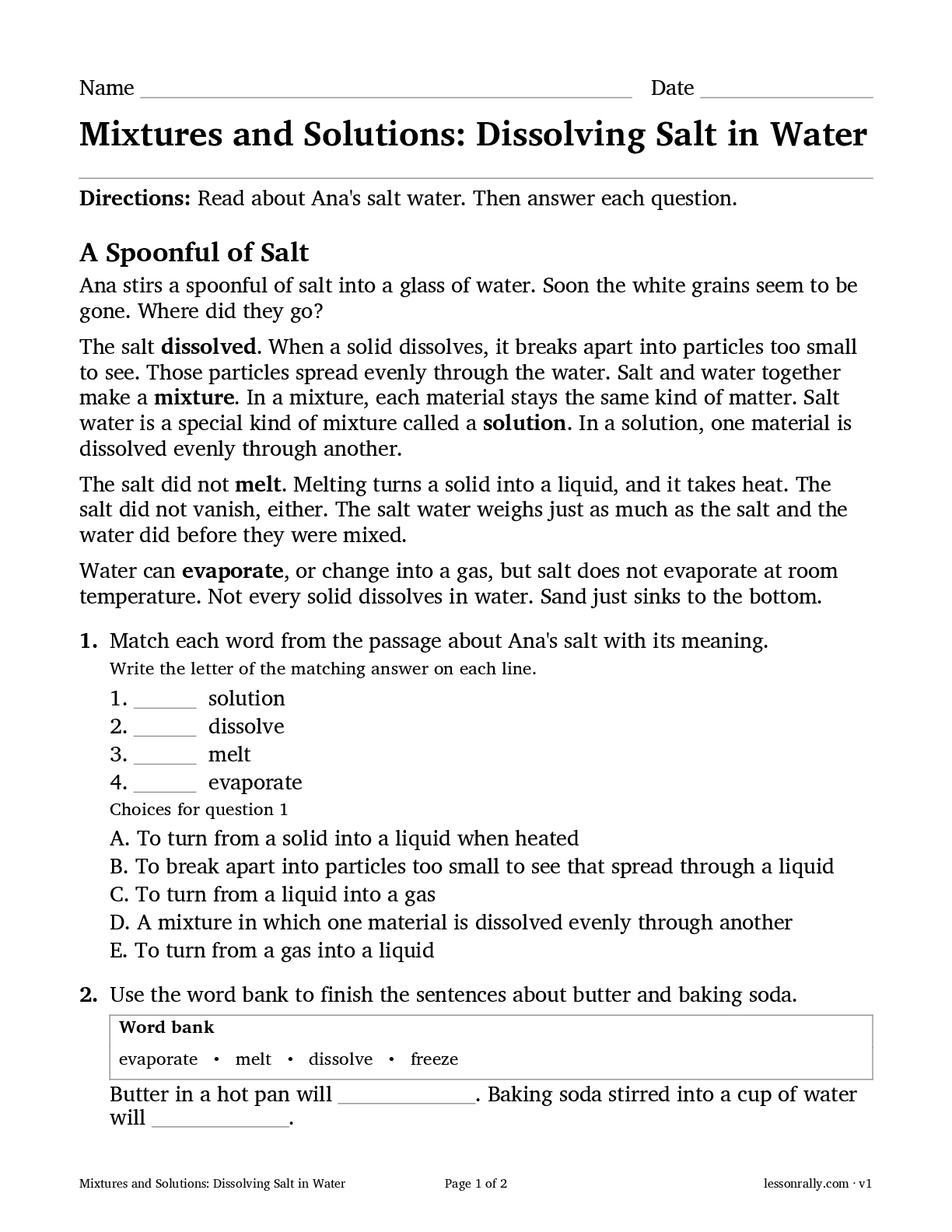
Read about Ana's salt water. Then answer each question.
Ana stirs a spoonful of salt into a glass of water. Soon the white grains seem to be gone. Where did they go?
The salt dissolved. When a solid dissolves, it breaks apart into particles too small to see. Those particles spread evenly through the water. Salt and water together make a mixture. In a mixture, each material stays the same kind of matter. Salt water is a special kind of mixture called a solution. In a solution, one material is dissolved evenly through another.
The salt did not melt. Melting turns a solid into a liquid, and it takes heat. The salt did not vanish, either. The salt water weighs just as much as the salt and the water did before they were mixed.
Water can evaporate, or change into a gas, but salt does not evaporate at room temperature. Not every solid dissolves in water. Sand just sinks to the bottom.
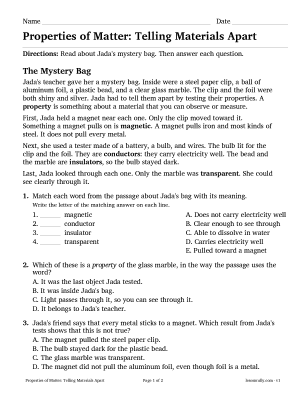
Match each word from the passage about Ana's salt with its meaning.
Match each item to an option.
Items
Options
Use the word bank to finish the sentences about butter and baking soda.
Fill in each blank.
Butter in a hot pan will blank 1. Baking soda stirred into a cup of water will blank 2.
Word bank
Sand stirred into water makes a mixture, but not a solution. Why not?
Choose one answer.
Which of these makes a solution, like Ana's salt water?
Choose one answer.
Ana sets a cup of water on a scale, and it reads 250 grams. She adds 20 grams of salt and stirs until all of it dissolves. What will the scale read now?
Choose one answer.
The passage says the salt particles spread evenly through the water. What does evenly tell you about Ana's salt water?
Choose one answer.
After all the salt has dissolved, Ana pours her salt water through a paper coffee filter. What comes out the other side?
Choose one answer.
What would happen if Ana poured her salt water into a wide, shallow dish and left it in a sunny window for a week?
Choose one answer.
No reviews yet.
Reviews come from teachers who assigned this activity to a class.
Have a topic of your own? Make a printable worksheet and online quiz, free.
Create an activityCommon Core RI.5.3
Made by Wes Calloway · LessonRally (AI-assisted)
Common Core RI.5.3
Made by Wes Calloway · LessonRally (AI-assisted)
Common Core RI.5.4
Made by Wes Calloway · LessonRally (AI-assisted)
Common Core RI.5.4
Made by Wes Calloway · LessonRally (AI-assisted)