Question 1
According to the table, at what time of day was the stick's shadow the shortest?
Choose one answer.
- 1:00 p.m.
- 12:00 p.m. (noon)
- 9:00 a.m.
- 5:00 p.m.


Teachers who sign in can assign LessonRally activities to their Google Classroom classes: students open them in Classroom and answer online, and their grades go to the teacher's Classroom gradebook. Practice lets you try it first, the way students see it.
Free for teachers. Sign in to assign activities to your Google Classroom classes.
 (opens in a new tab)
2 pages · Student copy, no answers
Print worksheet (opens in a new tab)Answer keyPremiumStudents read how two classmates measured a stick's shadow every hour on a sunny day, then use a data table of shadow length and direction to explain how Earth's rotation causes day and night and makes the Sun appear to move. Questions ask students to read the table, compare shadows, check a claim against the data, and predict a later shadow.
Learning goal: Use a table of shadow measurements to describe how a shadow's length and direction change during the day, and explain that Earth's rotation causes day and night.
The estimate is halfway between the two middle scores of four readability formulas. Their scores run from 2.9 to 5.8.
Adapted from common readability formulas (Flesch-Kincaid, Gunning Fog, Coleman-Liau and ARI, plus SMOG for long texts), which look at sentence length and word length. Answer choices count toward word length only. Grades below the estimate will likely find the text harder, grades above it easier. It does not measure ideas, background knowledge or images.
Explain the relationships or interactions between two or more individuals, events, ideas, or concepts in a historical, scientific, or technical text based on specific information in the text.
Student preview question 7
Matched independently by two AI models from this activity's questions.
© Copyright 2010. National Governors Association Center for Best Practices and Council of Chief State School Officers. All rights reserved.
Topic: Solar System and Space Chosen by LessonRally
Question types: multiple choice, fill in the blank.
The questions as students see them, without the answers.
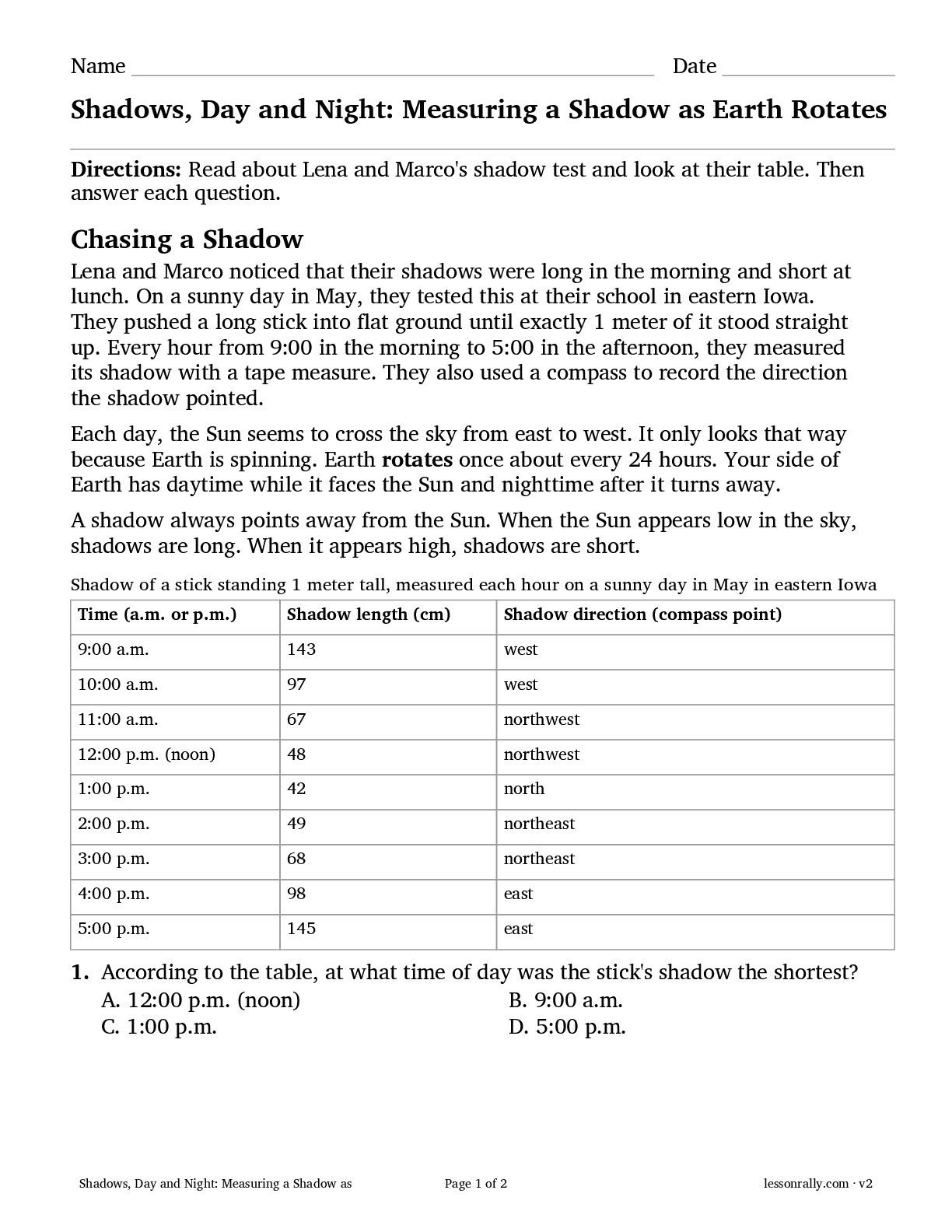
Read about Lena and Marco's shadow test and look at their table. Then answer each question.
Lena and Marco noticed that their shadows were long in the morning and short at lunch. On a sunny day in May, they tested this at their school in eastern Iowa. They pushed a long stick into flat ground until exactly 1 meter of it stood straight up. Every hour from 9:00 in the morning to 5:00 in the afternoon, they measured its shadow with a tape measure. They also used a compass to record the direction the shadow pointed.
Each day, the Sun seems to cross the sky from east to west. It only looks that way because Earth is spinning. Earth rotates once about every 24 hours. Your side of Earth has daytime while it faces the Sun and nighttime after it turns away.
A shadow always points away from the Sun. When the Sun appears low in the sky, shadows are long. When it appears high, shadows are short.
| Time (a.m. or p.m.) | Shadow length (cm) | Shadow direction (compass point) |
|---|---|---|
| 9:00 a.m. | 143 | west |
| 10:00 a.m. | 97 | west |
| 11:00 a.m. | 67 | northwest |
| 12:00 p.m. (noon) | 48 | northwest |
| 1:00 p.m. | 42 | north |
| 2:00 p.m. | 49 | northeast |
| 3:00 p.m. | 68 | northeast |
| 4:00 p.m. | 98 | east |
| 5:00 p.m. | 145 | east |
According to the table, at what time of day was the stick's shadow the shortest?
Choose one answer.
Which claim do Lena and Marco's measurements support?
Choose one answer.
Why was the shadow so much longer at 9:00 in the morning than at 1:00 in the afternoon?
Choose one answer.
Use the table. What is the difference between the 9:00 a.m. shadow length and the 1:00 p.m. shadow length?
Choose one answer.
Which time in the table had a shadow almost the same length as the 10:00 a.m. shadow?
Choose one answer.
Use the word bank to finish the sentence about the 9:00 a.m. shadow.
Fill in each blank.
At 9:00 a.m., the stick's shadow pointed blank 1, so the Sun appeared in the blank 2.
Word bank
What causes day and night in Lena and Marco's town?
Choose one answer.
What would happen if Lena and Marco measured the shadow again at 6:00 p.m. that same day?
Choose one answer.
No reviews yet.
Reviews come from teachers who assigned this activity to a class.
Have a topic of your own? Make a printable worksheet and online quiz, free.
Create an activityCommon Core RI.5.3
Made by Wes Calloway · LessonRally (AI-assisted)
Common Core RI.5.4
Made by Wes Calloway · LessonRally (AI-assisted)
Common Core RI.5.4
Made by Wes Calloway · LessonRally (AI-assisted)
Common Core RI.5.4
Made by Wes Calloway · LessonRally (AI-assisted)