Teachers who sign in can assign LessonRally activities to their Google Classroom classes: students open them in Classroom and answer online, and their grades go to the teacher's Classroom gradebook. Practice lets you try it first, the way students see it.
Students review how energy and matter move through ecosystems: producers, consumers and decomposers in a mountain meadow, why energy flows one way while matter cycles, the path of a carbon atom, the carbon cycle, what decomposers return, carbon stored in peat and coal, why food chains are short, an energy estimate, and a table of energy at each trophic level.
Learning goal: Explain why energy flows one way through an ecosystem while matter cycles, trace carbon through the carbon cycle, and calculate and interpret energy transfer between trophic levels.
Estimated reading level7.9
Grade 5Hard
Grade 6Stretch
Grade 7On level
Grade 8Easier
Grade 9Easy
About this estimate
The estimate is halfway between the two middle scores of four readability formulas. Their scores run from 6.9 to 10.2.
Flesch-Kincaid Grade Middle scoreSentence length and syllables per word7.7
Gunning FogSentence length and words of three or more syllables10.2
Coleman-Liau Middle scoreLetters per word and sentences per 100 words8.1
Automated Readability IndexCharacters per word and words per sentence6.9
Grade 181216
Flesch Reading Ease
66.0 on a 0 to 100 scale where higher is easier: standard. Not part of the estimate.
Text measured
1,002 words, 28 sentences
Adapted from common readability formulas (Flesch-Kincaid, Gunning Fog, Coleman-Liau and ARI, plus SMOG for long texts), which look at sentence length and word length. Answer choices count toward word length only. Grades below the estimate will likely find the text harder, grades above it easier. It does not measure ideas, background knowledge or images.
Common Core
Press Ctrl+C or Command+C to copy.
Closest anchor:CCRA.R.7Integrate and evaluate content presented in diverse media and formats, including visually and quantitatively, as well as in words.Anchor Standards for ReadingShow 1 matched standardHide matched standard
Translate quantitative or technical information expressed in words in a text into visual form (e.g., a table or chart) and translate information expressed visually or mathematically (e.g., in an equation) into words.
Question types: matching, multiple choice, fill in the blank.
Student preview
The questions as students see them, without the answers.
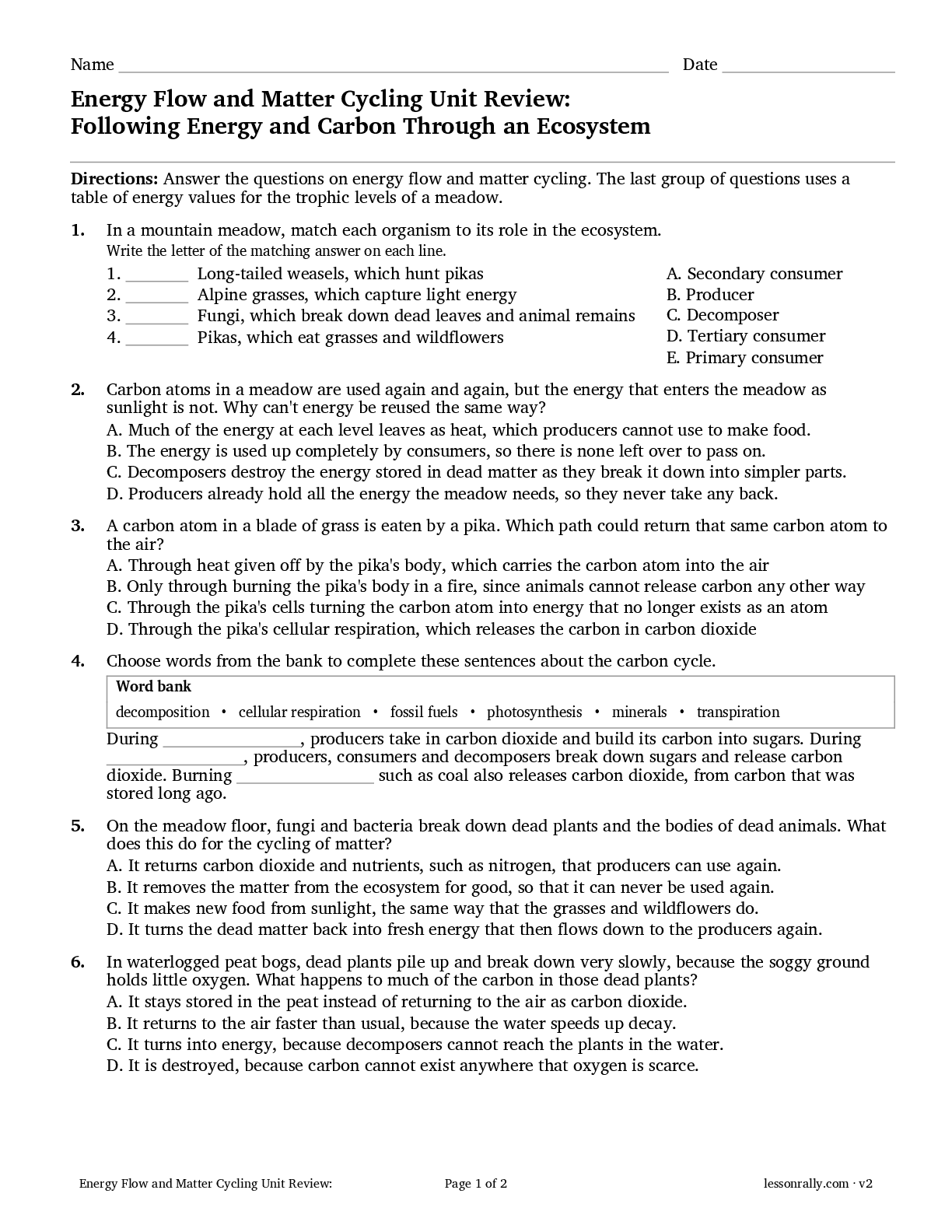
Answer the questions on energy flow and matter cycling. The last group of questions uses a table of energy values for the trophic levels of a meadow.
Question 1
In a mountain meadow, match each organism to its role in the ecosystem.
Match each item to an option.
Items
Long-tailed weasels, which hunt pikas
Alpine grasses, which capture light energy
Fungi, which break down dead leaves and animal remains
Pikas, which eat grasses and wildflowers
Options
Secondary consumer
Decomposer
Primary consumer
Producer
Tertiary consumer
Question 2
Carbon atoms in a meadow are used again and again, but the energy that enters the meadow as sunlight is not. Why can't energy be reused the same way?
Choose one answer.
Decomposers destroy the energy stored in dead matter as they break it down into simpler parts.
Producers already hold all the energy the meadow needs, so they never take any back.
The energy is used up completely by consumers, so there is none left over to pass on.
Much of the energy at each level leaves as heat, which producers cannot use to make food.
Question 3
A carbon atom in a blade of grass is eaten by a pika. Which path could return that same carbon atom to the air?
Choose one answer.
Through the pika's cells turning the carbon atom into energy that no longer exists as an atom
Only through burning the pika's body in a fire, since animals cannot release carbon any other way
Through heat given off by the pika's body, which carries the carbon atom into the air
Through the pika's cellular respiration, which releases the carbon in carbon dioxide
Question 4
Choose words from the bank to complete these sentences about the carbon cycle.
Fill in each blank.
During blank 1, producers take in carbon dioxide and build its carbon into sugars. During blank 2, producers, consumers and decomposers break down sugars and release carbon dioxide. Burning blank 3 such as coal also releases carbon dioxide, from carbon that was stored long ago.
Word bank
transpiration
cellular respiration
fossil fuels
photosynthesis
minerals
decomposition
Question 5
On the meadow floor, fungi and bacteria break down dead plants and the bodies of dead animals. What does this do for the cycling of matter?
Choose one answer.
It removes the matter from the ecosystem for good, so that it can never be used again.
It returns carbon dioxide and nutrients, such as nitrogen, that producers can use again.
It turns the dead matter back into fresh energy that then flows down to the producers again.
It makes new food from sunlight, the same way that the grasses and wildflowers do.
Question 6
In waterlogged peat bogs, dead plants pile up and break down very slowly, because the soggy ground holds little oxygen. What happens to much of the carbon in those dead plants?
Choose one answer.
It returns to the air faster than usual, because the water speeds up decay.
It stays stored in the peat instead of returning to the air as carbon dioxide.
It turns into energy, because decomposers cannot reach the plants in the water.
It is destroyed, because carbon cannot exist anywhere that oxygen is scarce.
Question 7
Coal formed from plants that lived and died millions of years ago. When coal burns, what happens to its carbon?
Choose one answer.
It is destroyed by the heat of the fire and no longer exists.
It stays in the ashes as pure carbon, so none of it reaches the air.
It joins with oxygen and enters the air as carbon dioxide.
It changes into pure energy, which is why burning gives off heat.
Question 8
Why do food chains rarely have more than four or five trophic levels?
Choose one answer.
Energy builds up at each level, so the top levels have more energy than any animal living there could use.
Only a small share of the energy at each level reaches the next, so too little is left for another level.
Matter is used up as it moves up the chain, so nothing is left to build the bodies of a sixth level.
Producers make only enough energy for four or five levels, and they cannot make any more of it.
Question 9
Producers in a grassland store about 30,000 kJ of energy per square meter in a year. If roughly 10 percent of the energy passes from each level to the next on average, about how much energy would reach the secondary consumers?
Choose one answer.
About 27,000 kJ
About 30 kJ
About 300 kJ
About 3,000 kJ
Energy at Each Trophic Level of a Meadow
In a study, ecologists estimated the energy stored in new tissue by all of the organisms at each trophic level of a mountain meadow over one year. The values are totals for each level per square meter of meadow.
Energy stored in new tissue at each trophic level of a mountain meadow in one year
Trophic level
Examples
Energy stored in new tissue (kJ per square meter per year)
Producers
Grasses, sedges and wildflowers
21,000
Primary consumers
Plant eaters such as grasshoppers and pikas
1,700
Secondary consumers
Animals that eat plant eaters, such as shrews and weasels
210
Tertiary consumers
Hawks and other predators that eat secondary consumers
16
Question 10
About what percent of the energy stored by the producers was stored by the primary consumers?
Choose one answer.
About 12 percent
About 1 percent
About 8 percent
About 80 percent
Question 11
Which statement about energy transfer in this meadow do the data support?
Choose one answer.
Exactly 10 percent of the energy passed from each level to the next level in the chain.
About half of each level's energy was stored by the next level up the food chain.
Each level stored more energy than the level below it, so energy grew up the chain.
The share passed from one level to the next varied, from about 8 to about 12 percent.
Question 12
The producers stored 21,000 kJ, but the primary consumers stored only 1,700 kJ. Based on how energy moves through living things, which explanation fits this difference best?
Choose one answer.
Most of the energy cycled back to the producers before the plant eaters had a chance to use it.
Energy was destroyed as it passed from the plants into the bodies of the grasshoppers and pikas.
The plant eaters turned most of the energy they took in into matter, which is not counted as energy.
Much plant material was never eaten or digested, and plant eaters lost much of what they ate as heat.
Question 13
Suppose a fifth level of predators fed only on the tertiary consumers. If its transfer were similar to those in the table, about how much energy would that level store per square meter in a year?