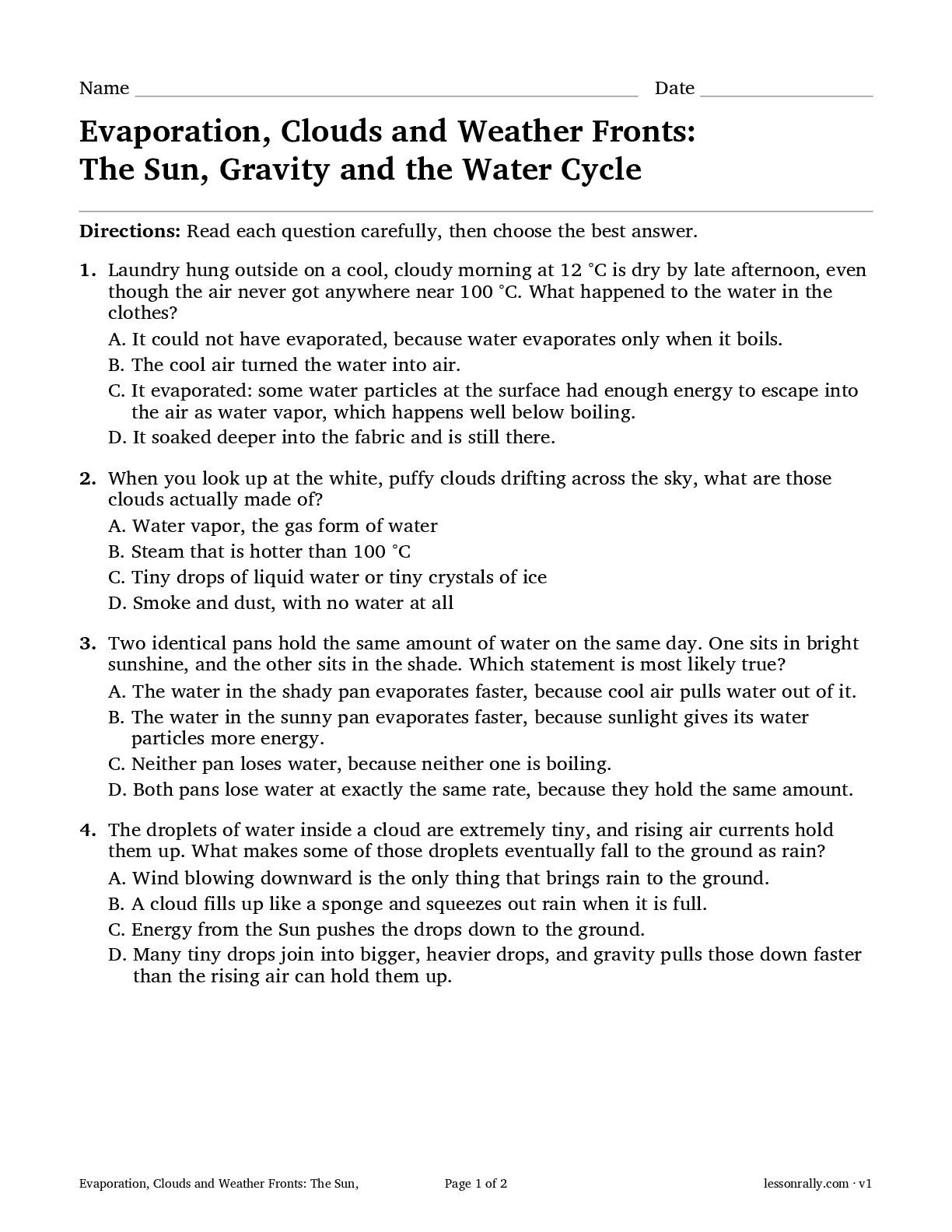
Evaporation, Clouds and Weather Fronts: The Sun, Gravity and the Water Cycle

8 questions · 8 points · Grade 6 · English · Preview the 8 questions

Made by Theo Nakamura · LessonRally (AI-assisted)

Digital classroom activity

What is a digital classroom activity?

Teachers who sign in can assign LessonRally activities to their Google Classroom classes: students open them in Classroom and answer online, and their grades go to the teacher's Classroom gradebook. Practice lets you try it first, the way students see it.

Free for teachers. Sign in to assign activities to your Google Classroom classes.

Printable worksheet

Students explain how energy from the Sun drives evaporation, why clouds are tiny drops of liquid water or ice rather than water vapor, how gravity brings rain down and moves water downhill, and what weather cold fronts and warm fronts usually bring. Questions take on the ideas that water evaporates only at boiling, that clouds are made of water vapor and that the water cycle uses water up.

Learning goal: Describe how energy from the Sun and the force of gravity move water through the water cycle, and compare the weather that cold fronts and warm fronts usually bring.

Estimated reading level 6.3

  1. Grade 4Hard
  2. Grade 5Stretch
  3. Grade 6On level
  4. Grade 7Easier
  5. Grade 8Easy
About this estimate

The estimate is halfway between the two middle scores of four readability formulas. Their scores run from 5.3 to 7.2.

  • Flesch-Kincaid Grade Middle scoreSentence length and syllables per word5.7
  • Gunning Fog Middle scoreSentence length and words of three or more syllables6.9
  • Coleman-LiauLetters per word and sentences per 100 words7.2
  • Automated Readability IndexCharacters per word and words per sentence5.3
Flesch Reading Ease
77.2 on a 0 to 100 scale where higher is easier: fairly easy. Not part of the estimate.
Text measured
634 words, 20 sentences

Adapted from common readability formulas (Flesch-Kincaid, Gunning Fog, Coleman-Liau and ARI, plus SMOG for long texts), which look at sentence length and word length. Answer choices count toward word length only. Grades below the estimate will likely find the text harder, grades above it easier. It does not measure ideas, background knowledge or images.

Topics: Water Cycle, Weather and Climate Chosen by LessonRally

Question types: multiple choice.

Student preview

The questions as students see them, without the answers.

Read each question carefully, then choose the best answer.

Question 1

Laundry hung outside on a cool, cloudy morning at 12 °C is dry by late afternoon, even though the air never got anywhere near 100 °C. What happened to the water in the clothes?

Choose one answer.

  • It soaked deeper into the fabric and is still there.
  • It could not have evaporated, because water evaporates only when it boils.
  • The cool air turned the water into air.
  • It evaporated: some water particles at the surface had enough energy to escape into the air as water vapor, which happens well below boiling.
Question 2

When you look up at the white, puffy clouds drifting across the sky, what are those clouds actually made of?

Choose one answer.

  • Water vapor, the gas form of water
  • Smoke and dust, with no water at all
  • Tiny drops of liquid water or tiny crystals of ice
  • Steam that is hotter than 100 °C

Question 3

Two identical pans hold the same amount of water on the same day. One sits in bright sunshine, and the other sits in the shade. Which statement is most likely true?

Choose one answer.

  • Neither pan loses water, because neither one is boiling.
  • The water in the sunny pan evaporates faster, because sunlight gives its water particles more energy.
  • The water in the shady pan evaporates faster, because cool air pulls water out of it.
  • Both pans lose water at exactly the same rate, because they hold the same amount.

Question 4

The droplets of water inside a cloud are extremely tiny, and rising air currents hold them up. What makes some of those droplets eventually fall to the ground as rain?

Choose one answer.

  • A cloud fills up like a sponge and squeezes out rain when it is full.
  • Energy from the Sun pushes the drops down to the ground.
  • Many tiny drops join into bigger, heavier drops, and gravity pulls those down faster than the rising air can hold them up.
  • Wind blowing downward is the only thing that brings rain to the ground.

Question 5

A student says, "The water cycle uses up water, so Earth has a little less water every year." Which statement is correct?

Choose one answer.

  • The water cycle moves water and changes its state, but the total amount of water on Earth stays about the same.
  • The water cycle makes brand-new water in clouds every day.
  • Evaporation removes water from Earth forever.
  • The student is right, because rain destroys some water every time it falls.

Question 6

Late one afternoon, a line of dark clouds sweeps in. Heavy rain and gusty winds last about half an hour, and then the air turns cooler and drier. Which kind of front most likely passed through?

Choose one answer.

  • A warm front, where warmer air slid in over colder air
  • A cold front, where colder air pushed in under the warm air
  • No front, because the air temperature changed
  • No front, because a front brings only wind, never rain

Question 7

Over a whole day, high, thin clouds slowly thicken and lower. Light rain falls steadily for several hours, and then the air turns warmer and more humid. Which kind of front most likely passed through?

Choose one answer.

  • A cold front, where colder air pushed in under warmer air
  • A warm front, where warmer air slid in over colder air
  • No front, because steady rain never comes from a front
  • No front, because the air turned warmer

Question 8

A sealed jar with a little water in it sits in the sun. Its lid stays cooler than the water at the bottom. After an hour, drops of water cover the inside of the lid. What explains the drops?

Choose one answer.

  • Water evaporated from the bottom, and some of the vapor condensed into liquid drops on the cooler lid.
  • Water leaked in from outside the jar.
  • The drops are water vapor stuck to the lid.
  • The lid made new water out of the air in the jar.

Reviews

No reviews yet.

Reviews come from teachers who assigned this activity to a class.

Sign in to write a review

Have a topic of your own? Make a printable worksheet and online quiz, free.

Create an activity

Answer key

Answer keys come with Premium

Print this worksheet with the correct answers marked. The key includes any explanations, sample answers, and rubrics supplied with the activity.

Answer keys aren't public: only teachers with Premium and the people who can edit an activity can download one, so students can't get a ready-to-print key from this page.

Premium includes:

  • No ads for you, and no ads for your students on the assignments you post.
  • Answer keys for printable worksheets, with the correct answers marked and any explanations, sample answers, and rubrics.
  • Create with AI: up to 100 activities a year (5 during the free trial), with every answer checked before you see the draft.

$29 a year, plus sales tax where it applies.

New Premium teachers can try it free for 7 days. A card or other payment method is needed to start. Unless you cancel before the trial ends, you are charged then and the plan renews every year.

Already have Premium or edit this activity? Sign in