Reasons for the Seasons: Earth's Tilt, Not Distance from the Sun

10 questions · 13 points · Grades 6–7 · English · Preview the 10 questions

Made by Theo Nakamura · LessonRally (AI-assisted)

Digital classroom activity

What is a digital classroom activity?

Teachers who sign in can assign LessonRally activities to their Google Classroom classes: students open them in Classroom and answer online, and their grades go to the teacher's Classroom gradebook. Practice lets you try it first, the way students see it.

Free for teachers. Sign in to assign activities to your Google Classroom classes.

Printable worksheet

Students test popular ideas about what causes each season against the evidence: Earth is closest to the Sun in January, the two hemispheres have opposite seasons, and both the angle of sunlight and the hours of daylight change during the year. Seasons vocabulary such as axis, hemisphere, solstice, equinox and revolution is practiced in context.

Learning goal: Explain that Earth's seasons come from the tilt of its axis, which changes how directly sunlight strikes and how long days last, and reject the idea that distance from the Sun causes them.

Estimated reading level 6.6

  1. Grade 4Hard
  2. Grade 5Stretch
  3. Grade 6On level
  4. Grade 7Easier
  5. Grade 8Easy
About this estimate

The estimate is halfway between the two middle scores of four readability formulas. Their scores run from 5.7 to 7.6.

  • Flesch-Kincaid GradeSentence length and syllables per word5.7
  • Gunning FogSentence length and words of three or more syllables7.6
  • Coleman-Liau Middle scoreLetters per word and sentences per 100 words7.4
  • Automated Readability Index Middle scoreCharacters per word and words per sentence5.7
Flesch Reading Ease
77.8 on a 0 to 100 scale where higher is easier: fairly easy. Not part of the estimate.
Text measured
917 words, 27 sentences

Adapted from common readability formulas (Flesch-Kincaid, Gunning Fog, Coleman-Liau and ARI, plus SMOG for long texts), which look at sentence length and word length. Answer choices count toward word length only. Grades below the estimate will likely find the text harder, grades above it easier. It does not measure ideas, background knowledge or images.

Topic: Weather and Climate Chosen by LessonRally

Question types: multiple choice, matching.

Student preview

The questions as students see them, without the answers.

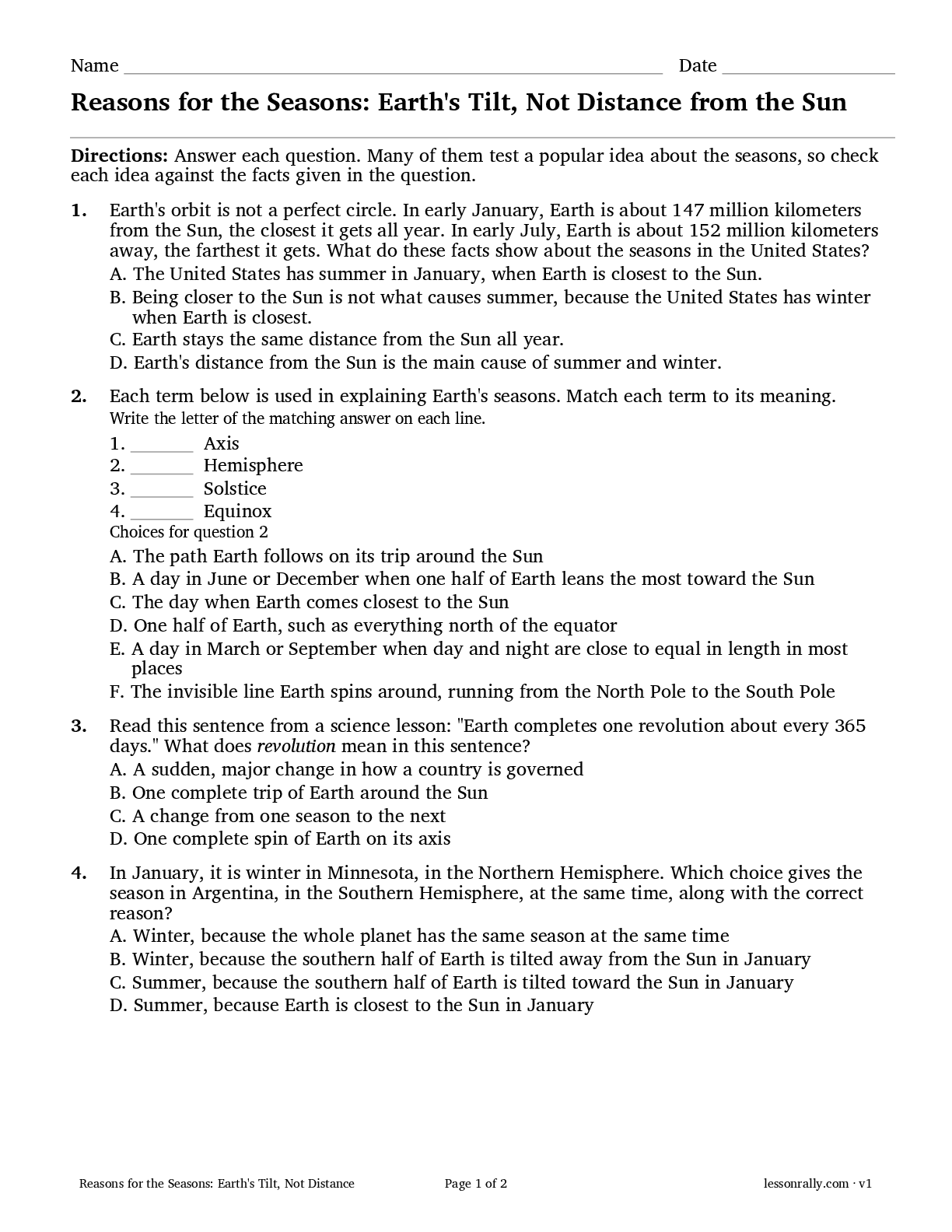
Answer each question. Many of them test a popular idea about the seasons, so check each idea against the facts given in the question.

Question 1

Earth's orbit is not a perfect circle. In early January, Earth is about 147 million kilometers from the Sun, the closest it gets all year. In early July, Earth is about 152 million kilometers away, the farthest it gets. What do these facts show about the seasons in the United States?

Choose one answer.

  • Earth stays the same distance from the Sun all year.
  • The United States has summer in January, when Earth is closest to the Sun.
  • Earth's distance from the Sun is the main cause of summer and winter.
  • Being closer to the Sun is not what causes summer, because the United States has winter when Earth is closest.
Question 2

Each term below is used in explaining Earth's seasons. Match each term to its meaning.

Match each item to an option.

Items

  1. Axis
  2. Hemisphere
  3. Solstice
  4. Equinox

Options

  1. A day in June or December when one half of Earth leans the most toward the Sun
  2. The invisible line Earth spins around, running from the North Pole to the South Pole
  3. The path Earth follows on its trip around the Sun
  4. The day when Earth comes closest to the Sun
  5. One half of Earth, such as everything north of the equator
  6. A day in March or September when day and night are close to equal in length in most places

Question 3

Read this sentence from a science lesson: "Earth completes one revolution about every 365 days." What does revolution mean in this sentence?

Choose one answer.

  • One complete spin of Earth on its axis
  • One complete trip of Earth around the Sun
  • A change from one season to the next
  • A sudden, major change in how a country is governed

Question 4

In January, it is winter in Minnesota, in the Northern Hemisphere. Which choice gives the season in Argentina, in the Southern Hemisphere, at the same time, along with the correct reason?

Choose one answer.

  • Summer, because the southern half of Earth is tilted toward the Sun in January
  • Winter, because the whole planet has the same season at the same time
  • Summer, because Earth is closest to the Sun in January
  • Winter, because the southern half of Earth is tilted away from the Sun in January

Question 5

Kayla thinks summer is warm because the Sun gives off more energy during the summer months. Which fact shows that her idea cannot explain the seasons?

Choose one answer.

  • When it is summer in the Northern Hemisphere, it is winter in the Southern Hemisphere, even though the same Sun lights both halves at the same time.
  • The Sun is much larger than Earth.
  • The Sun looks dimmer at sunset than it does at noon.
  • Summer days have more hours of daylight than winter days.

Question 6

Talia shines a flashlight straight down at a table and sees a small, bright circle. When she tilts the flashlight to a low angle, the same light spreads into a larger, dimmer oval. What does this model show about summer?

Choose one answer.

  • In summer, the Sun shines brighter, like turning up a flashlight.
  • In summer, the Sun is closer, so its light makes a brighter spot on the ground.
  • In summer, sunlight arrives at a low angle and spreads out, which heats the ground more.
  • In summer, sunlight strikes the ground more directly, so the same energy falls on a smaller area and heats it more.

Question 7

Chicago gets about 15 hours of daylight in late June but only about 9 hours in late December. What causes the difference?

Choose one answer.

  • The Sun gives off light for more hours each day in June.
  • Earth turns more slowly in June, which stretches out each day.
  • In June, the northern half of Earth leans toward the Sun, so Chicago spends more of each day on Earth's sunlit side.
  • Earth is closer to the Sun in June, so sunlight reaches farther around the planet.

Question 8

In June, the Northern Hemisphere is tilted toward the Sun. Jordan says the north is warmer then because the tilt brings it closer to the Sun. Earth is about 150 million kilometers from the Sun, and the tilt moves the northern half closer by only a few thousand kilometers. What does this tell you about Jordan's idea?

Choose one answer.

  • Jordan is right: even a few thousand kilometers closer makes the north much warmer.
  • Jordan is wrong, because the tilt moves the northern half farther from the Sun in June.
  • Jordan is right, but only near the North Pole, which gets the closest.
  • Jordan is wrong: a few thousand kilometers is tiny compared with 150 million kilometers, so it cannot explain summer.

Question 9

All year long, Earth's axis points toward almost the same spot in space, close to the North Star. So why does the northern half of Earth lean toward the Sun in June but away from it in December?

Choose one answer.

  • Earth rocks back and forth on its axis once a year, like a rocking chair.
  • Earth's axis flips to point the other way every six months.
  • Earth's tilt grows larger in June and smaller in December.
  • By December, Earth has moved to the opposite side of its orbit, so the same tilt now points the north away from the Sun.

Question 10

On the June solstice, the Sun climbs higher over Denver, Colorado, than on any other day of the year. Where is the Sun when it reaches its highest point that day?

Choose one answer.

  • High in the northern sky
  • High in the southern sky, but not straight overhead
  • Straight overhead, so a flagpole casts no shadow
  • Low in the southern sky, just above the horizon

Reviews

No reviews yet.

Reviews come from teachers who assigned this activity to a class.

Sign in to write a review

Have a topic of your own? Make a printable worksheet and online quiz, free.

Create an activity

Answer key

Answer keys come with Premium

Print this worksheet with the correct answers marked. The key includes any explanations, sample answers, and rubrics supplied with the activity.

Answer keys aren't public: only teachers with Premium and the people who can edit an activity can download one, so students can't get a ready-to-print key from this page.

Premium includes:

  • No ads for you, and no ads for your students on the assignments you post.
  • Answer keys for printable worksheets, with the correct answers marked and any explanations, sample answers, and rubrics.
  • Create with AI: up to 100 activities a year (5 during the free trial), with every answer checked before you see the draft.

$29 a year, plus sales tax where it applies.

New Premium teachers can try it free for 7 days. A card or other payment method is needed to start. Unless you cancel before the trial ends, you are charged then and the plan renews every year.

Already have Premium or edit this activity? Sign in