Question 1
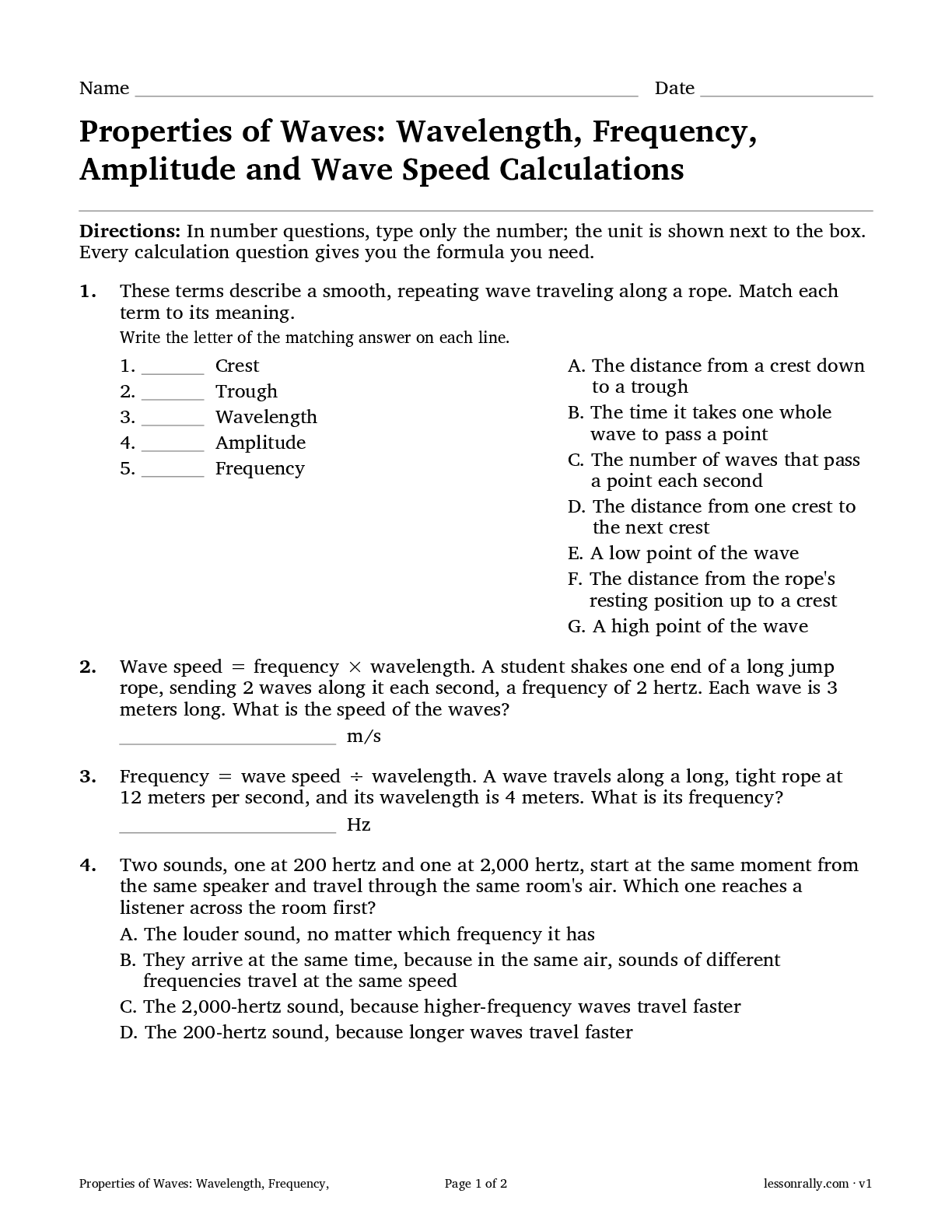
These terms describe a smooth, repeating wave traveling along a rope. Match each term to its meaning.
Match each item to an option.
Items
- Crest
- Trough
- Wavelength
- Amplitude
- Frequency
Options


Teachers who sign in can assign LessonRally activities to their Google Classroom classes: students open them in Classroom and answer online, and their grades go to the teacher's Classroom gradebook. Practice lets you try it first, the way students see it.
Free for teachers. Sign in to assign activities to your Google Classroom classes.
 (opens in a new tab)
2 pages · Student copy, no answers
Print worksheet (opens in a new tab)Answer keyPremiumStudents match wave properties to their meanings, calculate wave speed, frequency and wavelength with wave speed = frequency × wavelength, and explain how amplitude relates to a wave's energy and loudness and how frequency relates to pitch. Questions take on the ideas that higher-pitched sounds travel faster, that sound can cross empty space, and that a wave carries the water along with it.
Learning goal: Use wave speed = frequency × wavelength to calculate properties of waves, and explain how amplitude relates to a wave's energy, how frequency relates to pitch, and why sound needs a medium.
The estimate is halfway between the two middle scores of four readability formulas. Their scores run from 5.0 to 8.1.
Adapted from common readability formulas (Flesch-Kincaid, Gunning Fog, Coleman-Liau and ARI, plus SMOG for long texts), which look at sentence length and word length. Answer choices count toward word length only. Grades below the estimate will likely find the text harder, grades above it easier. It does not measure ideas, background knowledge or images.
Topic: Waves, Light and Sound Chosen by LessonRally
Question types: matching, number answer, multiple choice.
The questions as students see them, without the answers.
In number questions, type only the number; the unit is shown next to the box. Every calculation question gives you the formula you need.
These terms describe a smooth, repeating wave traveling along a rope. Match each term to its meaning.
Match each item to an option.
Items
Options
Wave speed = frequency × wavelength. A student shakes one end of a long jump rope, sending 2 waves along it each second, a frequency of 2 hertz. Each wave is 3 meters long. What is the speed of the waves?
Enter a number.
m/s
Frequency = wave speed ÷ wavelength. A wave travels along a long, tight rope at 12 meters per second, and its wavelength is 4 meters. What is its frequency?
Enter a number.
Hz
Two sounds, one at 200 hertz and one at 2,000 hertz, start at the same moment from the same speaker and travel through the same room's air. Which one reaches a listener across the room first?
Choose one answer.
A guitarist plays a higher note, and its sound travels through the same air as before, at the same speed. Compared with the lower note, what is different about the higher note's sound wave?
Choose one answer.
Wavelength = wave speed ÷ frequency. Sound travels through air at 20 °C at about 343 meters per second. Using 343 meters per second, what is the wavelength of a low bass note with a frequency of 49 hertz?
Enter a number.
m
Maya turns up the volume on a speaker that keeps playing the same note. Which property of the sound wave increases?
Choose one answer.
Wavelength = wave speed ÷ frequency. Sound travels through fresh water at 20 °C at about 1,480 meters per second. Using 1,480 meters per second, what is the wavelength of a 740-hertz sound in a lake?
Enter a number.
m
Far out in space, a small rock smashes into a satellite with a bright flash. An astronaut floating nearby, not touching anything, sees the flash but hears no sound. Why?
Choose one answer.
A rubber duck floats on a calm pond on a windless day while a series of small waves passes underneath it. What happens to the duck as the waves go by?
Choose one answer.
No reviews yet.
Reviews come from teachers who assigned this activity to a class.
Have a topic of your own? Make a printable worksheet and online quiz, free.
Create an activityCommon Core RST.6-8.7
Made by Myra Jefferson · LessonRally (AI-assisted)
Made by Myra Jefferson · LessonRally (AI-assisted)
Common Core RST.6-8.7
Made by Myra Jefferson · LessonRally (AI-assisted)
Common Core RST.6-8.4
Made by Myra Jefferson · LessonRally (AI-assisted)