Question 1
Why is coal called nonrenewable?
Choose one answer.
- It makes no smoke when it burns.
- It is too heavy to move by train.
- It cannot be burned.
- Once it is burned, making new coal would take nature millions of years.


Teachers who sign in can assign LessonRally activities to their Google Classroom classes: students open them in Classroom and answer online, and their grades go to the teacher's Classroom gradebook. Practice lets you try it first, the way students see it.
Free for teachers. Sign in to assign activities to your Google Classroom classes.
 (opens in a new tab)
2 pages · Student copy, no answers
Print worksheet (opens in a new tab)Answer keyPremiumStudents read about a car trip past wind turbines and a coal train and explain the difference between renewable and nonrenewable energy resources. Questions cover why the wind is not used up, why coal, natural gas, and oil are called nonrenewable fossil fuels, how solar panels and dams make electricity, and how using any energy resource can change the environment.
Learning goal: Explain why sunlight, wind, and moving water are renewable and coal, natural gas, and oil are not, and describe how using energy resources can affect the environment.
The estimate is the middle score of five readability formulas. Their scores run from 3.6 to 7.4.
Adapted from common readability formulas (Flesch-Kincaid, Gunning Fog, Coleman-Liau and ARI, plus SMOG for long texts), which look at sentence length and word length. Answer choices count toward word length only. Grades below the estimate will likely find the text harder, grades above it easier. It does not measure ideas, background knowledge or images.
Refer to details and examples in a text when explaining what the text says explicitly and when drawing inferences from the text.
Explain events, procedures, ideas, or concepts in a historical, scientific, or technical text, including what happened and why, based on specific information in the text.
Matched independently by two AI models from this activity's questions.
© Copyright 2010. National Governors Association Center for Best Practices and Council of Chief State School Officers. All rights reserved.
Topic: Energy Chosen by LessonRally
Question types: multiple choice, fill in the blank.
The questions as students see them, without the answers.
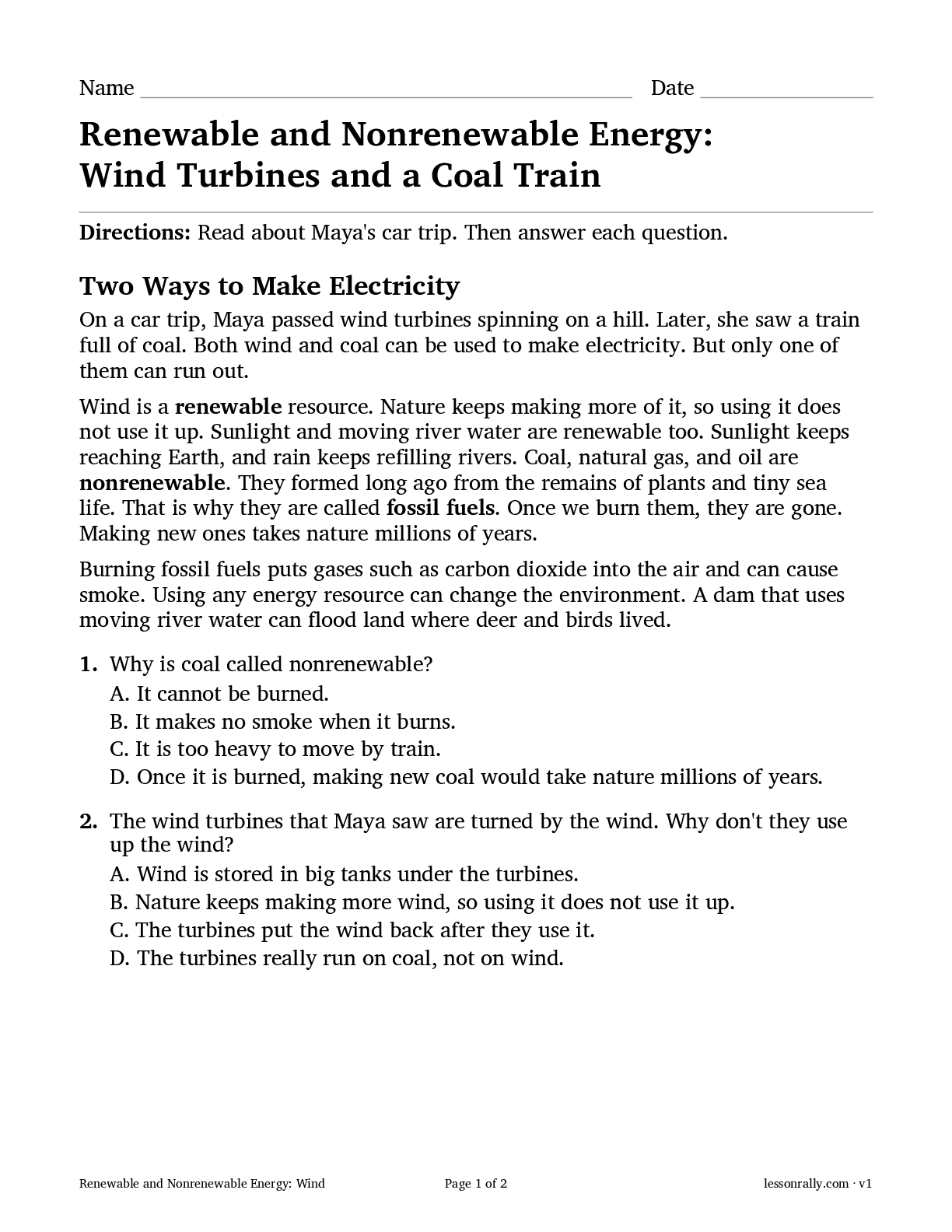
Read about Maya's car trip. Then answer each question.
On a car trip, Maya passed wind turbines spinning on a hill. Later, she saw a train full of coal. Both wind and coal can be used to make electricity. But only one of them can run out.
Wind is a renewable resource. Nature keeps making more of it, so using it does not use it up. Sunlight and moving river water are renewable too. Sunlight keeps reaching Earth, and rain keeps refilling rivers. Coal, natural gas, and oil are nonrenewable. They formed long ago from the remains of plants and tiny sea life. That is why they are called fossil fuels. Once we burn them, they are gone. Making new ones takes nature millions of years.
Burning fossil fuels puts gases such as carbon dioxide into the air and can cause smoke. Using any energy resource can change the environment. A dam that uses moving river water can flood land where deer and birds lived.
Why is coal called nonrenewable?
Choose one answer.
The wind turbines that Maya saw are turned by the wind. Why don't they use up the wind?
Choose one answer.
Use the word bank to finish the sentences about two other ways to make electricity.
Fill in each blank.
Solar panels on a roof make electricity from blank 1. At a dam, moving blank 2 from a river spins turbines, too.
Word bank
Why are coal, natural gas, and oil called fossil fuels?
Choose one answer.
What does the passage say happens to the air when coal is burned?
Choose one answer.
Maya says, "Renewable energy never changes the environment." Which detail from the passage shows that she is wrong?
Choose one answer.
Maya's neighbor puts solar panels on her roof. Why is sunlight called renewable?
Choose one answer.
What would happen if the wind stopped blowing for a few days near the turbines Maya saw?
Choose one answer.
No reviews yet.
Reviews come from teachers who assigned this activity to a class.
Have a topic of your own? Make a printable worksheet and online quiz, free.
Create an activityCommon Core RI.4.3
Made by Wes Calloway · LessonRally (AI-assisted)
Common Core RI.4.3
Made by Wes Calloway · LessonRally (AI-assisted)
Common Core RI.4.4
Made by Wes Calloway · LessonRally (AI-assisted)
Common Core RI.4.1
Made by Wes Calloway · LessonRally (AI-assisted)