Earthquakes and Volcanoes: Reading USGS Data on Magnitude, Plate Boundaries and Hot Spots

8 questions · 8 points · Grades 6–7 · English · Preview the 8 questions

Made by Theo Nakamura · LessonRally (AI-assisted)

Digital classroom activity

What is a digital classroom activity?

Teachers who sign in can assign LessonRally activities to their Google Classroom classes: students open them in Classroom and answer online, and their grades go to the teacher's Classroom gradebook. Practice lets you try it first, the way students see it.

Free for teachers. Sign in to assign activities to your Google Classroom classes.

Printable worksheet

Students read a short passage and a USGS table of six large earthquakes to compare magnitudes, connect earthquakes and volcanoes to plate boundaries and the Hawaii hot spot, and tell forecasting apart from prediction and early warning. Questions take on the ideas that each magnitude step adds a fixed amount, that every earthquake happens at a plate boundary and that earthquakes follow a schedule.

Learning goal: Use magnitude data and plate settings to compare earthquakes, explain why most earthquakes and volcanoes occur near plate boundaries but some, like Hawaii's, do not, and describe how scientists forecast earthquake chances.

Estimated reading level 8.7

  1. Grade 6Hard
  2. Grade 7Stretch
  3. Grade 8On level
  4. Grade 9Easier
  5. Grade 10Easy
About this estimate

The estimate is the middle score of five readability formulas. Their scores run from 6.6 to 9.4.

  • Flesch-Kincaid GradeSentence length and syllables per word6.6
  • Gunning Fog Middle scoreSentence length and words of three or more syllables8.7
  • Coleman-LiauLetters per word and sentences per 100 words8.9
  • Automated Readability IndexCharacters per word and words per sentence7.3
  • SMOGWords of three or more syllables, for texts of 30 sentences or more9.4
Flesch Reading Ease
71.9 on a 0 to 100 scale where higher is easier: fairly easy. Not part of the estimate.
Text measured
823 words, 38 sentences

Adapted from common readability formulas (Flesch-Kincaid, Gunning Fog, Coleman-Liau and ARI, plus SMOG for long texts), which look at sentence length and word length. Answer choices count toward word length only. Grades below the estimate will likely find the text harder, grades above it easier. It does not measure ideas, background knowledge or images.

Common Core

Closest anchor: CCRA.R.7 Integrate and evaluate content presented in diverse media and formats, including visually and quantitatively, as well as in words.Anchor Standards for ReadingShow 1 matched standardHide matched standard

Matched standard

  • RST.6-8.7

    Integrate quantitative or technical information expressed in words in a text with a version of that information expressed visually (e.g., in a flowchart, diagram, model, graph, or table).

    Student preview question 1

Matched independently by two AI models from this activity's questions.

© Copyright 2010. National Governors Association Center for Best Practices and Council of Chief State School Officers. All rights reserved.

Topic: Rocks, Minerals and Plate Tectonics Chosen by LessonRally

Question types: number answer, select all that apply, multiple choice.

Student preview

The questions as students see them, without the answers.

Read the passage and study the data table. In number questions, type only the number; the unit is shown next to the box.

Six Large Earthquakes

Use the passage and the data table to answer these questions.

Earthquake Size, Location and Warnings

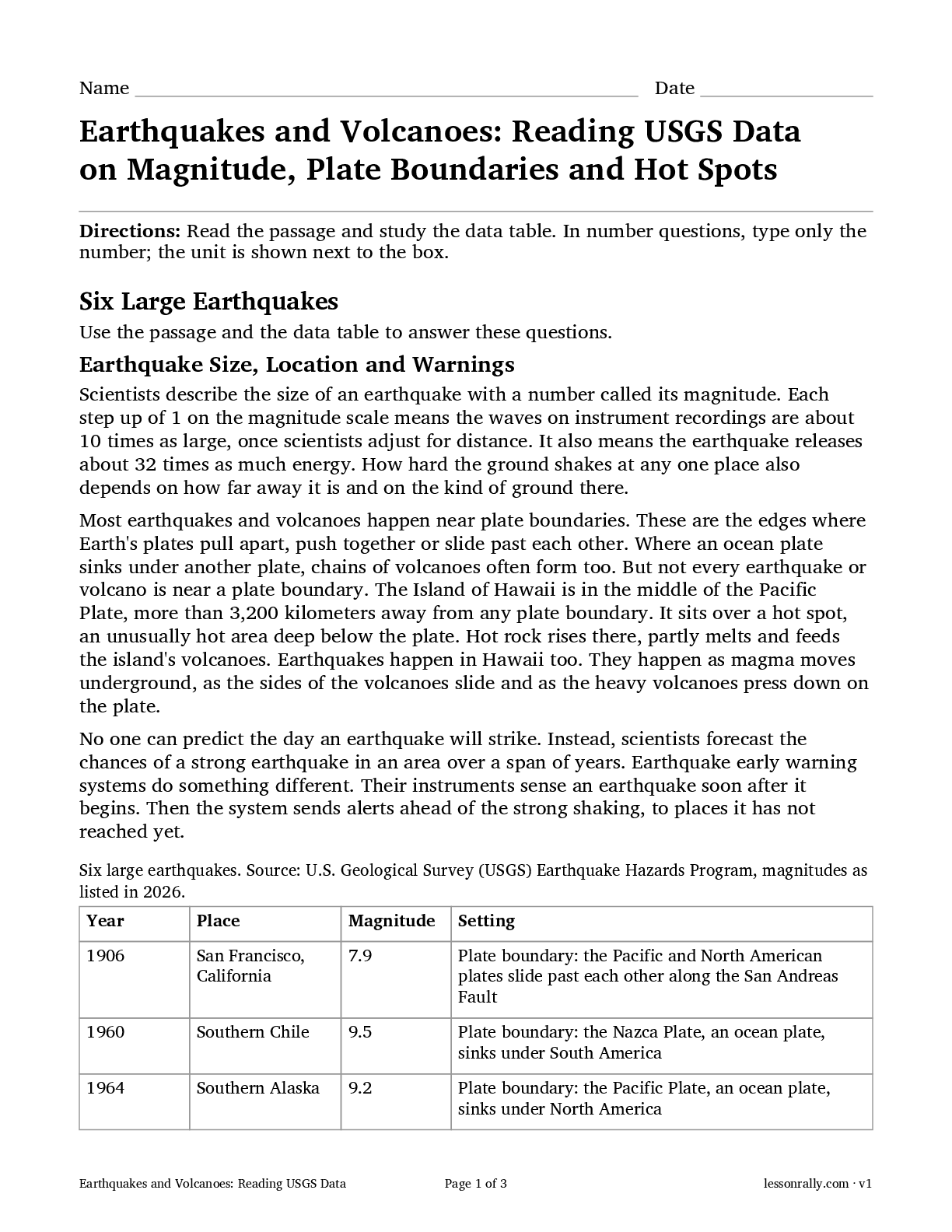
Scientists describe the size of an earthquake with a number called its magnitude. Each step up of 1 on the magnitude scale means the waves on instrument recordings are about 10 times as large, once scientists adjust for distance. It also means the earthquake releases about 32 times as much energy. How hard the ground shakes at any one place also depends on how far away it is and on the kind of ground there.

Most earthquakes and volcanoes happen near plate boundaries. These are the edges where Earth's plates pull apart, push together or slide past each other. Where an ocean plate sinks under another plate, chains of volcanoes often form too. But not every earthquake or volcano is near a plate boundary. The Island of Hawaii is in the middle of the Pacific Plate, more than 3,200 kilometers away from any plate boundary. It sits over a hot spot, an unusually hot area deep below the plate. Hot rock rises there, partly melts and feeds the island's volcanoes. Earthquakes happen in Hawaii too. They happen as magma moves underground, as the sides of the volcanoes slide and as the heavy volcanoes press down on the plate.

No one can predict the day an earthquake will strike. Instead, scientists forecast the chances of a strong earthquake in an area over a span of years. Earthquake early warning systems do something different. Their instruments sense an earthquake soon after it begins. Then the system sends alerts ahead of the strong shaking, to places it has not reached yet.


Six large earthquakes. Source: U.S. Geological Survey (USGS) Earthquake Hazards Program, magnitudes as listed in 2026.
YearPlaceMagnitudeSetting
1906San Francisco, California7.9Plate boundary: the Pacific and North American plates slide past each other along the San Andreas Fault
1960Southern Chile9.5Plate boundary: the Nazca Plate, an ocean plate, sinks under South America
1964Southern Alaska9.2Plate boundary: the Pacific Plate, an ocean plate, sinks under North America
1989Loma Prieta, California6.9Plate boundary: the San Andreas Fault system
2015Gorkha, Nepal7.8Plate boundary: the India and Eurasia plates, both carrying continents, push together
2018Island of Hawaii6.9Hot spot in the middle of the Pacific Plate, far from any plate boundary

Question 1

On the magnitude scale, each step of 1 stands for waves about 10 times as large on adjusted instrument recordings. Use 10 for each step. By this rule, how many times as large were the waves of the 1906 San Francisco earthquake as those of the 1989 Loma Prieta earthquake?

Enter a number.

times

Question 2

Each step of 1 in magnitude means about 32 times as much energy released. Use 32 for each step. How many times as much energy does a magnitude 8.0 earthquake release as a magnitude 6.0 earthquake? Type your answer without a comma.

Enter a number.

times

Question 3

According to the table, which two earthquakes happened where an ocean plate sinks under another plate?

Choose 2 answers.

  • The 2018 earthquake on the Island of Hawaii
  • The 1964 earthquake in Southern Alaska
  • The 1906 earthquake in San Francisco, California
  • The 2015 earthquake in Gorkha, Nepal
  • The 1960 earthquake in Southern Chile

Question 4

In this table, which kind of setting had the two largest earthquakes?

Choose one answer.

  • An ocean plate sinking under another plate
  • Two plates carrying continents pushing together
  • Two plates sliding past each other
  • A hot spot in the middle of a plate

Question 5

A classmate says, "Earthquakes happen only at plate boundaries." Which statement about the passage and table is true?

Choose one answer.

  • They support the claim, because every earthquake in the table happened at a plate boundary.
  • They support the claim, because a hot spot is one kind of plate boundary.
  • They do not support the claim, because most earthquakes in the table happened far from plate boundaries.
  • They do not support the claim, because the 2018 Hawaii earthquake happened far from any plate boundary, in the middle of a plate.

Question 6

According to the passage, why does the Island of Hawaii have volcanoes even though it is far from any plate boundary?

Choose one answer.

  • Two plates are pulling apart under the island, letting magma rise between them.
  • Two plates are sliding past each other under the island, and the rubbing melts the rock.
  • The Pacific Plate is sinking under another plate right next to the island.
  • Hot rock rising from an unusually hot area deep below the middle of the Pacific Plate partly melts and feeds the volcanoes.

Question 7

The 1906 San Francisco and 1989 Loma Prieta earthquakes both struck the San Andreas Fault system, 83 years apart. What can scientists say about when the next large earthquake there will strike?

Choose one answer.

  • There will be no more large earthquakes there, because the fault already released its energy.
  • It will strike in 2072, exactly 83 years after 1989.
  • They can use the 83-year gap to predict the exact day.
  • They cannot name the day, but they can forecast the chances of a large earthquake there over a span of years.

Question 8

Leo's phone shows an earthquake early warning alert. A few seconds later, the ground where he is starts to shake. Which statement best explains how the alert came before the shaking?

Choose one answer.

  • The alert went out before the earthquake started, because the ground gave a warning sign.
  • The alert made the shaking reach Leo later than it would have.
  • Instruments sensed the earthquake soon after it began, and the alert reached Leo before the shaking did.
  • Scientists predicted the day before that an earthquake would strike at that moment.

Reviews

No reviews yet.

Reviews come from teachers who assigned this activity to a class.

Sign in to write a review

Have a topic of your own? Make a printable worksheet and online quiz, free.

Create an activity

Answer key

Answer keys come with Premium

Print this worksheet with the correct answers marked. The key includes any explanations, sample answers, and rubrics supplied with the activity.

Answer keys aren't public: only teachers with Premium and the people who can edit an activity can download one, so students can't get a ready-to-print key from this page.

Premium includes:

  • No ads for you, and no ads for your students on the assignments you post.
  • Answer keys for printable worksheets, with the correct answers marked and any explanations, sample answers, and rubrics.
  • Create with AI: up to 100 activities a year (5 during the free trial), with every answer checked before you see the draft.

$29 a year, plus sales tax where it applies.

New Premium teachers can try it free for 7 days. A card or other payment method is needed to start. Unless you cancel before the trial ends, you are charged then and the plan renews every year.

Already have Premium or edit this activity? Sign in