The Rock Cycle: How Igneous, Sedimentary and Metamorphic Rocks Form and Change

8 questions · 12 points · Grades 6–7 · English · Preview the 8 questions

Made by Theo Nakamura · LessonRally (AI-assisted)

Digital classroom activity

What is a digital classroom activity?

Teachers who sign in can assign LessonRally activities to their Google Classroom classes: students open them in Classroom and answer online, and their grades go to the teacher's Classroom gradebook. Practice lets you try it first, the way students see it.

Free for teachers. Sign in to assign activities to your Google Classroom classes.
Printable worksheet

Students match rock cycle terms to their meanings, work out what words like cemented and erosion mean in context, and explain how igneous, sedimentary and metamorphic rocks form and change into one another. Questions cover weathering, erosion, magma, sediment, crystal size, fossils and the energy that drives the rock cycle.

Learning goal: Describe how igneous, sedimentary and metamorphic rocks form and change into one another in the rock cycle, and determine the meaning of rock cycle terms as they are used in context.

Estimated reading level 7.4

  1. Grade 5Hard
  2. Grade 6Stretch
  3. Grade 7On level
  4. Grade 8Easier
  5. Grade 9Easy
About this estimate

The estimate is halfway between the two middle scores of four readability formulas. Their scores run from 6.0 to 9.7.

  • Flesch-Kincaid GradeSentence length and syllables per word6.0
  • Gunning Fog Middle scoreSentence length and words of three or more syllables7.9
  • Coleman-LiauLetters per word and sentences per 100 words9.7
  • Automated Readability Index Middle scoreCharacters per word and words per sentence6.9
Flesch Reading Ease
73.0 on a 0 to 100 scale where higher is easier: fairly easy. Not part of the estimate.
Text measured
629 words, 20 sentences

Adapted from common readability formulas (Flesch-Kincaid, Gunning Fog, Coleman-Liau and ARI, plus SMOG for long texts), which look at sentence length and word length. Answer choices count toward word length only. Grades below the estimate will likely find the text harder, grades above it easier. It does not measure ideas, background knowledge or images.

Common Core

Closest anchor: CCRA.L.4 Determine or clarify the meaning of unknown and multiple-meaning words and phrases by using context clues, analyzing meaningful word parts, and consulting general and specialized reference materials, as appropriate.Anchor Standards for LanguageShow 1 matched standardHide matched standard

Matched standard

  • L.6.4a

    Use context (e.g., the overall meaning of a sentence or paragraph; a word's position or function in a sentence) as a clue to the meaning of a word or phrase.

    Student preview questions 3, 4

Matched independently by two AI models from this activity's questions.

© Copyright 2010. National Governors Association Center for Best Practices and Council of Chief State School Officers. All rights reserved.

Topic: Rocks, Minerals and Plate Tectonics Chosen by LessonRally

Question types: matching, multiple choice.

Student preview

The questions as students see them, without the answers.

Answer each question. Some questions ask what a science word means in a sentence, so read that sentence closely.

Question 1

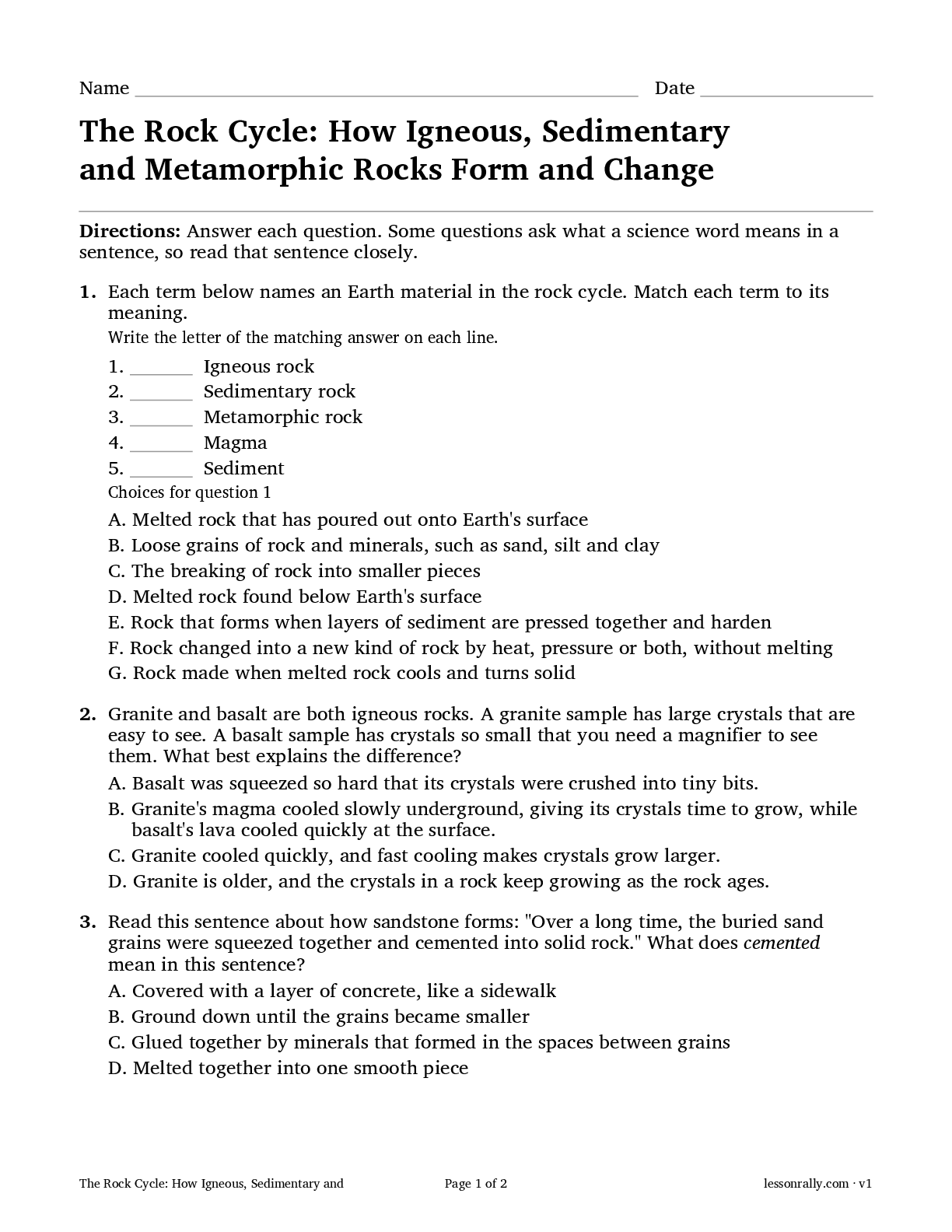
Each term below names an Earth material in the rock cycle. Match each term to its meaning.

Match each item to an option.

Items

  1. Igneous rock
  2. Sedimentary rock
  3. Metamorphic rock
  4. Magma
  5. Sediment

Options

  1. Melted rock found below Earth's surface
  2. Rock changed into a new kind of rock by heat, pressure or both, without melting
  3. The breaking of rock into smaller pieces
  4. Rock made when melted rock cools and turns solid
  5. Melted rock that has poured out onto Earth's surface
  6. Loose grains of rock and minerals, such as sand, silt and clay
  7. Rock that forms when layers of sediment are pressed together and harden

Question 2

Granite and basalt are both igneous rocks. A granite sample has large crystals that are easy to see. A basalt sample has crystals so small that you need a magnifier to see them. What best explains the difference?

Choose one answer.

  • Granite's magma cooled slowly underground, giving its crystals time to grow, while basalt's lava cooled quickly at the surface.
  • Granite is older, and the crystals in a rock keep growing as the rock ages.
  • Granite cooled quickly, and fast cooling makes crystals grow larger.
  • Basalt was squeezed so hard that its crystals were crushed into tiny bits.

Question 3

Read this sentence about how sandstone forms: "Over a long time, the buried sand grains were squeezed together and cemented into solid rock." What does cemented mean in this sentence?

Choose one answer.

  • Ground down until the grains became smaller
  • Covered with a layer of concrete, like a sidewalk
  • Melted together into one smooth piece
  • Glued together by minerals that formed in the spaces between grains

Question 4

Read this sentence: "Weathering cracked the granite into loose grains, and then erosion carried the grains down the mountain in a stream." What does erosion mean in this sentence?

Choose one answer.

  • The breaking of rock into smaller pieces
  • The melting of rock deep underground
  • The moving of rock pieces from one place to another by water, wind, ice or gravity
  • The pressing of loose grains into solid rock

Question 5

Dante writes in his notes: "Every rock goes through the rock cycle in the same order: igneous, then sedimentary, then metamorphic, then igneous again." Which statement corrects his notes?

Choose one answer.

  • Any kind of rock can become any other kind, so rocks take many different paths through the cycle.
  • Rocks follow that order, but they stop changing once they become metamorphic.
  • His notes are right, because each step must happen before the next one can start.
  • Only igneous rock can turn into other kinds of rock.

Question 6

Most metamorphic rock forms deep below Earth's surface. Why is deep underground a good place for it to form?

Choose one answer.

  • Rock deep underground melts completely, and that melted rock is what turns into metamorphic rock.
  • Deep underground, rock is protected from both heat and pressure.
  • The deeper you go, the hotter the rock gets, and the weight of the rock above squeezes it hard.
  • Wind and rain wear rock away fastest deep underground.

Question 7

Two energy sources keep the rock cycle going: heat from Earth's hot interior and energy from the Sun. Which part of the rock cycle is driven mainly by energy from the Sun?

Choose one answer.

  • Melting rock into magma deep underground
  • Pushing magma up toward the surface
  • Weathering and erosion, through wind, rain, flowing water and ice
  • Heating and squeezing rock into metamorphic rock

Question 8

A geologist finds the fossil of a seashell inside a layer of rock. Which kind of rock is the layer most likely to be?

Choose one answer.

  • Igneous rock, because melted rock keeps shells safe as it cools
  • Metamorphic rock, because heat and pressure help preserve shells
  • Any kind of rock, because fossils are found equally often in all three kinds
  • Sedimentary rock, because shells can be buried in layers of sediment that later harden into rock

Reviews

No reviews yet.

Reviews come from teachers who assigned this activity to a class.

Sign in to write a review

Have a topic of your own? Make a printable worksheet and online quiz, free.

Create an activity

Answer key

Answer keys come with Premium

Print this worksheet with the correct answers marked. The key includes any explanations, sample answers, and rubrics supplied with the activity.

Answer keys aren't public: only teachers with Premium and the people who can edit an activity can download one, so students can't get a ready-to-print key from this page.

Premium includes:

  • No ads for you, and no ads for your students on the assignments you post.
  • Answer keys for printable worksheets, with the correct answers marked and any explanations, sample answers, and rubrics.
  • Create with AI: up to 100 activities a year (5 during the free trial), with every answer checked before you see the draft.

$29 a year, plus sales tax where it applies.

New Premium teachers can try it free for 7 days. A card or other payment method is needed to start. Unless you cancel before the trial ends, you are charged then and the plan renews every year.

Already have Premium or edit this activity? Sign in