Question 1
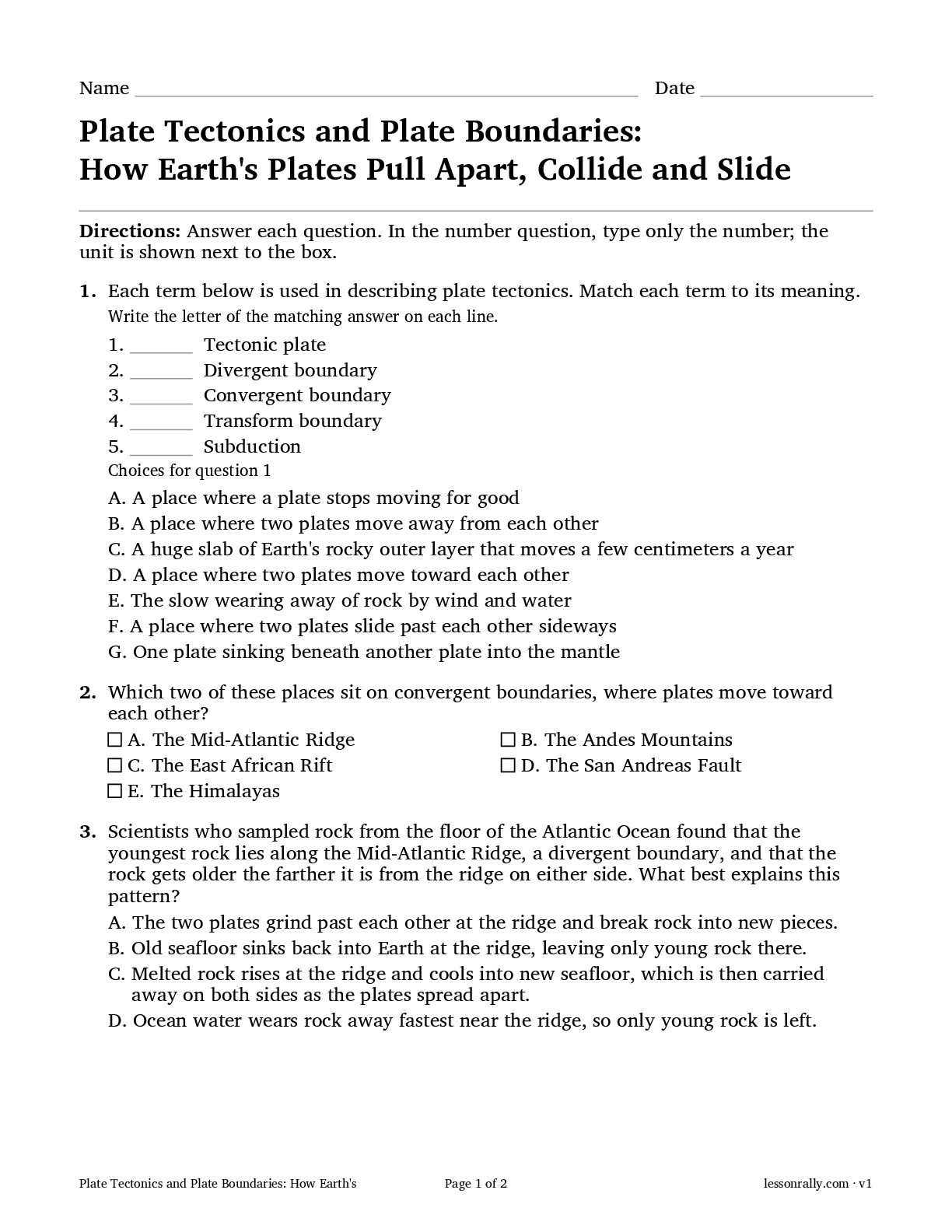
Each term below is used in describing plate tectonics. Match each term to its meaning.
Match each item to an option.
Items
- Tectonic plate
- Divergent boundary
- Convergent boundary
- Transform boundary
- Subduction
Options


Teachers who sign in can assign LessonRally activities to their Google Classroom classes: students open them in Classroom and answer online, and their grades go to the teacher's Classroom gradebook. Practice lets you try it first, the way students see it.
Free for teachers. Sign in to assign activities to your Google Classroom classes.
 (opens in a new tab)
2 pages · Student copy, no answers
Print worksheet (opens in a new tab)Answer keyPremiumStudents match plate tectonics terms to their meanings, decide which kind of plate boundary each place sits on (divergent, convergent or transform), and explain how moving plates build mid-ocean ridges, trenches, volcanoes, mountains and earthquakes. Questions take on the idea that plates float on a sea of magma, and a calculation shows how a few centimeters a year adds up over a million years.
Learning goal: Describe divergent, convergent and transform plate boundaries and explain how plate motion produces features such as mid-ocean ridges, trenches, volcanoes, mountains and earthquakes.
The estimate is halfway between the two middle scores of four readability formulas. Their scores run from 5.3 to 8.6.
Adapted from common readability formulas (Flesch-Kincaid, Gunning Fog, Coleman-Liau and ARI, plus SMOG for long texts), which look at sentence length and word length. Answer choices count toward word length only. Grades below the estimate will likely find the text harder, grades above it easier. It does not measure ideas, background knowledge or images.
Topic: Rocks, Minerals and Plate Tectonics Chosen by LessonRally
Question types: matching, select all that apply, multiple choice, number answer.
The questions as students see them, without the answers.
Answer each question. In the number question, type only the number; the unit is shown next to the box.
Each term below is used in describing plate tectonics. Match each term to its meaning.
Match each item to an option.
Items
Options
Which two of these places sit on convergent boundaries, where plates move toward each other?
Choose 2 answers.
Scientists who sampled rock from the floor of the Atlantic Ocean found that the youngest rock lies along the Mid-Atlantic Ridge, a divergent boundary, and that the rock gets older the farther it is from the ridge on either side. What best explains this pattern?
Choose one answer.
Along the west coast of South America, the oceanic Nazca Plate sinks beneath the South American Plate. Which set of features would you most likely find there?
Choose one answer.
The Himalayas formed where the plate carrying India pushes into the Eurasian Plate. Both plates carry thick continental crust. Why did this collision push up very high mountains instead of making a deep ocean trench?
Choose one answer.
The San Andreas Fault in California is a transform boundary, where the Pacific Plate and the North American Plate slide past each other. Why are earthquakes common there?
Choose one answer.
Owen says Earth's plates float on a sea of melted rock, the way ice floats on a lake. What is wrong with his idea?
Choose one answer.
Distance = speed × time. Suppose a plate moves 5 centimeters a year. How many kilometers would it move in 1,000,000 years? There are 100,000 centimeters in 1 kilometer.
Enter a number.
km
No reviews yet.
Reviews come from teachers who assigned this activity to a class.
Have a topic of your own? Make a printable worksheet and online quiz, free.
Create an activityCommon Core RST.6-8.7
Made by Theo Nakamura · LessonRally (AI-assisted)
Common Core RST.6-8.4
Made by Myra Jefferson · LessonRally (AI-assisted)
Made by Theo Nakamura · LessonRally (AI-assisted)
Common Core RST.6-8.4
Made by Myra Jefferson · LessonRally (AI-assisted)