Made by Simone Thornbury · LessonRally (AI-assisted)
Digital classroom activity
What is a digital classroom activity?
Teachers who sign in can assign LessonRally activities to their Google Classroom classes: students open them in Classroom and answer online, and their grades go to the teacher's Classroom gradebook. Practice lets you try it first, the way students see it.
Students learn how the prefixes un-, in-, im-, dis- and non- add the meaning not to a base word. They match prefixed words to their meanings, complete sentences from a word bank, use a prefix and context clues to decode new words, and practice spotting words where in- or im- means in or into instead of not. A grade 6 set on prefixes that mean not.
Learning goal: Use the prefixes un-, in-, im-, dis- and non- to work out word meanings, and tell when in- or im- means in or into instead of not.
Estimated reading level6.7
Grade 4Hard
Grade 5Stretch
Grade 6On level
Grade 7Easier
Grade 8Easy
About this estimate
The estimate is the middle score of five readability formulas. Their scores run from 4.9 to 7.9.
Flesch-Kincaid GradeSentence length and syllables per word5.5
Gunning FogSentence length and words of three or more syllables7.9
Coleman-Liau Middle scoreLetters per word and sentences per 100 words6.7
Automated Readability IndexCharacters per word and words per sentence4.9
SMOGWords of three or more syllables, for texts of 30 sentences or more7.7
Grade 181216
Flesch Reading Ease
78.4 on a 0 to 100 scale where higher is easier: fairly easy. Not part of the estimate.
Text measured
618 words, 30 sentences
Adapted from common readability formulas (Flesch-Kincaid, Gunning Fog, Coleman-Liau and ARI, plus SMOG for long texts), which look at sentence length and word length. Answer choices count toward word length only. Grades below the estimate will likely find the text harder, grades above it easier. It does not measure ideas, background knowledge or images.
Common Core
Press Ctrl+C or Command+C to copy.
Closest anchor:CCRA.L.4Determine or clarify the meaning of unknown and multiple-meaning words and phrases by using context clues, analyzing meaningful word parts, and consulting general and specialized reference materials, as appropriate.Anchor Standards for LanguageShow 1 matched standardHide matched standard
Question types: matching, fill in the blank, multiple choice.
Student preview
The questions as students see them, without the answers.
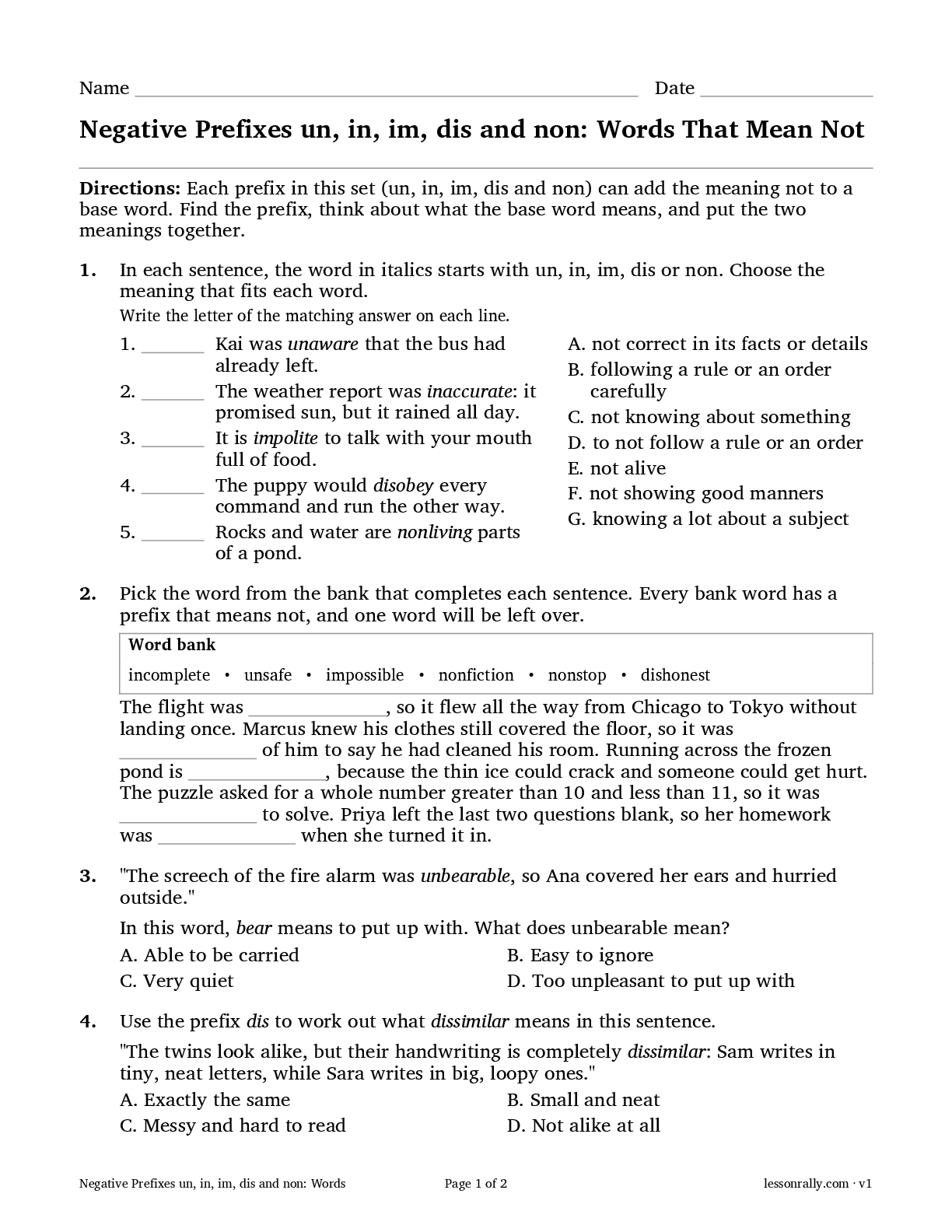
Each prefix in this set (un, in, im, dis and non) can add the meaning not to a base word. Find the prefix, think about what the base word means, and put the two meanings together.
Question 1
In each sentence, the word in italics starts with un, in, im, dis or non. Choose the meaning that fits each word.
Match each item to an option.
Items
Kai was unaware that the bus had already left.
The weather report was inaccurate: it promised sun, but it rained all day.
It is impolite to talk with your mouth full of food.
The puppy would disobey every command and run the other way.
Rocks and water are nonliving parts of a pond.
Options
following a rule or an order carefully
to not follow a rule or an order
knowing a lot about a subject
not showing good manners
not knowing about something
not correct in its facts or details
not alive
Question 2
Pick the word from the bank that completes each sentence. Every bank word has a prefix that means not, and one word will be left over.
Fill in each blank.
The flight was blank 1, so it flew all the way from Chicago to Tokyo without landing once. Marcus knew his clothes still covered the floor, so it was blank 2 of him to say he had cleaned his room. Running across the frozen pond is blank 3, because the thin ice could crack and someone could get hurt. The puzzle asked for a whole number greater than 10 and less than 11, so it was blank 4 to solve. Priya left the last two questions blank, so her homework was blank 5 when she turned it in.
Word bank
incomplete
unsafe
dishonest
impossible
nonfiction
nonstop
Question 3
"The screech of the fire alarm was unbearable, so Ana covered her ears and hurried outside."
In this word, bear means to put up with. What does unbearable mean?
Choose one answer.
Easy to ignore
Very quiet
Able to be carried
Too unpleasant to put up with
Question 4
Use the prefix dis to work out what dissimilar means in this sentence.
"The twins look alike, but their handwriting is completely dissimilar: Sam writes in tiny, neat letters, while Sara writes in big, loopy ones."
Choose one answer.
Messy and hard to read
Exactly the same
Not alike at all
Small and neat
Question 5
"Coal is a nonrenewable resource. Once people dig it up and burn it, nature needs millions of years to make more."
If renewable means able to be replaced, what does nonrenewable mean?
Choose one answer.
Not useful for heating homes
Able to be used again and again
Not able to be replaced as fast as people use it
Found only under the ocean
Question 6
Edible means safe and fit to eat. Which phrase could replace inedible in this sentence?
"After the bread burned black in the oven, it was inedible, and the family had to throw it away."
Choose one answer.
too heavy to lift
too hot to touch
not fit to eat
fresh and tasty
Question 7
"After the blizzard, the cars on Hill Street were immobile, buried in snow up to their windows."
The base word mobile means able to move. How would you describe the cars?
Choose one answer.
They were brand new.
They could not move.
They were moving slowly.
They had just been washed.
Question 8
The prefix in does not always mean not. In which word does in mean not?
Choose one answer.
insert
inhale
indoor
incorrect
Question 9
Which prefix turns patient (able to wait calmly) into the usual English word today for someone who has trouble waiting calmly?
Choose one answer.
dis
in
im
un
Question 10
Each sentence uses a word that begins with im. In which sentence does im mean not?
Choose one answer.
The flooded dirt road was impassable for a week.
The grocery store imports bananas from Ecuador.
The family plans to immigrate to Canada next year.
The vet will implant a tiny ID chip under the puppy's skin.