Question 1
Match each Greek word part (bio, geo, graph, auto and logy) to its meaning.
Match each item to an option.
Items
- bio
- geo
- graph
- auto
- logy
Options


Teachers who sign in can assign LessonRally activities to their Google Classroom classes: students open them in Classroom and answer online, and their grades go to the teacher's Classroom gradebook. Practice lets you try it first, the way students see it.
Free for teachers. Sign in to assign activities to your Google Classroom classes.
 (opens in a new tab)
2 pages · Student copy, no answers
Print worksheet (opens in a new tab)Answer keyPremiumStudents meet the Greek roots bio, geo and graph, along with the word parts auto and logy. They match each root to its meaning, complete sentences with root words from a word bank, then use a root and context clues to decode unfamiliar words from science and the arts, including words about earthquakes, deep-sea life and dance.
Learning goal: Use the Greek roots bio, geo and graph, along with context clues, to work out the meanings of unfamiliar words.
The estimate is the middle score of five readability formulas. Their scores run from 4.9 to 8.7.
Adapted from common readability formulas (Flesch-Kincaid, Gunning Fog, Coleman-Liau and ARI, plus SMOG for long texts), which look at sentence length and word length. Answer choices count toward word length only. Grades below the estimate will likely find the text harder, grades above it easier. It does not measure ideas, background knowledge or images.
Use common, grade-appropriate Greek or Latin affixes and roots as clues to the meaning of a word (e.g., audience, auditory, audible).
Student preview questions 1, 2, 3, 4, 5, 6, 7, 8, 9, 10, 11, 12
Use context (e.g., the overall meaning of a sentence or paragraph; a word's position or function in a sentence) as a clue to the meaning of a word or phrase.
Matched independently by two AI models from this activity's questions.
© Copyright 2010. National Governors Association Center for Best Practices and Council of Chief State School Officers. All rights reserved.
Topics: Prefixes, Suffixes and Roots, Context Clues Chosen by LessonRally
Question types: matching, fill in the blank, multiple choice.
The questions as students see them, without the answers.
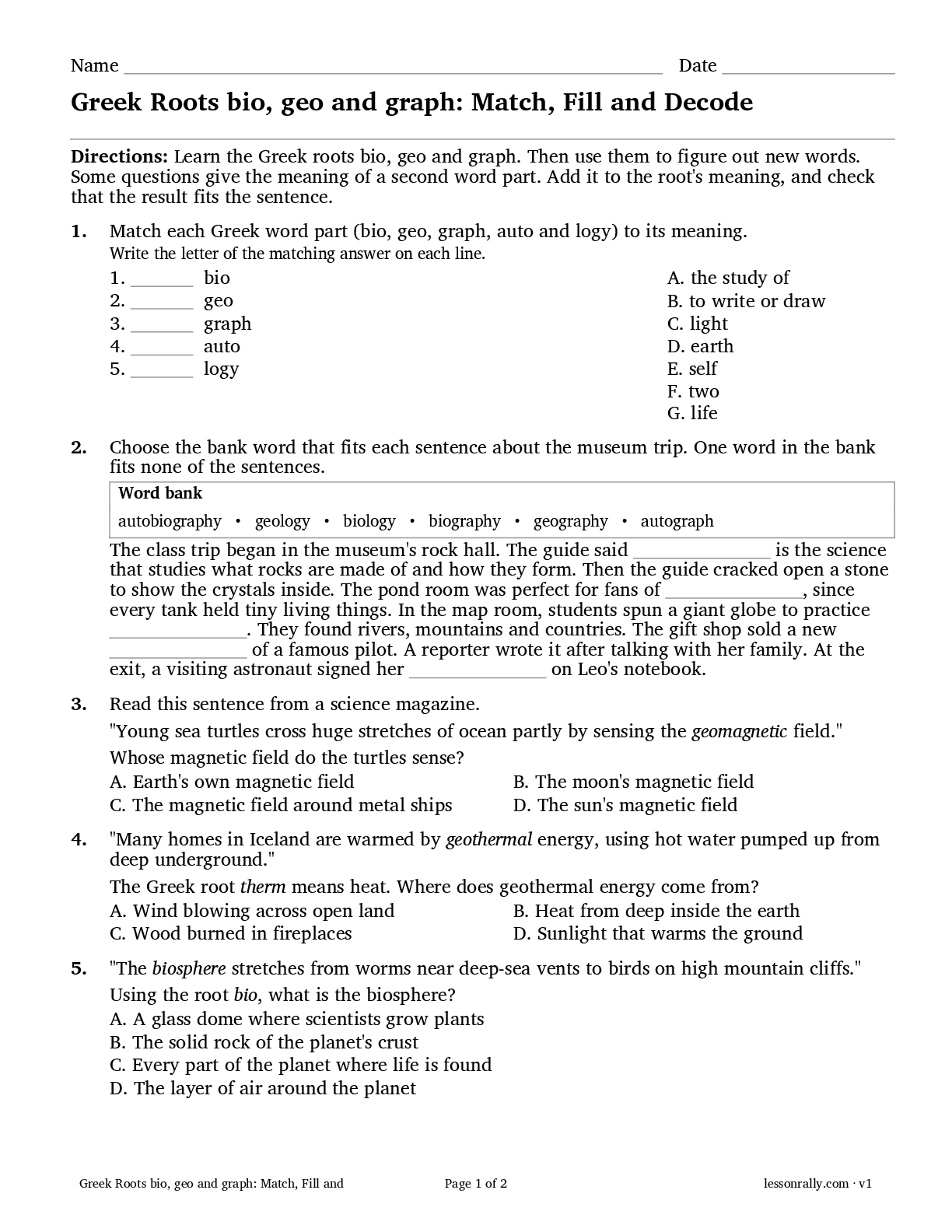
Learn the Greek roots bio, geo and graph. Then use them to figure out new words. Some questions give the meaning of a second word part. Add it to the root's meaning, and check that the result fits the sentence.
Match each Greek word part (bio, geo, graph, auto and logy) to its meaning.
Match each item to an option.
Items
Options
Choose the bank word that fits each sentence about the museum trip. One word in the bank fits none of the sentences.
Fill in each blank.
The class trip began in the museum's rock hall. The guide said blank 1 is the science that studies what rocks are made of and how they form. Then the guide cracked open a stone to show the crystals inside. The pond room was perfect for fans of blank 2, since every tank held tiny living things. In the map room, students spun a giant globe to practice blank 3. They found rivers, mountains and countries. The gift shop sold a new blank 4 of a famous pilot. A reporter wrote it after talking with her family. At the exit, a visiting astronaut signed her blank 5 on Leo's notebook.
Word bank
Read this sentence from a science magazine.
"Young sea turtles cross huge stretches of ocean partly by sensing the geomagnetic field."
Whose magnetic field do the turtles sense?
Choose one answer.
"Many homes in Iceland are warmed by geothermal energy, using hot water pumped up from deep underground."
The Greek root therm means heat. Where does geothermal energy come from?
Choose one answer.
"The biosphere stretches from worms near deep-sea vents to birds on high mountain cliffs."
Using the root bio, what is the biosphere?
Choose one answer.
During the earthquake, the pen on the seismograph swung wildly. It drew tall, jagged lines on the paper.
Seismo comes from a Greek word for shaking. What is a seismograph?
Choose one answer.
For many centuries, most sky watchers believed in a geocentric model of the universe. Each day, the sun, moon and stars seemed to circle around them.
If centric means centered on, what sits at the center of a geocentric model?
Choose one answer.
Sym is a Greek prefix that means together.
"The clownfish and the sea anemone live in symbiosis. The fish hides in the anemone's stinging arms. In return, it chases off fish that try to eat the anemone."
What does symbiosis mean?
Choose one answer.
On a dark beach, the waves sparkled blue because bioluminescent plankton glowed each time the water moved. Luminescent means giving off light. What does bioluminescent mean?
Choose one answer.
"Mei practiced calligraphy for weeks. Now she can letter wedding cards in graceful, curling strokes."
Calli comes from the Greek word for beauty. Based on its parts and the sentence, what is calligraphy?
Choose one answer.
Before the spring show, the choreographer planned every step, spin and leap the dancers would perform. Choreo comes from the Greek word for dance. What is a choreographer's job?
Choose one answer.
Degrade means to break down. The school garden's compost bin takes only biodegradable waste. Which item belongs in the bin?
Choose one answer.
No reviews yet.
Reviews come from teachers who assigned this activity to a class.
Have a topic of your own? Make a printable worksheet and online quiz, free.
Create an activityCommon Core L.6.4a
Made by Simone Thornbury · LessonRally (AI-assisted)
Common Core L.6.4b
Made by Simone Thornbury · LessonRally (AI-assisted)
Common Core L.6.4b
Made by Simone Thornbury · LessonRally (AI-assisted)
Common Core RL.6.5
Made by Claire Fenwood · LessonRally (AI-assisted)