Made by Simone Thornbury · LessonRally (AI-assisted)
Digital classroom activity
What is a digital classroom activity?
Teachers who sign in can assign LessonRally activities to their Google Classroom classes: students open them in Classroom and answer online, and their grades go to the teacher's Classroom gradebook. Practice lets you try it first, the way students see it.
Students learn how the suffixes -tion, -ment and -ness turn verbs and adjectives into nouns. They match base words to the nouns made from them, notice spelling changes along the way, choose nouns that fit sentences by meaning, and work out the meanings of new nouns in context. A grade 6 suffix set on noun suffixes.
Learning goal: Use the suffixes -tion, -ment and -ness to form nouns, notice spelling changes, and determine the meanings of unfamiliar nouns.
Estimated reading level7.3
Grade 5Hard
Grade 6Stretch
Grade 7On level
Grade 8Easier
Grade 9Easy
About this estimate
The estimate is the middle score of five readability formulas. Their scores run from 5.0 to 7.9.
Flesch-Kincaid GradeSentence length and syllables per word5.1
Gunning Fog Middle scoreSentence length and words of three or more syllables7.3
Coleman-LiauLetters per word and sentences per 100 words7.9
Automated Readability IndexCharacters per word and words per sentence5.0
SMOGWords of three or more syllables, for texts of 30 sentences or more7.6
Grade 181216
Flesch Reading Ease
76.6 on a 0 to 100 scale where higher is easier: fairly easy. Not part of the estimate.
Text measured
483 words, 30 sentences
Adapted from common readability formulas (Flesch-Kincaid, Gunning Fog, Coleman-Liau and ARI, plus SMOG for long texts), which look at sentence length and word length. Answer choices count toward word length only. Grades below the estimate will likely find the text harder, grades above it easier. It does not measure ideas, background knowledge or images.
Common Core
Press Ctrl+C or Command+C to copy.
Closest anchor:CCRA.L.4Determine or clarify the meaning of unknown and multiple-meaning words and phrases by using context clues, analyzing meaningful word parts, and consulting general and specialized reference materials, as appropriate.Anchor Standards for LanguageShow 1 matched standardHide matched standard
Use context (e.g., the overall meaning of a sentence or paragraph; a word's position or function in a sentence) as a clue to the meaning of a word or phrase.
Question types: multiple choice, matching, fill in the blank.
Student preview
The questions as students see them, without the answers.
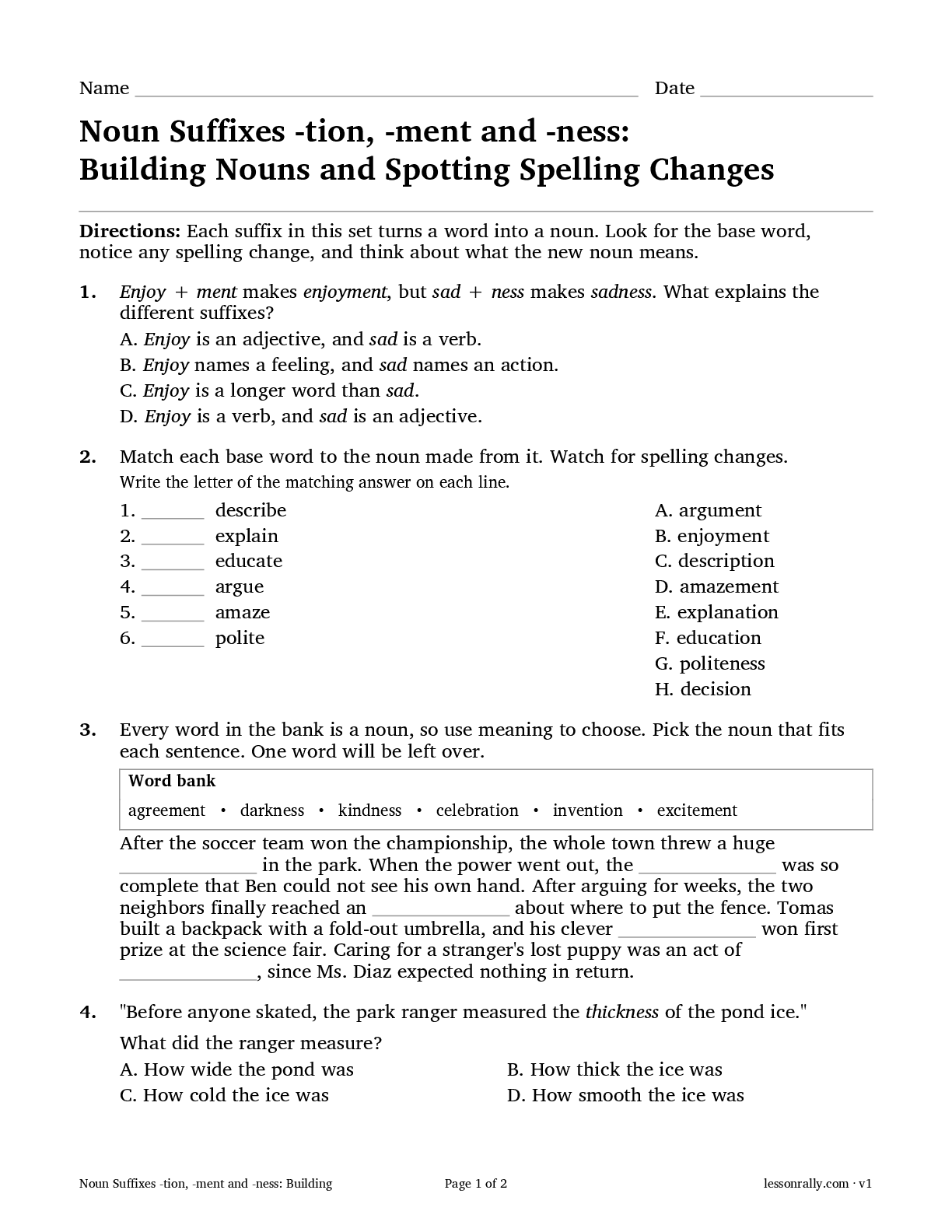
Each suffix in this set turns a word into a noun. Look for the base word, notice any spelling change, and think about what the new noun means.
Question 1
Enjoy + ment makes enjoyment, but sad + ness makes sadness. What explains the different suffixes?
Choose one answer.
Enjoy names a feeling, and sad names an action.
Enjoy is a verb, and sad is an adjective.
Enjoy is a longer word than sad.
Enjoy is an adjective, and sad is a verb.
Question 2
Match each base word to the noun made from it. Watch for spelling changes.
Match each item to an option.
Items
describe
explain
educate
argue
amaze
polite
Options
amazement
argument
decision
education
politeness
description
explanation
enjoyment
Question 3
Every word in the bank is a noun, so use meaning to choose. Pick the noun that fits each sentence. One word will be left over.
Fill in each blank.
After the soccer team won the championship, the whole town threw a huge blank 1 in the park. When the power went out, the blank 2 was so complete that Ben could not see his own hand. After arguing for weeks, the two neighbors finally reached an blank 3 about where to put the fence. Tomas built a backpack with a fold-out umbrella, and his clever blank 4 won first prize at the science fair. Caring for a stranger's lost puppy was an act of blank 5, since Ms. Diaz expected nothing in return.
Word bank
celebration
kindness
agreement
invention
darkness
excitement
Question 4
"Before anyone skated, the park ranger measured the thickness of the pond ice."
What did the ranger measure?
Choose one answer.
How smooth the ice was
How wide the pond was
How thick the ice was
How cold the ice was
Question 5
When lazy becomes laziness, what spelling change happens?
Choose one answer.
The a changes to e.
The y changes to i.
An e is added before ness.
The z is doubled.
Question 6
Astonish means to surprise greatly.
"To the crowd's astonishment, the tiny dog pulled the heavy wagon all by itself."
What does astonishment mean?
Choose one answer.
Great surprise
Boredom
Anger
Loud cheering
Question 7
"Each fall, the ground squirrel curls up in its burrow and goes into hibernation, sleeping until spring."
What does hibernation mean?
Choose one answer.
A trip to a warmer place
A burrow dug for winter
A search for food
A long winter rest that is like a deep sleep
Question 8
"Before the climb, the hikers checked their equipment: ropes, helmets and a first-aid kit."
Equip means to supply with what is needed. What is equipment?
Choose one answer.
The tools and supplies needed for a job
The time it takes to climb
The weather on the mountain
The leader of the group
Question 9
Coach Bell's warm words helped the nervous swimmer try the high dive again. Which noun names what the coach gave the swimmer?
Choose one answer.
Carelessness
Loneliness
Encouragement
Pollution
Question 10
Pollute means to make dirty or harmful.
"Smoke from factories and exhaust from cars add to air pollution in many big cities."