Context Clues, Main Idea and Key Details in Informational Text: Life Around a Tide Pool

7 questions · 10 points · Grade 4 · English · Preview the 7 questions

Made by Andre Whitaker · LessonRally (AI-assisted)

Digital classroom activity

What is a digital classroom activity?

Teachers who sign in can assign LessonRally activities to their Google Classroom classes: students open them in Classroom and answer online, and their grades go to the teacher's Classroom gradebook. Practice lets you try it first, the way students see it.

Free for teachers. Sign in to assign activities to your Google Classroom classes.

Printable worksheet

Students read a short informational passage about the animals around a tide pool and use context clues to work out the meaning of words and phrases such as batter, seals, exposed, crevice and low tide. They also find the main idea and use details from the passage to tell how one animal holds on and what gift high tide brings. Grade 4 vocabulary in context and reading comprehension practice with a nonfiction text.

Learning goal: Use context clues to determine the meaning of general academic and topic words and phrases in an informational passage.

Estimated reading level 5.7

  1. Grade 3Hard
  2. Grade 4Stretch
  3. Grade 5On level
  4. Grade 6Easier
  5. Grade 7Easy
About this estimate

The estimate is the middle score of five readability formulas. Their scores run from 3.5 to 6.3.

  • Flesch-Kincaid GradeSentence length and syllables per word3.7
  • Gunning FogSentence length and words of three or more syllables5.9
  • Coleman-Liau Middle scoreLetters per word and sentences per 100 words5.7
  • Automated Readability IndexCharacters per word and words per sentence3.5
  • SMOGWords of three or more syllables, for texts of 30 sentences or more6.3
Flesch Reading Ease
88.3 on a 0 to 100 scale where higher is easier: easy. Not part of the estimate.
Text measured
783 words, 35 sentences

Adapted from common readability formulas (Flesch-Kincaid, Gunning Fog, Coleman-Liau and ARI, plus SMOG for long texts), which look at sentence length and word length. Answer choices count toward word length only. Grades below the estimate will likely find the text harder, grades above it easier. It does not measure ideas, background knowledge or images.

Common Core

Closest anchor: CCRA.R.1 Read closely to determine what the text says explicitly and to make logical inferences from it; cite specific textual evidence when writing or speaking to support conclusions drawn from the text.Anchor Standards for ReadingShow 3 matched standardsHide matched standards

Matched standards

  • RI.4.1

    Refer to details and examples in a text when explaining what the text says explicitly and when drawing inferences from the text.

    Student preview questions 3, 7

  • RI.4.2

    Determine the main idea of a text and explain how it is supported by key details; summarize the text.

    Student preview question 1

  • RI.4.4

    Determine the meaning of general academic and domain-specific words or phrases in a text relevant to a grade 4 topic or subject area.

    Student preview question 5

Matched independently by two AI models from this activity's questions.

© Copyright 2010. National Governors Association Center for Best Practices and Council of Chief State School Officers. All rights reserved.

Topics: Main Idea and Key Details, Context Clues Chosen by LessonRally

Question types: multiple choice, matching.

Student preview

The questions as students see them, without the answers.

Read the passage about tide pools. When a question asks about a word or phrase, find it in the passage, then read its sentence and the sentences around it. Use clues from the passage to answer every question.

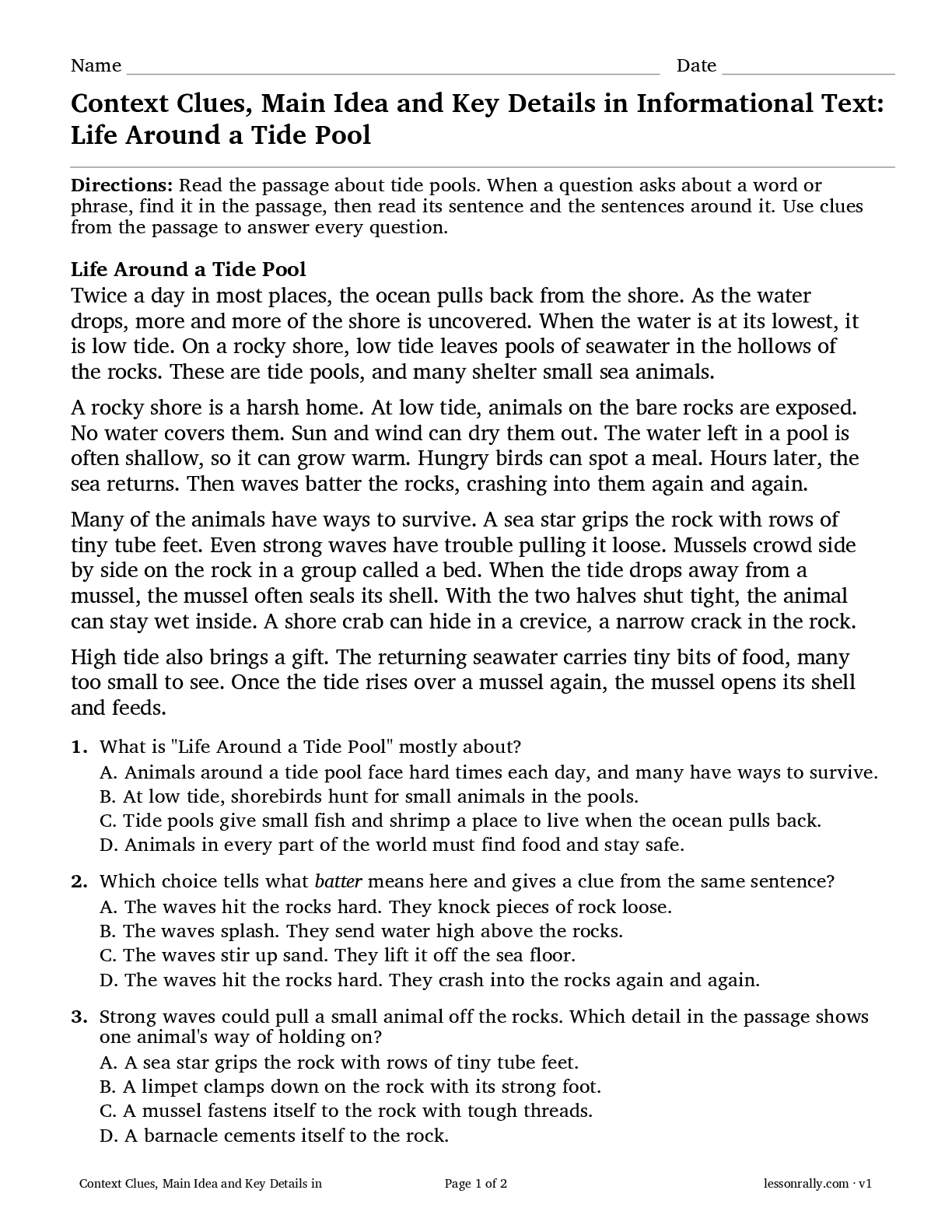
Life Around a Tide Pool

Twice a day in most places, the ocean pulls back from the shore. As the water drops, more and more of the shore is uncovered. When the water is at its lowest, it is low tide. On a rocky shore, low tide leaves pools of seawater in the hollows of the rocks. These are tide pools, and many shelter small sea animals.

A rocky shore is a harsh home. At low tide, animals on the bare rocks are exposed. No water covers them. Sun and wind can dry them out. The water left in a pool is often shallow, so it can grow warm. Hungry birds can spot a meal. Hours later, the sea returns. Then waves batter the rocks, crashing into them again and again.

Many of the animals have ways to survive. A sea star grips the rock with rows of tiny tube feet. Even strong waves have trouble pulling it loose. Mussels crowd side by side on the rock in a group called a bed. When the tide drops away from a mussel, the mussel often seals its shell. With the two halves shut tight, the animal can stay wet inside. A shore crab can hide in a crevice, a narrow crack in the rock.

High tide also brings a gift. The returning seawater carries tiny bits of food, many too small to see. Once the tide rises over a mussel again, the mussel opens its shell and feeds.


Question 1

What is "Life Around a Tide Pool" mostly about?

Choose one answer.

  • At low tide, shorebirds hunt for small animals in the pools.
  • Animals in every part of the world must find food and stay safe.
  • Animals around a tide pool face hard times each day, and many have ways to survive.
  • Tide pools give small fish and shrimp a place to live when the ocean pulls back.

Question 2

Which choice tells what batter means here and gives a clue from the same sentence?

Choose one answer.

  • The waves hit the rocks hard. They crash into the rocks again and again.
  • The waves hit the rocks hard. They knock pieces of rock loose.
  • The waves splash. They send water high above the rocks.
  • The waves stir up sand. They lift it off the sea floor.

Question 3

Strong waves could pull a small animal off the rocks. Which detail in the passage shows one animal's way of holding on?

Choose one answer.

  • A limpet clamps down on the rock with its strong foot.
  • A sea star grips the rock with rows of tiny tube feet.
  • A mussel fastens itself to the rock with tough threads.
  • A barnacle cements itself to the rock.

Question 4

What does a mussel do when it seals its shell, and how does the passage say this helps?

Choose one answer.

  • It opens its shell a little, which can help it take in oxygen.
  • It closes its shell tightly, which helps it stay wet inside.
  • It closes its shell tightly, which can help keep predators out.
  • It grows a thicker shell, which can help protect it from crabs.

Question 5

Match each word to the choice that gives its meaning and the detail from the passage. Four choices will be left over.

Match each item to an option.

Items

  1. hollows
  2. exposed
  3. bed
  4. crevice

Options

  1. low spots in the rocks where seawater is left behind
  2. a group of barnacles crowded side by side
  3. low spots in the rocks where seaweed grows
  4. left with no water covering them
  5. a group of mussels crowded side by side
  6. a narrow crack where snails gather
  7. left uncovered after sand washes off the rocks
  8. a narrow crack where a shore crab can hide

Question 6

What does low tide mean here, and where does the passage explain it?

Choose one answer.

  • The sea is at its highest point. Look just after the sentence about a very high tide that covers the rocks.
  • The sea is as low as it will go before it rises again. Look just after the sentence about places with only one low tide a day.
  • The sea is still going down. Look just after the sentence about two low tides that reach different levels.
  • The sea is as low as it will go before it rises again. Look just after the sentence about more of the shore being uncovered.

Question 7

Which detail explains what the author means by saying that high tide "brings a gift"?

Choose one answer.

  • The rising water lets small fish swim in close to shore.
  • The seawater carries in strands of seaweed to hide under.
  • The seawater carries in tiny bits of food.
  • The seawater carries in sand that some animals dig into.

Reviews

No reviews yet.

Reviews come from teachers who assigned this activity to a class.

Sign in to write a review

Have a topic of your own? Make a printable worksheet and online quiz, free.

Create an activity

Answer key

Answer keys come with Premium

Print this worksheet with the correct answers marked. The key includes any explanations, sample answers, and rubrics supplied with the activity.

Answer keys aren't public: only teachers with Premium and the people who can edit an activity can download one, so students can't get a ready-to-print key from this page.

Premium includes:

  • No ads for you, and no ads for your students on the assignments you post.
  • Answer keys for printable worksheets, with the correct answers marked and any explanations, sample answers, and rubrics.
  • Create with AI: up to 100 activities a year (5 during the free trial), with every answer checked before you see the draft.

$29 a year, plus sales tax where it applies.

New Premium teachers can try it free for 7 days. A card or other payment method is needed to start. Unless you cancel before the trial ends, you are charged then and the plan renews every year.

Already have Premium or edit this activity? Sign in